

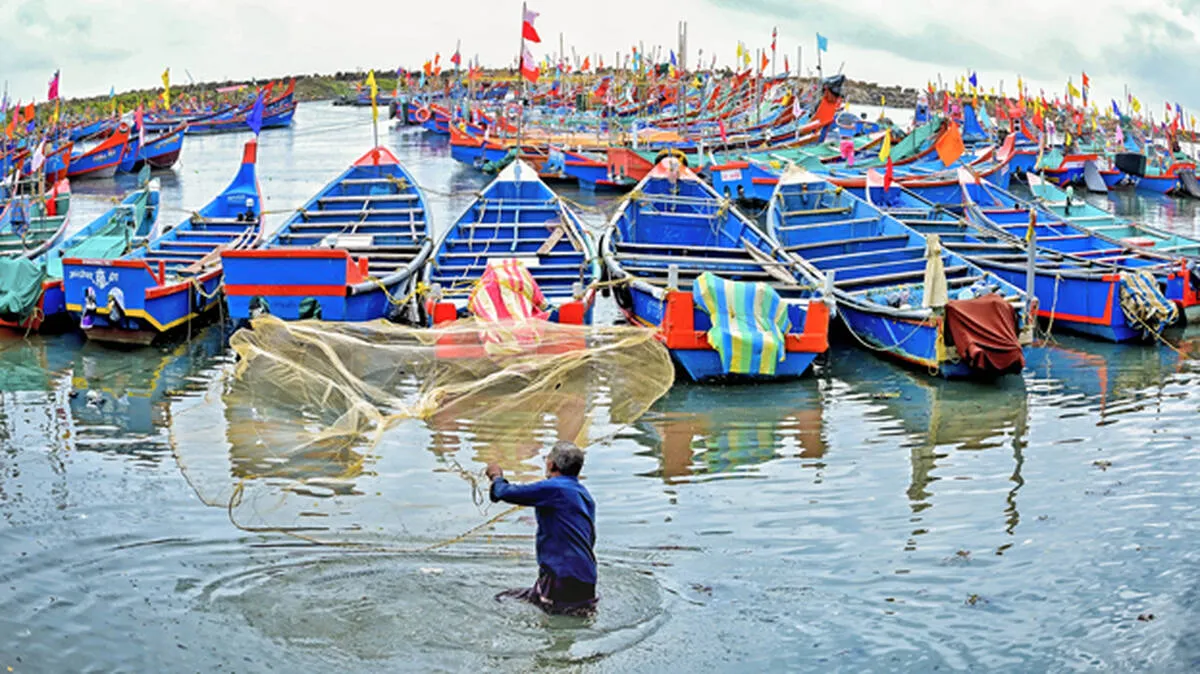
KOLLAM: The annual 52-day monsoon trawling ban came into effect along the Kerala coast at midnight, aimed at protecting marine fish stock during the peak breeding season. The restriction, which applies to all mechanised trawling boats operating within 12 nautical miles of the state’s coast, will remain in place until midnight on July 31. Traditional fishing vessels and inboard boats engaged in surface fishing are exempted from the ban.
As the state's busiest fishing hub, the Neendakara and Sakthikulangara harbours in Kollam observed a total halt in mechanised operations. To enforce the restriction and prevent boats from venturing out, fisheries department officials and the coastal police secured the waters by casting a barrier chain across the Neendakara bridge at midnight.
The annual suspension of trawling operations brings immediate economic hardship to the coastal community, directly impacting an estimated 275,000 workers. While a section of the local workforce shifts to traditional, non-mechanised boats, the income generated from these operations is minimal compared to mechanised fishing.
Consequently, the exodus of migrant labourers—who constitute a significant portion of the boat crews—began yesterday as they headed back to their home states.
The economic ripple effect extends well beyond the fishermen themselves. The suspension leaves thousands of allied workers without employment, including:
Inadequate relief measures
With regular income completely halted, coastal families face a challenging two months ahead. Members of the community note that the free ration kits provided by the state government rarely suffice for even a week.
Financial assistance is available through the Fishermen Relief Scheme, which provides registered members with a monthly stipend of ₹1,500 across June, July, and August. However, local leaders and workers point out that this amount is woefully inadequate to cover basic household expenses during this lean period.
Numbers at glance






 HOME
HOME LATEST
 NOTIFIED NEWS
 POLL
POLL KERALA
  EDITORIAL
  INDIA
INDIA  WORLD
WORLD  CINEMA
  SPORTS
  LIFESTYLE
  SPECIAL
  SCIENCE & TECHNOLOGY
 |
|