


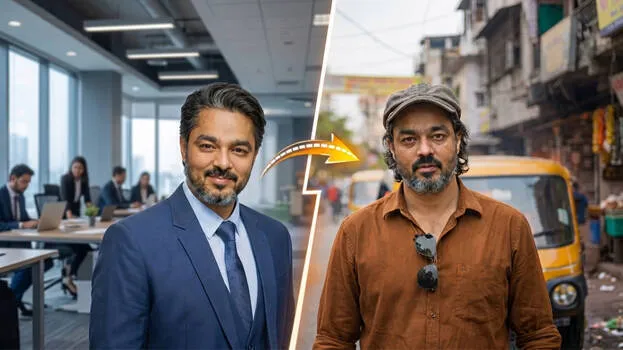
BENGALURU: In a city where the "dream" is to land a six-figure salary at a global tech giant, Rakesh B. Pal did the unthinkable. He had the high-rise office, the prestigious "Apple" tag on his resume, and a bank balance that saw lakhs credited every month. Then, he walked away from it all to drive an electric auto-rickshaw.
If you’ve taken an auto in Bengaluru recently, you might have met him—a man who speaks fluent English, quotes psychological theories, and greets you with a smile that a corporate bonus could never buy. However, his journey from the boardroom to the driver’s seat wasn't a "mid-life crisis"—it was a desperate battle to reclaim his soul.
Hollow gold of corporate life
For fifteen years, Rakesh climbed the corporate ladder with clinical precision, moving from tech giant Apple to high-ranking roles in major banks and construction firms. On paper, he was the definition of success. In reality, he was fading into a ghost of himself. He describes his former life as a performance, one where he became a professional "people pleaser" who had forgotten his own identity while chasing the approval of others.
Despite the luxury cars and the premium lifestyle, he found himself staring at a void. He eventually realised that the corporate world he occupied was built on a foundation of "artificiality" and manipulation. The pressure wasn't just professional; it followed him home, compounding with personal struggles that eventually led to a total mental and physical breakdown.
Darkest days: From NIMHANS to silence
The transition from executive to driver wasn't an overnight whim; it was a gruelling four-year recovery process. At his lowest point, Rakesh sought treatment at NIMHANS and Victoria Hospital. He became heavily reliant on medications to manage his spiralling mental health. There were days when he would sit motionless for seven hours at a time, trapped in a single, looping thought, confined to the lonely walls of his home.
To regain control, Rakesh didn't just look for a new job—he looked for a new understanding of the world. He began studying the "Dark Triad"—the personality traits of Narcissism, Machiavellianism, and Psychopathy—to decode the toxic dynamics he had survived in the high-stakes workplace.
Hard road to redemption
Before settling behind the handle of an auto-rickshaw, Rakesh intentionally took on roles that most white-collar professionals would find beneath them. He viewed these "odd jobs" as a form of therapy and ego-stripping. He lost fifteen kilograms through strict intermittent fasting and turned his physical weakness into strength by taking up Muay Thai and Jiu-Jitsu, eventually winning a silver medal at a state-level championship.
During this period of reinvention, he worked as a food delivery executive, a bike taxi driver, and even a gym assistant where his duties included cleaning floors and toilets. Each task was a step toward shedding the "status" that had previously weighed him down.
"Not a corporate slave anymore"
Today, Rakesh drives his electric auto for six or seven hours a day. He earns a fraction of his former salary—averaging about eight hundred to one thousand rupees a day—but he insists he has never felt richer. The time he once spent in soul-crushing meetings is now dedicated to painting, dancing, and meaningful conversations with his passengers.
"Auto driver, not a corporate slave anymore," he wrote in a post that captured the internet's attention. While his family initially struggled to accept his choice, Rakesh remains steadfast. For him, the electric auto is more than just a vehicle; it is his path to freedom. In a world obsessed with "hustle culture," Rakesh’s story serves as a startling reminder: sometimes, the only way to move forward is to shift gears entirely and drive in a different direction.




 HOME
HOME LATEST
 NOTIFIED NEWS
 POLL
POLL KERALA
  EDITORIAL
  INDIA
INDIA  WORLD
WORLD  CINEMA
  SPORTS
  LIFESTYLE
  SPECIAL
  SCIENCE & TECHNOLOGY
 |
| 


