


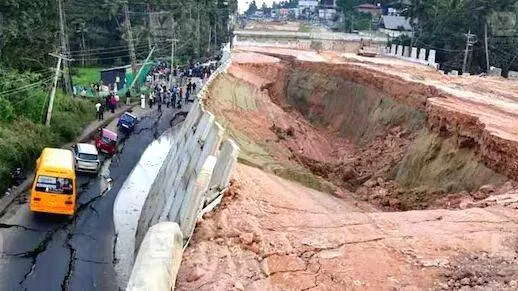
Until recently, most of us believed that road safety was only about vehicles and driving. That belief was shattered last May when a section of National Highway 66 at Kooriyad in Malappuram completely caved in during construction work. Luckily, no one was buried under the debris. After the Kooriyad incident, similar issues and minor accidents were reported in several construction stretches of the highway, including in Kasaragod. Six months later, the same kind of collapse happened at Mylakkad in Kollam, where a service road cracked open wide enough to swallow small vehicles. Again, it was pure luck that prevented a major disaster. The condition of the national highway can now be summed up as: “Built by the authorities, protected by God.”
Even though late, it appears that the incidents at Kooriyad and Mylakkad have taught at least a few lessons to the National Highways Authority. The authority has now decided to conduct safety inspections along the entire stretch of the National Highway being constructed in Kerala. Inspections will be carried out at 378 locations between Kasaragod and Thiruvananthapuram, covering over 603 km. Soil testing will be done within a month at about 100 locations- those already completed, under construction, or yet to start. Geotechnical agencies have been assigned the work. The remaining locations will be inspected within three months. The authority has said that wherever serious structural weaknesses are found, the road will be dug up and rebuilt.
While it is commendable that precautionary steps are being taken without waiting for a major tragedy, one must question why soil stability was not properly checked before building a highway meant to support thousands of vehicles, including heavy trucks, 24 hours a day. In Kooriyad and Mylakkad, the road was built on weak soil—fields and marshland. The soil used for filling, often taken from lakebeds, lacked strength. It does not take advanced engineering knowledge to understand that a road built on such weak ground cannot withstand pressure. Should people believe that the authorities knowingly built a dangerous structure?
At all places where elevated sections of the National Highway are being constructed, traffic is currently being diverted through the service roads located below their slopes. These soil embankments are common where the new highway is being levelled by removing slopes. With repeated construction flaws being reported, even travelling on service roads has become risky. When an elevated section collapses, the service road below cracks open widely. Should people travel with the fear that “the ground might swallow them at any moment”? The National Highways Authority must ensure that soil strength is checked thoroughly at every construction point with zero negligence. Human life is valuable, and that must never be forgotten.













 HOME
HOME LATEST
 NOTIFIED NEWS
 POLL
POLL KERALA
  EDITORIAL
  INDIA
INDIA  WORLD
WORLD  CINEMA
  SPORTS
  LIFESTYLE
  SPECIAL
  SCIENCE & TECHNOLOGY
 |
|