


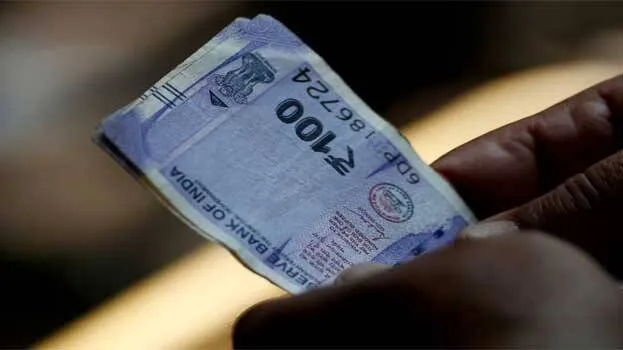
India’s position: growth with heavy dollar needs
India is projected to grow between 6.4% and 7% annually through 2027, keeping it the fastest-growing major economy, with domestic demand doing most of the heavy lifting. Manufacturing and construction have rebounded, and a manufacturing PMI above 56 in late 2025 signals robust expansion aligned with the “China-plus-one” realignment in global supply chains. On the capital side, India has secured record FDI commitments of around $135 billion (₹12.15 lakh crore) in 2025, driven by multi-year AI, cloud, and data-center investments from Big Tech. These are long-horizon deployments into capacity creation - structurally different from the interest-sensitive, often volatile flows of FPI.
Together, they indicate that India’s growth momentum is being underwritten by both strong domestic engines and durable global confidence.
Why the rupee still weakens
The paradox is that this strong backdrop coexists with a rupee around ₹90 per dollar despite RBI smoothing operations. First, high growth is import-intensive: as India builds infrastructure and digital capacity, it imports more crude, capital goods and electronics, mechanically raising dollar demand and widening pressure on the current account. Second, over the long term, currencies tend to adjust by inflation differentials to preserve real competitiveness; a gently weakening rupee helps keep India’s IT, pharma and manufacturing sectors price-competitive. Third, the dollar continues to enjoy safe-haven flows amid geopolitical uncertainty and shifting U.S. trade policy under President Trump-pressuring most emerging-market currencies irrespective of their internal fundamentals.
RBI’s doctrine and the medium-term path
The RBI’s recent $5 billion FX swap and open-market bond operations show its approach clearly: it targets volatility, not any specific rupee level, consistent with its long-standing policy of containing disorderly moves while allowing trend adjustment. Market polls and bank research point to the rupee stabilizing within a broad ₹90–91 band into FY26, implying a controlled, not destabilizing, depreciation that supports exports and cushions dollar-earning sectors. If the baseline of 6.5–7% growth, steady reforms and strong FDI deployment holds, India can comfortably accommodate a somewhat weaker currency. The key risks lie abroad: a sharper global slowdown, an oil price spike, or a major geopolitical shock that temporarily overwhelms even strong domestic fundamentals.
Forecast: Domestic Strength to Navigate Global Headwinds
Looking ahead to 2026, India is poised to remain the world’s fastest-growing major economy, but this momentum will coexist with a managed depreciation of its currency. We expect real GDP growth to settle into a robust 6.5% to 7% range, powered by resilient domestic consumption and a long-awaited revival in private capital expenditure, especially in manufacturing, infrastructure, and the expanding digital and energy ecosystem.
The Indian rupee is likely to trade within a ₹90 - 91 per dollar corridor, as the Reserve Bank of India continues its doctrine of managing volatility rather than defending any specific level. This will allow a gradual adjustment to inflation differentials and India’s structurally high import bill. Capital flows will follow a dual track: a cyclical revival in Foreign Portfolio Investment (FPI) as U.S. rates ease, and the steady, multi-year deployment of the ~$135 billion Foreign Direct Investment (FDI) pipeline, which will anchor long-term external stability and finance capacity expansion across sectors.
The key risks to this otherwise stable outlook remain external. A sudden spike in crude oil prices or a deeper-than-expected global slowdown could test India’s macroeconomic buffers, affecting both the current account and fiscal dynamics. Absent such shocks, India’s story through 2026 will be one of navigating global turbulence with domestic momentum - where a softer currency is not a vulnerability, but a pragmatic instrument of competitiveness in an increasingly complex global economy.






 HOME
HOME LATEST
 NOTIFIED NEWS
 POLL
POLL KERALA
  EDITORIAL
  INDIA
INDIA  WORLD
WORLD  CINEMA
  SPORTS
  LIFESTYLE
  SPECIAL
  SCIENCE & TECHNOLOGY
 |
|