


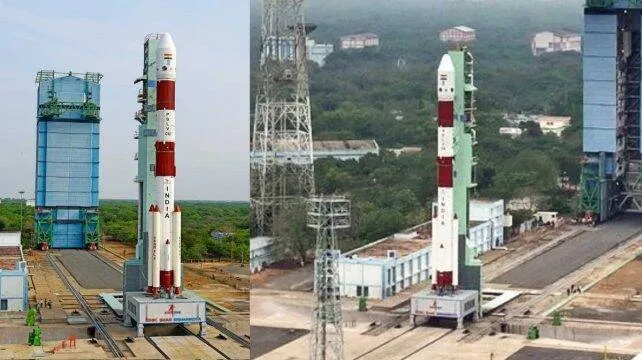
Whenever India achieves major milestones in space, the scientific community often praises the reliability of ISRO’s PSLV rocket. The PSLV made history in 2017 by launching 104 satellites in a single mission. It has successfully carried out several landmark missions that drew global attention, including India’s first lunar mission Chandrayaan-1, the Mars Orbiter Mission Mangalyaan-1, and the solar mission Aditya-L1. Since its first launch in 1993, the PSLV has completed 64 missions, with only a few failures. Importantly, it had never faced consecutive failures- until now, making a detailed investigation necessary.
The PSLV-C62 rocket, which lifted off from Sriharikota at 10.17 am on Monday, carrying 15 commercial satellites, failed after deviating from its intended trajectory. The satellites could not be placed into orbit. The mission also included DRDO’s advanced surveillance satellite ‘Anvesha’, meant for defence monitoring. A similar failure had occurred during the 63rd PSLV launch on May 18 last year, and investigators believe the same issue may have been repeated. While the earlier failure occurred during the third stage, which uses solid fuel, this time the loss of control happened during the fourth stage. Why the same failure occurred again can be determined only through a detailed investigation.
The failed mission is estimated to have caused a loss of around Rs 600 crore, including Rs 200 crore for the rocket and Rs 400 crore for the 15 satellites. The losses could increase further if India loses future contracts for launching foreign satellites. Although PSLV has recorded only four failures in 64 launches, the repeated failure has surprised ISRO scientists. While the possibility of sabotage appears low, experts say it should still be examined given the current circumstances. At the same time, social media users have been urged to avoid spreading baseless speculation. Not every mission can succeed every time, and technical failures cannot be completely ruled out in complex space operations. However, a failure remains a failure.
The setback has also had a significant emotional impact on the scientists and technical staff who worked around the clock to prepare the mission. The incident has brought back memories of an earlier failure, when Prime Minister Narendra Modi was seen consoling the then ISRO chairman. ISRO is now expected to focus its research on preventing pressure variations during solid-fuel combustion, with data analysis being the first step. This is expected to help identify the exact cause of the failure. ISRO Chairman V. Narayanan has said that more details about the incident will be shared after the analysis is completed. Until the next successful mission, ISRO scientists are likely to face many sleepless nights as they work to restore confidence in the PSLV programme.












 HOME
HOME LATEST
 NOTIFIED NEWS
 POLL
POLL KERALA
  EDITORIAL
  INDIA
INDIA  WORLD
WORLD  CINEMA
  SPORTS
  LIFESTYLE
  SPECIAL
  SCIENCE & TECHNOLOGY
 |
|