


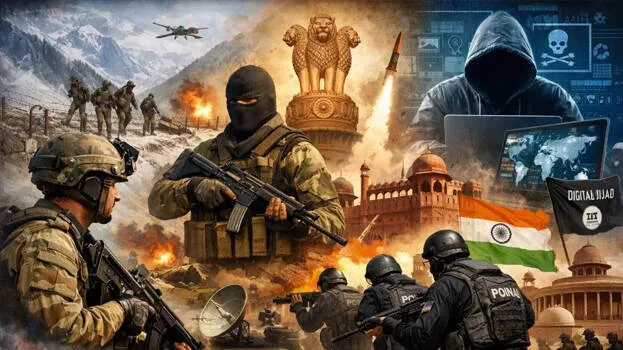
India is at the forefront of countries that have taken an uncompromising stand against terrorism. Prime Minister Narendra Modi has repeatedly given the message of unity against terrorism during his visits to foreign countries. Ours is also a country that has repeatedly experienced the evil deeds of terrorist groups that pull strings from Pakistan. While India previously operated under a reactive, "befitting reply" approach when terrorist attacks or such activities occurred, the central government hadn't formulated a written policy against terrorism. However, for the first time, the Union Home Ministry has made it clear that there is no compromise on terrorism and has announced a new policy to combat terrorism. The action plan has been named 'PRAHAAR'.
The new policy also highlights that cyber attacks are a serious threat alongside cross-border terrorism. The new policy aims to address modern terrorist threats such as cyber attacks, misuse of drones and robots, and digital financial crimes. PRAHAAR is a national counter-terrorism initiative aimed at protecting Indian citizens and their interests from terrorist attacks and providing an appropriate and prompt response to terrorist activities. The new policy makes it clear that India does not associate terrorism with any particular religion, ethnicity or nationality. We have already made it clear that India does not respond to terrorist activities from any side on religious or ethnic lines.
PRAHAAR will have a permanent system to monitor the activities of global terrorist organisations like Al-Qaeda and ISIS in India, the relationship between terrorist groups and domestic criminal groups, arms distribution, recruitment, encrypted messages, and movements on dark websites on the Internet. Terrorism is facilitated through cryptocurrency funding in modern times. Only specially trained security forces can stop this. In addition, anti-terrorism programs that seek the cooperation of the people will be implemented as part of the policy. The policy calls for providing information to the government's security forces, informing the security forces of suspicious incidents and movements, and preparing the people. Awareness programs will be organised for the youth as part of this.
The secret plans of terrorist groups often succeed when they receive local support. The first thing that terrorists who infiltrate the country do is to do what is necessary to gain local support for their secret operations and sabotage activities. That is why, in cases where terrorist groups are caught by the army, some local residents or local groups are often involved in the investigation related to it! Such conditions that pave the way for terrorism, its influence and propaganda need to be weakened and eliminated. In short, the Union Home Ministry has envisaged prevention and recovery measures that involve the entire society through this policy announcement. It can be expected that this policy will be useful in providing more credibility and clarity to anti-terrorism measures.













 HOME
HOME LATEST
 NOTIFIED NEWS
 POLL
POLL KERALA
  EDITORIAL
  INDIA
INDIA  WORLD
WORLD  CINEMA
  SPORTS
  LIFESTYLE
  SPECIAL
  SCIENCE & TECHNOLOGY
 |
|