


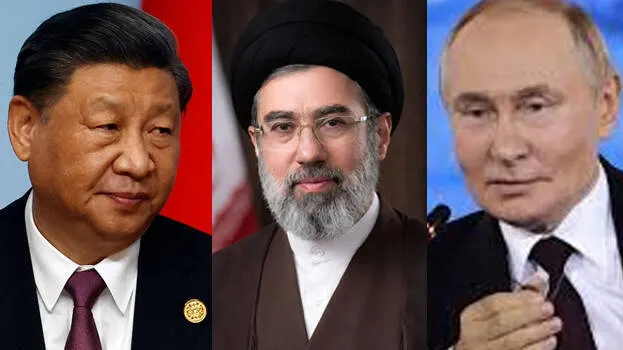
BEIJING: In a major escalation of diplomatic tension, China has issued a sharp warning to the United States and Israel to refrain from military actions targeting Iran’s new Supreme Leader, Mojtaba Khamenei. Beijing, through its Foreign Ministry, stated that any attack on the new leadership would fundamentally alter regional dynamics. Chinese officials cautioned that external interference in Iran’s internal affairs risks pushing the Middle East toward a broader global conflict, emphasising that Tehran's sovereignty must be respected.
Russia has moved to mirror this position, with President Vladimir Putin officially reaffirming his country’s unwavering support for Iran. In a formal message, Putin described Russia as a loyal partner and noted that Mojtaba Khamenei’s new role requires great dedication as the nation faces what the Kremlin characterises as unprovoked armed aggression.
This diplomatic alignment between Beijing and Moscow marks a pivotal shift in the ongoing conflict, highlighting a widening divide between global powers. The stance is in direct opposition to the United States, where President Donald Trump has declared that he does not recognise the legitimacy of the transition. Trump stated that no leader will remain in power in Iran for long without approval from the White House, explicitly labelling the appointment of Khamenei’s son as unacceptable. Israel has similarly maintained a hardline approach, reiterating previous warnings that it would continue to target those within the Iranian power structure.
The appointment of Mojtaba Khamenei follows the death of his father, Ayatollah Ali Khamenei, who was killed in a joint U.S.-Israeli strike on February 28, 2026. This transition is historically significant as the first time power has passed within the same family in the Islamic Republic, a move that has triggered debate and scepticism within Iran regarding the shift toward a form of hereditary rule.




 HOME
HOME LATEST
 NOTIFIED NEWS
 POLL
POLL KERALA
  EDITORIAL
  INDIA
INDIA  WORLD
WORLD  CINEMA
  SPORTS
  LIFESTYLE
  SPECIAL
  SCIENCE & TECHNOLOGY
 |
| 


