

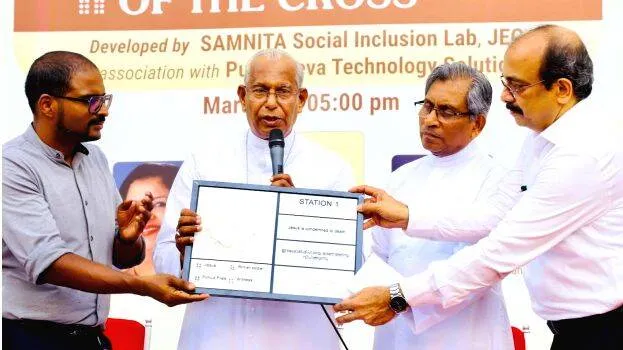
THRISSUR: In Thrissur, Kerala, a historic breakthrough has transformed the Puthenpalli Church into a global beacon of inclusive design, proving that technology reaches its highest potential when guided by deep human empathy. For centuries, the "Way of the Cross" has been an intensely visual pilgrimage, with its fourteen stations traditionally depicted through paintings and sculptures that invited the faithful to look and meditate. However, for millions living with visual impairments, this spiritual journey has often been one of exclusion. This changed with the inauguration of the world’s first fully accessible Stations of the Cross, a project that redefines the intersection of faith and innovation.
The project was not born in a conventional design studio but within the SAMNITA Social Inclusion Lab at Jyothi Engineering College. Under the mentorship of the Kerala-based startup Punarjeeva Technology Solutions, a team of young engineers set out to solve a fundamental human problem: how to "see" a story without sight. The result is a multi-sensory masterpiece that utilises a sophisticated blend of high-tech and high-touch features. Each station features precision-engineered 3D tactile reliefs, optimised by Artificial Intelligence to ensure that complex scenes are distinct enough for sensitive fingertips to interpret. Integrated QR codes trigger immersive audio descriptions in both Malayalam and English, while tactile floor paths and Braille inscriptions allow individuals to navigate the entire spiritual path without needing a sighted guide.
The inauguration and blessing ceremony, led by Mar Andrews Thazhath, Metropolitan Archbishop of Thrissur, highlighted the profound impact of "empathy engineering." During his inaugural address, the Archbishop emphasised that religious experiences should be equally accessible to everyone, regardless of physical ability. The event was opened with a welcome speech by Rev. Fr. Thomas Kakkassery, Rector of Our Lady of Dolours Basilica, who saw the project as a vital step toward a more inclusive parish. The methodology behind the installation was rooted in the mantra "Nothing about us without us," as Robin Tommy, the visionary founder of the Samnita Lab and Senior Scientist at TCS, explained during the innovation showcase. Members of the visually impaired community were core collaborators, testing prototypes and providing the feedback necessary to ensure the installation was a functional tool for true devotion.
This initiative serves as a blueprint for the future of education, aligning with the World Economic Forum’s 2030 future skills by teaching students that the most important tool in an engineer's kit is the ability to collaborate and prioritise human dignity. This sentiment was echoed in the felicitations provided by Rev. Fr. Dr Jose Kannampuzha, Academic Director of JECC, and supported by a distinguished dais including Principal Dr P. Sojan Lal, Registrar Dr V.M. Xaviour, and Reshmi Ravindranathan, Chief Digital Officer of Punarjeeva Technology Solutions. Also present were Fr. Solomon Kadampattuparambil of Darsana Service Society, Basilica Trustee Joy Joseph Aloor, and faculty mentors Mr Jinesh K.J. and Dr Shiny M.I., all of whom played a role in bridging this gap in the human experience.
As the ceremony concluded with a vote of thanks by Rev. Fr. David Nettikadan, it was clear that the Puthenpalli Church project had set a new international standard for cultural and spiritual landmarks. While the world has made significant strides in accessible transport and workplaces, this innovation reminds us that inclusion must extend to the soul. As Holy Week begins, the "Way of the Cross" in Thrissur is no longer just a path of sorrow, but a path of belonging—a powerful testament to the fact that when we innovate with empathy, we don't just bridge a gap in technology, we create a world where everyone truly belongs.






 HOME
HOME LATEST
 NOTIFIED NEWS
 POLL
POLL KERALA
  EDITORIAL
  INDIA
INDIA  WORLD
WORLD  CINEMA
  SPORTS
  LIFESTYLE
  SPECIAL
  SCIENCE & TECHNOLOGY
 |
|