


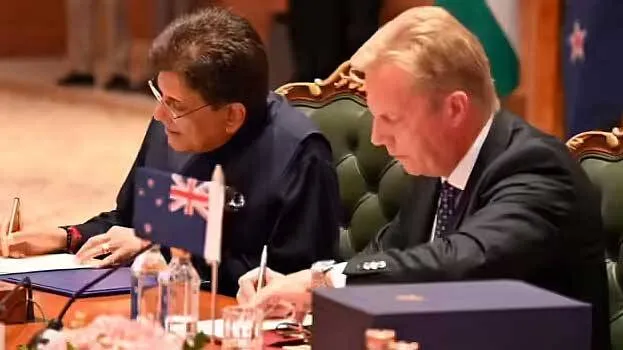
Some policy shifts arrive with fanfare. Others move quietly, almost unnoticed, until their cumulative force becomes impossible to ignore. India’s recent acceleration on Free Trade Agreements belongs to the second category. Over the past few years, India has signed or concluded a series of important trade arrangements with partners such as United Arab Emirates, Australia, New Zealand and the European Free Trade Association bloc. Taken together, they suggest a country rethinking its place in global commerce.
Yet enthusiasm should be accompanied by memory. India has travelled this road before.
Earlier agreements with ASEAN, Japan and South Korea produced mixed outcomes. In several cases, imports rose faster than exports. Trade deficits widened. Domestic producers complained of asymmetric gains. Studies also pointed to low utilization rates of tariff preferences, sometimes estimated around a quarter of eligible trade, because exporters found rules of origin cumbersome, paperwork burdensome, and awareness inadequate.
That history matters. It reminds us that signing an FTA is not the same thing as benefiting from one.
Still, it would be a mistake to assume nothing has changed. Today’s India is very different from India of the earlier FTA era. The economy is larger, infrastructure is improving, digital systems are stronger, manufacturing policy is more deliberate, and India’s geopolitical weight has increased significantly. Most importantly, India now negotiates with a more strategic sense of partner selection.
That shift is visible in the recent agreements. These are not indiscriminate market-opening exercises. They are more calibrated arrangements with countries where complementarities exist. The UAE offers a logistics and re-export hub. Australia brings resources, education links, and strategic depth. The EFTA bloc brings technology, high-value capital, and a reported long-term investment commitment. New Zealand, though smaller in trade volume, offers access to a sophisticated, rules-driven market whose standards credibility can matter far beyond its population size.
This is why judging agreements only by bilateral trade volume misses the larger picture. Some markets matter because they confer trust. If Indian goods or services perform well in demanding advanced economies, that success can travel elsewhere.
The early evidence from the newer FTAs is encouraging, though not yet conclusive. Trade with the UAE has expanded sharply. Australia has shown positive momentum in goods and services linkages. FTA-partner trade in several cases appears to be growing faster than trade with some non-FTA markets. But it remains early in the cycle. Durable success cannot be measured merely by whether gross trade numbers rise in the first two or three years.
The true test lies elsewhere.
Will Indian exports become more diversified rather than concentrated in a few legacy sectors? Will manufacturing deepen, creating domestic value addition rather than simple assembly? Will supply chains move into India because market access is credible? Will employment rise in sectors exposed to new demand? Will Indian firms move up the value ladder rather than compete only on cost?
Those are the metrics that matter.
This is also where domestic constraints become decisive. Even the best-negotiated trade agreement cannot compensate for inefficiencies at home. Logistics costs in India have improved, but remain a commercial concern in many sectors. Port turnaround times, multimodal connectivity, warehousing efficiency, and last-mile movement still shape export competitiveness. Advanced markets also impose stringent quality, sustainability, traceability, and certification standards. Many Indian MSMEs remain underprepared for those requirements.
Skill gaps pose another challenge. If India wants to use FTAs to expand advanced manufacturing, healthcare exports, design-intensive goods, and services mobility, workforce readiness must keep pace. Trade access without skill depth produces only partial gains.
Then there is the political economy of protectionism. India, like every serious country, protects sensitive sectors. Agriculture and dairy are obvious examples. That may be justified in many circumstances, but selective defensiveness also means some trade gains will naturally remain limited. Every nation wants open markets abroad and guarded markets at home. India is not unique in this contradiction.
Nor are external barriers disappearing. Tariffs are only one obstacle. Non-tariff measures - from sanitary standards to licensing requirements to technical regulations - often matter more in advanced economies. Many exporters discover that market entry is easier on paper than in practice.
And yet, despite all these caveats, India’s FTA turn still makes strategic sense.
The multilateral trading order under World Trade Organization remains valuable, but it has struggled as a forum for major new bargains. Too many participants, conflicting development priorities, domestic political constraints, and strategic rivalry have slowed progress. In that environment, bilateral and plurilateral agreements become practical instruments.
They are also geopolitical instruments.
The world is reorganizing supply chains amid concerns over excessive concentration, resilience, and strategic dependency. Terms such as “friend-shoring” and “China plus one” reflect this reality. Countries seen as stable, scalable, and increasingly networked through trade agreements gain an advantage. India’s FTA strategy must be understood in that wider context. It is not only about tariffs. It is about positioning India as a trusted node in a fragmented world economy.
For states like Kerala, the implications are immediate. Ayurveda, wellness, spices, marine exports, tourism, healthcare talent, education services, and sustainable consumer products all fit the profile of sectors that can benefit from access to premium markets. But local businesses must invest in standards, branding, packaging, certification, and market intelligence. Opportunity rarely rewards the unprepared.
So the balanced verdict is this: India’s new FTA wave deserves attention, but not triumphalism. The strategy is smarter than many earlier attempts, the timing is stronger, and the partner selection appears more disciplined. But trade agreements are frameworks, not miracles.
They open doors. They do not guarantee that anyone will walk through them successfully.
India has entered a more ambitious trade era. The hard part now begins at home.













 HOME
HOME LATEST
 NOTIFIED NEWS
 POLL
POLL KERALA
  EDITORIAL
  INDIA
INDIA  WORLD
WORLD  CINEMA
  SPORTS
  LIFESTYLE
  SPECIAL
  SCIENCE & TECHNOLOGY
 |
|