

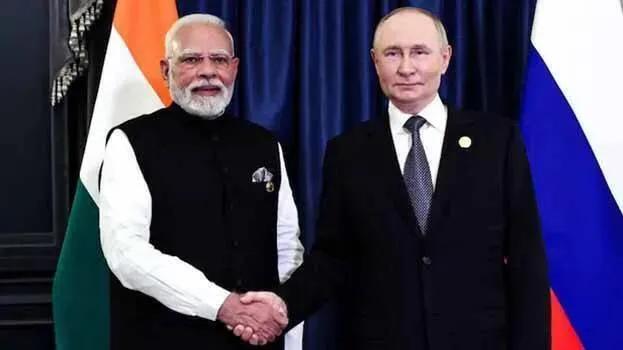
Vladimir Putin’s interview with India Today ahead of his visit to New Delhi has garnered intense attention. While the Russian President spoke warmly about India’s culture, society and Prime Minister Narendra Modi, the significance of his remarks goes far beyond sentiment. At a time when global alignments are shifting rapidly and great-power politics is entering a more fractious phase, Putin’s message to India, both explicit and implicit, deserves a closer look.
Much of the early commentary has focused on perceived gaps: Russia’s closeness to China, lack of public clarity on the India–China boundary issues, and the complicated backdrop of the Ukraine conflict. These criticisms are not without basis, and India must view any foreign leader’s words through the lens of national interest. Yet, there is a broader strategic context that explains why India continues to find value in its partnership with Russia, and why Putin’s interview reinforces that relevance.
A partnership rooted in trust, evolving through realism
Putin described India–Russia ties as a “heart-to-heart” relationship forged over decades. For many Indians and Russians, this is not rhetoric but lived historical memory - from cultural exchanges in the Soviet era to deep defence cooperation and diplomatic coordination.
But today’s India does not rely on nostalgia. Engagement with Russia is increasingly grounded in strategic realism. Despite profound global turbulence, New Delhi and Moscow have managed to keep their core relationship stable, predictable and insulated from external pressure. That alone is an achievement in the current geopolitical climate.
Putin’s open admiration for Prime Minister Modi also carries weight. Leaders do not publicly praise counterparts unless there is genuine comfort at the personal and institutional levels. In international diplomacy, such chemistry translates into smoother negotiations and fewer surprises - assets that India values deeply.
Energy, Economics and A Calculated Partnership
Much has been made of India’s purchase of discounted Russian oil since the Ukraine conflict. Critics frame this as a temporary transactional arrangement driven by Russia’s isolation. Yet this criticism misses an important point: India transformed a geopolitical crisis into an economic opportunity, securing affordable energy at a moment of global volatility.
Russia benefited from a stable market; India benefited from lower import costs and diversified energy sources. This has given New Delhi greater strategic autonomy in an era when energy politics is increasingly weaponised.
Putin’s comments that Russia wants to increase imports from India to balance trade are equally significant. They signal Moscow’s recognition that the relationship must be made more symmetric and commercially broad-based. This aligns with India’s long-standing view that the bilateral economic partnership must evolve beyond hydrocarbons and defence.
Managing China: The Quiet Value of Russian Neutrality
One of the central critiques raised by Indian commentators is that Russia’s growing dependence on China limits Moscow’s ability to act as a meaningful partner for India. The concern is valid, but only partially.
Russia will not publicly criticize Beijing; that is realistic. Yet it is equally true that Russia has never taken a position that undermines India’s sovereignty or territorial interests. Moscow’s neutrality, though imperfect, is far preferable to a scenario in which Russia drifts entirely into China’s strategic orbit.
By continuing to engage both powers, India prevents Asia from becoming a binary bloc dominated by Beijing. For a country committed to multipolarity, Russia’s independent relationship with India remains a geopolitical lever - not a liability.
Ukraine, Sovereignty and India’s Strategic Balance
Putin’s remarks on Ukraine were predictable and aligned with Russia’s long-stated position. India has maintained a careful balancing act - calling for dialogue, refraining from public condemnation, and simultaneously supporting humanitarian principles and territorial integrity.
India’s nuanced position is often misunderstood. It is not an endorsement of any side; it is an affirmation that national interest, stability and diplomacy - not moral grandstanding - must guide foreign policy.
Maintaining open lines with Moscow is essential, whether for defence supplies, energy security, or global governance. This requires India to remain a credible interlocutor for all parties, not a partisan actor in a distant conflict.
BRICS, Global South and an Emerging Order
One of the most important parts of the interview concerned the changing global power landscape. Putin spoke of India, Indonesia and African nations as rising centres of gravity. This is not diplomatic flattery, it is a reflection of global economic reality.
India today is courted by all major power blocs because it is increasingly central to the architecture of the emerging world order. Russia’s strong articulation of India’s global role reinforces this international perception.
Putin’s pragmatic stance on a BRICS currency acknowledging that the idea is premature also supports India’s cautious approach. New Delhi has consistently argued that monetary sovereignty is non-negotiable and integration must not be rushed. In this instance, Russia aligns with India’s view.
A relationship that gives India strategic space
In a world of unpredictable alliances and volatile supply chains, India’s engagement with Russia offers distinct advantages:
Energy stability in a turbulent market
Defence depth during a major military modernisation cycle
Multipolar leverage against pressure from any single bloc
A diplomatic bridge that keeps India central to global negotiations
For India, the Indo-Russian relationship is not about choosing sides, it is about preventing the world from returning to rigid, polarised camps.
The Way Forward
Putin’s interview reaffirmed one essential truth: India and Russia continue to see each other as reliable partners in an increasingly unreliable world. Differences exist, and India is wise to recognise them. But they do not overshadow the long-term logic that guides the partnership.
As New Delhi deepens ties with the U.S., Europe, Japan and the Indo-Pacific, it also keeps its channels with Moscow open -reflecting a foreign policy rooted in autonomy, not alignment.
In the end, Putin’s message was clear: Russia respects India’s rise, values its leadership, and sees it as an indispensable pole in the emerging global order. For India, that recognition is strategically useful and worth responding to with the same clarity and confidence.







 HOME
HOME LATEST
 NOTIFIED NEWS
 POLL
POLL KERALA
  EDITORIAL
  INDIA
INDIA  WORLD
WORLD  CINEMA
  SPORTS
  LIFESTYLE
  SPECIAL
  SCIENCE & TECHNOLOGY
 |
|