


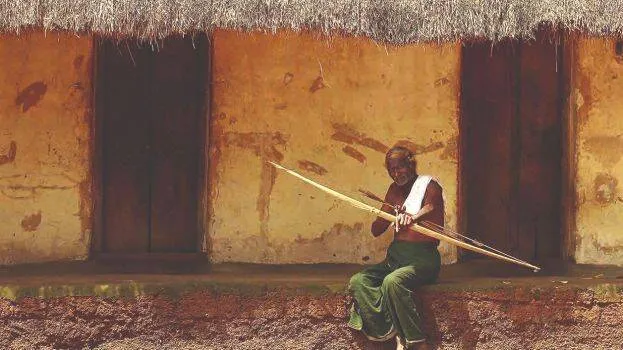
Tribal communities are not just a group of people living in forest areas. They are a rich source of culture, language, rare traditional medicinal knowledge, forest resources and ancient art forms. That is why the World Health Organisation, the central and state governments, and thousands of heritage and social organisations announce projects worth thousands of crores every year for their protection and development. Huge amounts of money are allocated to tribal regions. Sadly, not even a small percentage of this money has been properly spent on their welfare or protection. Instead, much of it has reportedly been misused by middlemen, politicians and contractors.
On February 5, Kerala Kaumudi published a front-page report prepared by Shabil Basheer titled 'Tribal families in Nilambur starving.' The report highlighted the difficult living conditions of 90 people from 28 families belonging to the Kattunayaka and Muthuvan tribal communities in Vettilakkodi settlement in the Nilambur forest area of Malappuram district. Here, each family is given 30 kilograms of rice per month through the ration system. However, since they have nothing else to eat to satisfy their hunger and depend only on rice for all three meals, these 30 kilograms of rice do not last even for two weeks. The report focused on a tribal man named Sundaran, who suffered a serious spinal injury after falling from a tree. After coming across the report, Tribal Welfare Minister O.R. Kelu assured that urgent steps would be taken to address the hardships faced by the tribal families in Vettilakkodi.
After reading the report, prominent businessman A. Paulraj, owner of Paulraj and Sons in Parassala, Thiruvananthapuram, announced immediate financial assistance of Rs 1 lakh for Sundaran’s treatment. As Sundaran does not have a bank account, the company decided to provide the money directly. It is surprising that such hunger exists among tribal communities in Kerala, a state that proudly claims to have eliminated extreme poverty. Recently, during a medical camp conducted by a doctors’ organisation in Vettilakkodi, 30 out of 40 people examined were found to be suffering from anaemia caused by malnutrition. Vettilakkodi settlement is located deep inside the forest and can be reached only after walking five kilometres through difficult terrain. In a state that speaks proudly of development, how many people are aware of the suffering of these families living deep in the forest?
The government must take urgent steps to address the silent suffering of tribal communities who live away from mainstream society and often out of public view. The Public Distribution, Health, Forest and Revenue departments should jointly prepare a comprehensive plan and take immediate action. The first step should be to ensure adequate food supplies and medical assistance to the tribal families of Vettilakkodi. Minister O.R. Kelu has promised free medical treatment, including specialised care for Sundaran’s spinal injury and for others with health issues. There should be no delays in fulfilling this promise. At the same time, permanent solutions must be found for the hardships faced by more than 4.75 lakh tribal people living across different districts in the state.






 HOME
HOME LATEST
 NOTIFIED NEWS
 POLL
POLL KERALA
  EDITORIAL
  INDIA
INDIA  WORLD
WORLD  CINEMA
  SPORTS
  LIFESTYLE
  SPECIAL
  SCIENCE & TECHNOLOGY
 |
|