


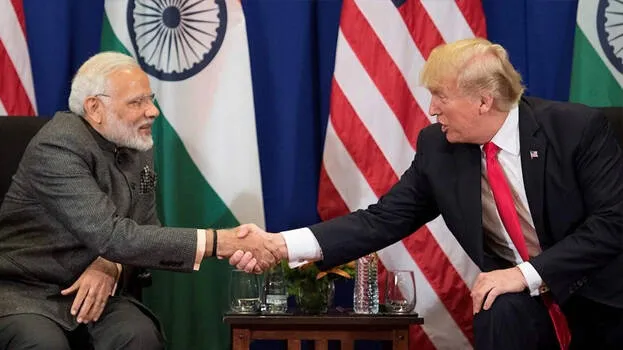
The idea that one country should get all the benefits of an agreement between two nations is not right. Those who blame our country and its administrators for the same are not living in the world of reality. An agreement between two independent countries is not possible without making some compromises from both sides. We will be giving priority to protecting the interests of our country's citizens. Similarly, the government entering into an agreement needs to protect the interests of its citizens. These interests are almost as different as parallel lines. Finding common ground in such circumstances is what makes an agreement successful. Looking from that angle, the interim trade agreement between India and the United States is a great success politically and economically.
The interim trade agreement has been finalised after more than a year of discussions between Indian Commerce Minister Piyush Goyal and his team of officials with American officials at various stages. The joint statement states that the agreement aims to achieve a trade of Rs 50 lakh crore in the next five years. The main criticism of this agreement is from Congress and the media which support it. Why such a trade agreement was not reached even after the UPA government ruled India for ten years is also a matter to ponder in this context.
The main reason for the delay in the interim agreement is that India was not ready to accept the US demand for the complete opening of the Indian market for American agricultural products. The agreement does not allow India to import corn and soybeans, which are abundantly produced in India, from the US. On the other hand, tree nuts such as almonds and walnuts, which are not produced much in India, can be imported from the US. Similarly, cattle feed produced from the ethanol market can be imported. This has been welcomed by the Indian farming community since that cattle feed costs half the price of Indian cattle feed. The quality is also better. Similarly, the Indian dairy market has not been opened to the US.
The reduction in US tariffs from 50% to 18% on products exported from India is not a freebie that our other Asian neighbours have received. Tariffs on some products will be reduced to zero. Exports of tea, coffee, copra, coconut, dates, cashew nuts, coconut oil, etc., to the US will no longer be subject to tariffs. The agreement, which protects agricultural and dairy products while at the same time leading to a boom in many sectors such as textiles, leather, gems, diamonds, pharma products and thereby increasing employment opportunities in India, is generally beneficial for both countries. Those who mock it are likely to become ridiculed in the future.














 HOME
HOME LATEST
 NOTIFIED NEWS
 POLL
POLL KERALA
  EDITORIAL
  INDIA
INDIA  WORLD
WORLD  CINEMA
  SPORTS
  LIFESTYLE
  SPECIAL
  SCIENCE & TECHNOLOGY
 |
|