


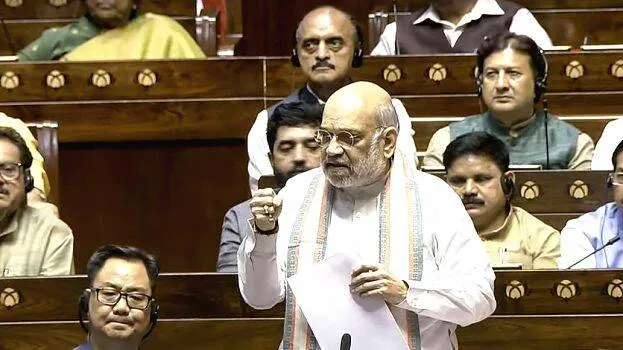
Maoist-Naxalite groups, which once believed that social and economic problems could not be solved through democracy and instead required armed revolution by a minority, are now surrendering to the central government one after another. Union Home Minister Amit Shah informed the Lok Sabha the other day that Naxalism in India has largely come to an end. He made this statement during a discussion on Naxalism, saying that the movement has been effectively defeated. The government followed a dual strategy to tackle Maoists, using democratic methods where possible, and armed action where necessary. At the same time, rehabilitation programs were offered to those who surrendered. The government also held talks with those willing to give up violence, while taking strict action against groups that continued armed resistance.
The Maoist threat has been almost completely eliminated in 12 states, including Chhattisgarh, Telangana, Andhra Pradesh, Odisha, Maharashtra, Madhya Pradesh, Jharkhand, Bihar, West Bengal, Kerala, Karnataka, and Uttar Pradesh.
According to official data, 4,839 Naxalites have surrendered, 2,218 have been jailed, and 706 have been killed in police encounters. Out of 21 top Maoist leaders, only one remains. Over the years, around 20,000 people, including 5,000 security personnel, have lost their lives in Naxalite-related violence. In most states, Maoist groups were eliminated even before 2024, except in some areas of Chhattisgarh. The government’s call for Maoists to lay down arms and join mainstream society was accepted by a majority of them without much resistance.
The central government first focused on cutting off financial and logistical support to Maoist groups, both from within India and abroad. This put significant pressure on them. Security measures were also strengthened to ensure that Maoists did not receive local support. The government also worked to convince people that Maoists were not helping development, but instead blocking it. In many places, they opposed the construction of roads, bridges, and other infrastructure projects.
Naxalite activities in India began in the late 1960s. At that time, China’s official newspaper “People’s Daily” had described the movement as 'A peal of spring thunder has crashed over the land of India.' Many young people joined the movement with hopes of a better future, driven by its ideology. However, the violent methods they adopted eventually led them away from their goals and contributed to their decline. At the same time, it cannot be ignored that social inequalities and exploitation played a role in the rise of such movements. Today, with violence decreasing and peace returning in affected regions, the situation is seen as a positive development.













 HOME
HOME LATEST
 NOTIFIED NEWS
 POLL
POLL KERALA
  EDITORIAL
  INDIA
INDIA  WORLD
WORLD  CINEMA
  SPORTS
  LIFESTYLE
  SPECIAL
  SCIENCE & TECHNOLOGY
 |
|