

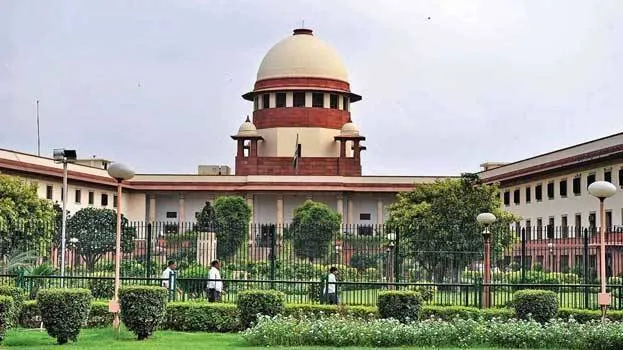
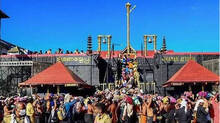
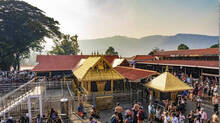
NEW DELHI: The Supreme Court observed that even a non-believer must follow the customs of a temple when visiting it. It was Justice Joymalya Bagchi, part of a nine-judge Constitution Bench, who made this remark during a hearing. Justice BV Nagarathna, the only woman judge on the bench, also said that devotees must respect and follow the traditions of the temple while offering prayers. The bench was hearing arguments on matters related to religious beliefs, including the Sabarimala Temple women's entry issue.
The observations came after counsel for the Nair Service Society (NSS), senior advocate CS Vaidyanathan, argued that Hinduism does not have a rigid structure and is based on diverse practices. The NSS also contended that the judiciary should not interfere in matters of faith.
Justice MM Sundresh pointed out that some temples in Kerala do not allow entry while wearing shirts. He said one cannot insist on entering such temples while ignoring these customs. Chief Justice Surya Kant noted that shirts are not allowed inside the Guruvayur Temple. He also referred to practices in gurdwaras, where visitors are required to cover their heads.
The Constitution Bench, which includes Chief Justice Surya Kant and Justices BV Nagarathna, MM Sundresh, Ahsanuddin Amanullah, Aravind Kumar, Augustine George Masih, Prasanna B Varale, R Mahadevan, and Joymalya Bagchi, will continue hearing the matter next week. The Devaswom Board is expected to present its arguments on Wednesday.
Ayyappa devotees form a distinct religious group
The NSS argued that devotees of Lord Ayyappa form a distinct religious group. It said people of all religions, including Christians and Muslims, are allowed to visit Sabarimala, provided they have faith in Lord Ayyappa and follow the required rituals, including the 41-day penance.
Temple entry should be open to all sections: Justice Nagarathna
Justice BV Nagarathna said it is not appropriate in Hinduism to restrict temple entry only to a particular community. She emphasised that it is the duty of the government to ensure access for all sections of society. Justice Aravind Kumar added that such restrictions could lead to social division. The court also referred to a previous case involving the Mulki temple in Karnataka, which belonged to the Gowda Saraswat Brahmin community. The Supreme Court had ruled that temple entry laws apply there as well, allowing access to other communities.
Even men face restrictions
Representing the central government, Solicitor General Tushar Mehta said that in some temples, even men face restrictions. For example, married men are not allowed entry into the Brahma Temple. At the Kottankulangara Devi Temple, men visit the temple dressed as women. He said the issue is not about whether practices are male-centric or female-centric, but about respecting the customs of each temple.







 HOME
HOME LATEST
 NOTIFIED NEWS
 POLL
POLL KERALA
  EDITORIAL
  INDIA
INDIA  WORLD
WORLD  CINEMA
  SPORTS
  LIFESTYLE
  SPECIAL
  SCIENCE & TECHNOLOGY
 |
|