


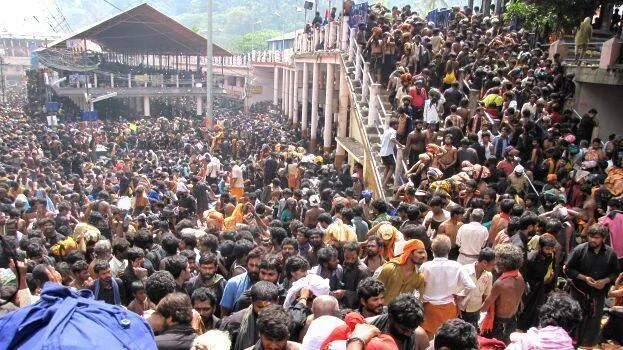
SABARIMALA: Central agencies have begun an investigation into allegations that an artificial crowd was created at Sabarimala during the three days of the Makaravilakku festival. The probe is being conducted by an intelligence wing under the Union Ministry of Home Affairs based on an intelligence report. Officials from the agency have already reached Sabarimala. Earlier, Special Commissioner R. Jayakrishnan had submitted a report to the High Court stating that the police had created an artificial rush.
The report said that the massive crowd witnessed on January 4, 5, and 6 was due to pilgrims being allowed to move without any regulation. The High Court had sought an explanation from the police regarding the issue. More than one lakh pilgrims had darshan on each of these days. The Special Commissioner’s report alleged that the police deliberately created the crowd by failing to control the flow of devotees.
According to the report, pilgrims who arrived at Nilakkal for spot booking were directed by the police to proceed to Pampa. However, since there was no spot booking facility at Pampa, the situation turned chaotic. When large groups of devotees gathered at Pampa and became agitated, they were allowed to proceed to Sannidhanam without any control. The report described this as a serious security lapse and warned that if any untoward incident had occurred, the Devaswom Board and the police alone would have been responsible. Since the opening of the temple for the Makaravilakku festival, more than one lakh pilgrims have been arriving for darshan on most days. As per court orders, only 80,000 pilgrims are allowed to have darshan per day.
Lapse during Mandala season as well
Crowd control had also failed on one day during the Mandala season, creating fears of a possible disaster. This happened even when senior police officers, including ADGP S. Sreejith, who is in charge of Sabarimala security, were present at the spot. Several pilgrims reportedly collapsed while standing in queues. The police had initiated an investigation at the time, suspecting external interference, but it did not lead to any conclusion.




 HOME
HOME LATEST
 NOTIFIED NEWS
 POLL
POLL KERALA
  EDITORIAL
  INDIA
INDIA  WORLD
WORLD  CINEMA
  SPORTS
  LIFESTYLE
  SPECIAL
  SCIENCE & TECHNOLOGY
 |
| 


