


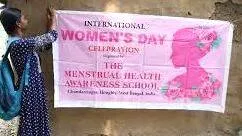
The Supreme Court's ruling that menstrual health is a part of the fundamental right to life and privacy under Article 21 of the Constitution, and that sanitary pads should be made available free of charge in government and private schools, requires urgent action. The apex court highlighted the need to ensure clean toilets for females. The court also clarified that such facilities are part of the right to education. Ensuring privacy and dignity will reduce the psychological stress on girls who cannot deal with menstrual problems. A bench comprising Justices J.B. Pardiwala and R. Mahadevan ruled that it would be difficult for girls to spend the entire time in school and that the 'Menstrual Hygiene Management’ should be implemented across the country within three months.
The court held that the lack of functional toilets and sanitary facilities hindered the girl child's right to education and the opportunity to compete and advance. In school, they may be forced to abstain and accept unsafe methods. Accepting other methods can also affect sexual and reproductive health. The court reminded that menstrual health is not a secret matter for women and suggested that the male community also take responsibility. The Supreme Court, in its ruling, called for the nation’s attention to a responsible and important issue. Every state government is bound to take responsibility according to the suggestion put forward by the Supreme Court.
The order states that all government and private schools, regardless of city or village, must ensure girls-only toilets, have soap and water, and be designed to ensure privacy. Oxo-biodegradable sanitary napkins should be made freely available. Suitable vending machines should be installed in toilet areas or other places where they can be easily obtained. ‘Sanitation Management Corners' should be established where basic clothing, uniforms, disposable shoes, and other essential items are available.
There should be a system for the safe disposal of sanitary pads. Toilets should have a covered, flushable waste bin for disposing of used sanitary pads. The court's intervention came on a public interest litigation filed by public activist Dr Jaya Thakur. The court said that all girl students studying in classes 6 to 12 should be provided with free sanitary pads and separate female toilets.
The court seriously took the issue where three female sanitation workers at Maharshi Dayanand University in Haryana were forced to show photos of their sanitary pads last November after they expressed difficulty in working during those hours. Justice Pardiwala pointed out that the verdict is for the society, which failed to discern the silence of girls, and for every girl student who could not attend school due to the burden of their biological process.
This judgment also indicates that governments are not really paying attention to the most essential problems of humanity. In our capital itself, women travelling to public places do not have access to toilets. Many public toilets were opened just for the sake of it. Nobody would have the guts to enter it due to the poor hygiene and terrible maintenance. The Supreme Court ruling should make the authorities wake up from their slumber.













 HOME
HOME LATEST
 NOTIFIED NEWS
 POLL
POLL KERALA
  EDITORIAL
  INDIA
INDIA  WORLD
WORLD  CINEMA
  SPORTS
  LIFESTYLE
  SPECIAL
  SCIENCE & TECHNOLOGY
 |
|