


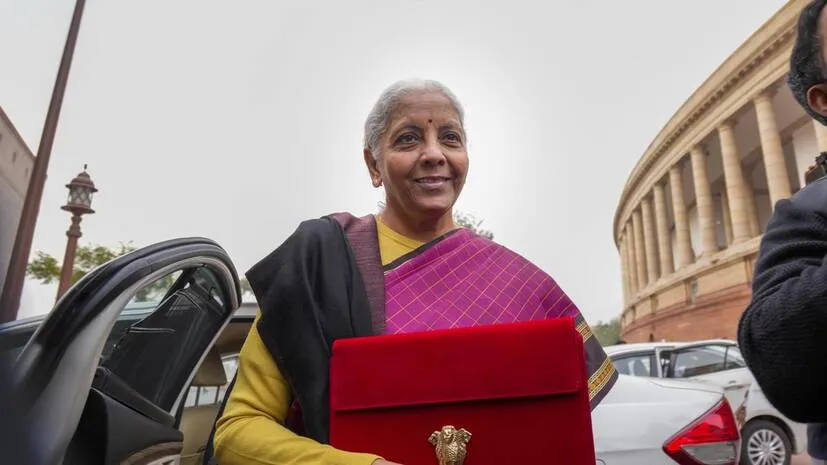
The third budget of the third Modi government is aimed at smoothing the economic path towards achieving the goal of development for all. This is the ninth consecutive budget presented by Union Finance Minister Nirmala Sitharaman. The Finance Minister, who arrived draped in a Kanchipuram silk saree, deftly emphasising her Tamil Nadu roots, began the budget presentation saying that the first duty of the Union government is to ensure economic growth by increasing domestic production.
The Finance Minister had a formal meeting with President Droupadi Murmu at Rashtrapati Bhavan ahead of the budget presentation. This is also the first budget in history to be presented on Sunday.
The budget focuses on six priority sectors to ensure sustainable and continuous economic growth in India at a time when the entire world is grappled by an economic slowdown. The six priority sectors include semiconductors, biopharma, textiles, MSMEs, and urban economic clusters. Most of the proposals put forward by the Finance Minister in the budget are aimed at converting the setback faced by exports due to the tariff war into an opportunity by increasing domestic production and employment opportunities.
The Finance Minister pointed out in her budget speech that the government is giving utmost importance to increasing production in strategic and frontline sectors such as health, electronics, chemicals, and capital goods.
At the same time, Kerala was in for a disappointment as the budget didn’t include the state in the much-touted Vega Rail project. The budget announced seven high-speed rail corridors: Mumbai-Pune, Pune-Hyderabad, Hyderabad-Bengaluru, Hyderabad-Chennai, Chennai-Bengaluru, Delhi-Varanasi, and Varanasi-Siliguri. ‘Kerala Kerala’ shouts from Kerala MPs filled the parliament during the budget presentation in protest at the ignorance. It was disappointing that the state's long-standing demand for AIIMS was not considered this time, too. However, the mineral corridor has been announced in the central budget, covering the states of Kerala, Odisha, Andhra Pradesh, and Tamil Nadu, which are rich in mineral deposits. The state should view this as an opportunity to make mineral deposits the cornerstone of Kerala's development. The state should try to utilise this plan to increase rare mineral mining without raising controversies.
The Finance Minister announced 'Biopharma Shakti' in view of the changed healthcare requirements in the country due to the experience and context of the Covid pandemic. What is needed now in the health sector is progress that comes through the integration of knowledge, technology and innovative projects. That will be the goal of 'Biopharma Shakti'. An investment of Rs 10,000 crore has been announced to make India a global biopharma hub. This is expected to lead to a major leap in vaccines, monoclonal antibodies and cell-gene therapy. Three National Pharmaceutical Institutes will also be set up for education and research.
Another important sector to boost domestic production is the semiconductor sector, which has been allocated Rs 40,000 crore. In addition to semiconductor chip manufacturing, this budget also gives priority to related materials, equipment and design. As part of the India Semiconductor Mission, 10 semiconductor projects have been approved under a Rs 76,000 crore incentive scheme. A scheme has also been announced under which chip design startups will get financial assistance of up to Rs 15 crore. In short, this budget will lead to a big jump in the electronics manufacturing sector.
A special fund of Rs 10,000 crore was announced in the budget for the growth of the MSME sector. It aims to increase productivity, expand into new markets and facilitate access to credit. This fund will also be used to revive traditional industries. As part of this, special assistance schemes have been announced for women and SC-ST entrepreneurs. Several announcements have also been made in the budget to support the growth of the chemical sector. Special chemical parks will be set up to increase domestic chemical production. It is also proposed to reduce import duty on raw materials like phosphoric acid, boric acid and sorbitol. Great importance has been given to the production of rare-earth permanent magnets. This is intended to reduce dependence on China and increase domestic production.
The Finance Minister announced that the new Income Tax Act will come into effect from April 1 this year, with major changes including the easing of income tax rules. The new law will also have provisions for severe penalties for providing false income information.
Income tax returns can be filed till July 31. Tax return information can be updated even after the audit. The foreign travel tax was reduced from five per cent to two per cent. Tax will also be reduced on the transfer of immovable property of expatriates. TCS for medical education was slashed from 5 per cent to 2 per cent. No tax will be levied on compensation for road accidents. The price of 17 medicines for cancer treatment will be reduced. There will be no duty on medicines for seven rare diseases.
For Kerala:
Hostels for girl students in all districts, a special centre for sea turtle care in Kerala, a plan for medical tourism, five national waterways, a Finance Commission grant of Rs 1.4 lakh crore to states, a plan to increase coconut production, a special plan for container manufacturing, etc., have also been announced in the budget.
The third budget is one that focuses more on increasing the country's domestic production, bereft of any revolutionary promises. The budget attempts not to win people's applause but to ensure the path towards development remains smooth. Nonetheless, it is a fact that Kerala has got nothing big to cheer from this budget.














 HOME
HOME LATEST
 NOTIFIED NEWS
 POLL
POLL KERALA
  EDITORIAL
  INDIA
INDIA  WORLD
WORLD  CINEMA
  SPORTS
  LIFESTYLE
  SPECIAL
  SCIENCE & TECHNOLOGY
 |
|