

Some numbers reveal their true meaning only when history forces us to look at them again. For India, one such number is the share of crude oil that the country imports to sustain its economy. Today, that figure is close to ninety percent. For many years, it existed mainly as a statistic in policy papers and economic briefings. Analysts warned about it, economists debated it, and governments spoke about diversification. Yet the number rarely felt urgent.
Events unfolding in West Asia this year have changed that perception. The escalating confrontation between the United States and Iran has once again drawn global attention to the Strait of Hormuz, the narrow maritime corridor through which a substantial portion of the world’s oil supply passes. Nearly half of India’s crude imports historically travel through this passage. When tension rises in that narrow stretch of water, the consequences ripple quickly through the Indian economy.
Oil prices briefly climbed into the range of one hundred to one hundred and twenty dollars per barrel before settling lower as markets began adjusting supply routes. Economists often rely on a simple rule of thumb to understand the impact of such volatility. Every ten-dollar increase in crude prices adds roughly fifteen billion dollars to India’s annual import bill. When that happens, the rupee weakens, inflation creeps upward, and fiscal space tightens. A geopolitical confrontation thousands of kilometres away begins to influence the economic life of millions of Indian households.
Moments like these encourage a nation to ask a deeper question. It is not only about energy prices or market stability. It is about dependence and whether a country aspiring to become a ten trillion dollar economy can afford to build its future on a supply chain that remains vulnerable to distant conflicts.
India’s response to the energy challenge is often described through the remarkable expansion of renewable power. Over the past decade, the country has built one of the largest renewable energy programmes in the world. Solar parks now stretch across the deserts of Rajasthan and Gujarat, while wind turbines rotate along the coasts of Tamil Nadu and Maharashtra. India today operates more than two hundred and sixty gigawatts of renewable capacity. When large hydro and nuclear are included, the share of non-fossil electricity capacity becomes even more substantial. The target of five hundred gigawatts of non-fossil capacity by 2030 reflects one of the most ambitious clean energy transitions undertaken anywhere in the world.
This transformation deserves recognition. Yet it is also important to recognise the limits of relying on renewables alone. Solar power disappears every evening just as electricity demand begins to climb. Wind patterns change across seasons and regions. Battery storage technologies are improving rapidly, but remain expensive when deployed at the scale required to stabilise a national grid. For lighting homes or charging vehicles intermittent supply may be manageable. For steel plants, semiconductor fabrication units, data centres, railway electrification systems and hydrogen electrolysers, continuous electricity is essential.
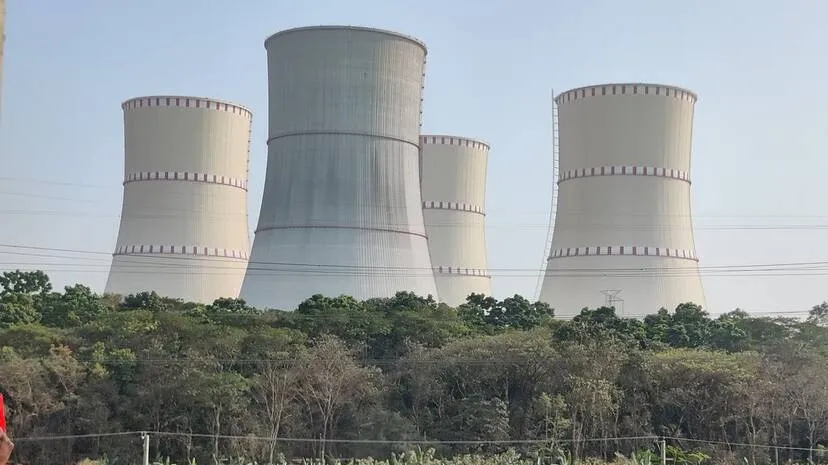
Modern industrial economies depend on reliable baseload power available at all hours of the day. Historically, that role was played by coal or natural gas. In a world that is trying to reduce carbon emissions, the only large-scale alternative capable of providing stable electricity is nuclear energy. Within the nuclear sector, a new generation of technology has begun to attract attention because it attempts to solve many of the challenges that slowed earlier nuclear expansion.
Small Modular Reactors, often referred to as SMRs, represent an attempt to rethink nuclear power for the twenty-first century. Traditional nuclear plants are vast engineering projects capable of generating more than one thousand megawatts of electricity. They require enormous capital investment and often take more than a decade to build. SMRs follow a different philosophy. They are designed as smaller reactors that can be manufactured in factories and transported to sites where they are assembled. Individual modules typically produce between fifty and three hundred megawatts of electricity. Several modules can be installed together to increase output as demand grows.
This approach offers several advantages. Construction timelines can potentially fall to four or six years instead of a decade. Financing becomes easier because projects can be built gradually rather than requiring enormous upfront capital. SMRs can be installed at locations where coal plants are retiring, allowing existing land and transmission infrastructure to be reused. Many designs also include passive safety mechanisms that allow reactors to shut down automatically without external power or operator intervention.
India has traditionally developed its nuclear power programme through state-owned institutions such as the Nuclear Power Corporation of India Limited. However, the policy environment is beginning to evolve as the country recognises the need to expand nuclear capacity more rapidly. Government initiatives under the Nuclear Energy Mission for Viksit Bharat have committed substantial resources to advanced reactor technologies. Policy reforms in recent years have also opened the door for broader participation in areas such as nuclear component manufacturing, technology partnerships and specialised engineering services.
Within India’s scientific community, the Bhabha Atomic Research Centre has been developing several indigenous SMR designs. One of them, known as the BSMR two hundred, is a two-hundred-megawatt pressurised water reactor that has been proposed for early deployment at Tarapur in Maharashtra. Another smaller design aims to serve industrial clusters that require a dedicated electricity supply. Researchers are also exploring high-temperature reactors capable of producing heat for hydrogen generation, linking nuclear energy to the emerging hydrogen economy that many countries view as an important component of future energy systems.
At present, India operates roughly nine gigawatts of nuclear capacity. Compared with major nuclear economies, this figure remains modest. China operates more than fifty-five gigawatts of nuclear power, while the United States maintains close to ninety gigawatts. France continues to generate the majority of its electricity from nuclear reactors. India’s long-term ambition is far more expansive than its current capacity suggests. Energy planners increasingly discuss the possibility of reaching one hundred gigawatts of nuclear power by the year 2047, the centenary of independence.
If that scale is achieved, the economic implications would be substantial. A nuclear fleet of one hundred gigawatts operating at high capacity could generate more than seven hundred billion units of stable electricity every year. That amount of reliable power would support large segments of India’s industrial economy while reducing dependence on imported fossil fuels. It would also help insulate the country from the inflationary shocks that accompany global oil volatility.
Energy independence has always been about more than economics. It also concerns sovereignty and strategic resilience. When a nation depends heavily on imported energy that travels through contested sea routes, global events beyond its control begin to shape domestic policy choices. The tanker routes through the Strait of Hormuz are a reminder that energy security and geopolitical stability are closely linked.
Small Modular Reactors are not a replacement for renewable energy. Solar and wind power will continue to form the backbone of India’s clean energy transition. What SMRs can offer is a stable foundation beneath that system. They provide electricity that does not depend on weather patterns or seasonal cycles and that can be generated within the country’s own borders.
Technological transformations often begin quietly. They take shape in research laboratories, engineering workshops and policy discussions long before they appear in headlines. The development of SMRs may represent such a moment for India’s energy future.
If the country chooses to scale this technology seriously, it could build not only a reliable new source of electricity but also an advanced manufacturing ecosystem around nuclear engineering and reactor components. The benefits would extend beyond power generation to include industrial capability, technological leadership and greater economic stability.
Many years from now, historians may look back at this period and see it as the moment when India began to rethink the foundations of its energy system. The turning point may not have been a technological breakthrough or a single policy decision. It may simply have been the recognition that dependence on distant oil supplies carries risks that a rising economy cannot indefinitely accept.
When that recognition takes hold, nations begin to search for solutions closer to home. For India, the quiet promise of small modular reactors suggests that the energy powering the country’s future might increasingly come not from ships crossing uncertain seas, but from reactors operating steadily within its own borders.
And when that day arrives, India’s economic rise will rest less on the fragile geography of global oil routes and more on the steady confidence of a nation that has learned how to power itself.
CA. M R Ranjit Karthikeyan BCom., LLM., DISA (ICAI), FCA
Founding Partner, Ranjit Karthikeyan Associates LLP
Thiruvananthapuram | Kochi | Kozhikode | Bengaluru
www.rkaglobal.com | +91 989 599 7000 | 949 727 0000



 HOME
HOME LATEST
 NOTIFIED NEWS
 POLL
POLL KERALA
  EDITORIAL
  INDIA
INDIA  WORLD
WORLD  CINEMA
  SPORTS
  LIFESTYLE
  SPECIAL
  SCIENCE & TECHNOLOGY
 |
|