

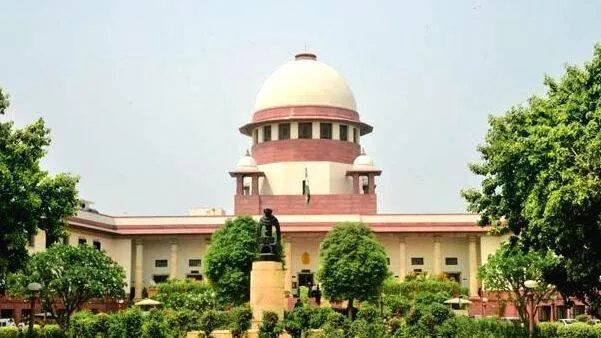
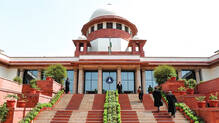
NEW DELHI: The Kerala government has informed the Supreme Court that the opinions of religious scholars and social reformers should be sought before re-examining the rituals and customs at Sabarimala Temple. The state government said that a proper study and detailed discussions are necessary before deciding whether any changes should be made to the temple’s rituals.
With elections approaching, the government has submitted an affidavit that appears to emphasise that traditional practices should not be violated. However, it did not directly state that women should be barred from entering the temple. The affidavit presents arguments related to the seven questions currently being examined by a nine-judge Constitution Bench of the Supreme Court.
The government also explained that past experiences related to Sabarimala and the responses of devotees, including women, support this view.
These arguments were presented in an affidavit submitted before the nine-judge Constitution Bench of the Supreme Court in connection with the case on women’s entry into Sabarimala. The government had expressed a similar opinion earlier in 2007 as well.
The state said the issue involves beliefs and values accepted by the people and that the court should take a neutral approach. It added that a decision should be taken only after thoroughly examining the views of religious scholars.
The response was given to a question regarding the scope of judicial review of religious practices under Article 25 of the Constitution, which guarantees freedom of religion.
According to the government, whether a practice is an essential part of religion should be determined based on the opinion of society. However, practices that violate the law or go against public policy and morality cannot be accepted. If human rights violations occur in the name of religious practices, even people outside the faith community have the right to question them.
The affidavit was submitted through advocate Nisha Shankar. The 17-page document also includes the history of the case and details of the 2018 judgment delivered by a bench led by then Chief Justice Dipak Misra.
Arguments in the case will begin on April 7. The Malankara Jacobite Syrian Orthodox Church has also submitted an affidavit explaining its stand.
Nine-judge Constitution Bench formed
The Supreme Court has also constituted a nine-judge Constitution Bench to examine the correct interpretation of the term “industry.” Arguments in that case will conclude on March 17 and 18. The same bench will consider cases, including the Sabarimala matter, from April 7. The bench is headed by Chief Justice Surya Kant. Other members include Justices B V Nagarathna, P S Narasimha, Dipankar Datta, Ujjal Bhuyan, Satish Chandra Sharma, Joymalya Bagchi, Alok Aradhe, and Vipul M Pancholi.










 HOME
HOME LATEST
 NOTIFIED NEWS
 POLL
POLL KERALA
  EDITORIAL
  INDIA
INDIA  WORLD
WORLD  CINEMA
  SPORTS
  LIFESTYLE
  SPECIAL
  SCIENCE & TECHNOLOGY
 |
|