


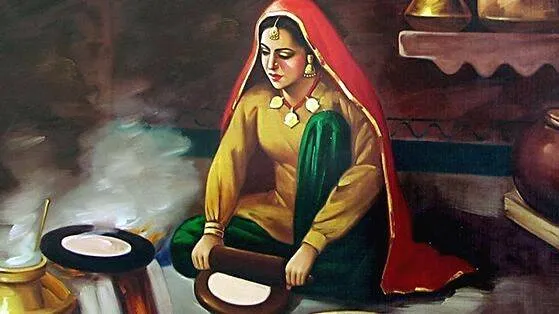
The Supreme Court's unique observation made the other day heralded a new chapter in the annals of gender equality in the country. The court underlined that the husband has equal responsibility in household chores along with the wife, and said that the wife is not a housemaid. The court said that the husband should also do the cooking and other chores according to the changing times. This remark was made while considering a marital dispute case. Although this was said in the context of household chores, the court commented that the status of women in all our administrative, political and social spheres is the same as that of men. In other words, women have a role along with men in building the family, society and the nation, and men should not have supremacy or upper hand in this. This observation by the Supreme Court also points to the significance of the concept of 'equality in social status and access to opportunities', which is illuminated in the preamble of our great Constitution.
It is a universal truth that humanity can only move forward through the union of two different genders. In this, both men and women have equal responsibilities. Both groups must carry out this responsibility and move forward. Unfortunately, as social thinkers have pointed out, ours has been a patriarchal society for ages, which has led to the subordination of women and restricted them to just doing all the household chores. The Supreme Court's stance has thus severed the patriarchal approach that is ill-fitted for a civilised society.
The representation of women in our Constituent Assembly is no better. Out of the total 389 members, only 15 were women. However, the provisions for protecting the dignity and rights of women were clearly included in the Constitution. The stories of Amba in the Mahabharata and Sita in the Ramayana, which uphold the dignity and right of women to self-determination, provide an opportunity for reflection on the status of women. However, since power, especially in the political and administrative spheres, is held by men, the old notions remain unchanged in practice.
The 33 per cent women's reservation bill in Parliament and state assemblies (Nari Shakti Vandan Abhiyan) was unanimously passed by both houses of Parliament in September 2023, but it has not been implemented. It has now been announced that it will be implemented after the 2029 census. It should be remembered that the amendment, which was introduced in 1996, has not been implemented even after three decades. In such a context, the Supreme Court's observation that men have equal responsibilities in household chores along with women will undoubtedly help in a new democratic life and culture in our families.













 HOME
HOME LATEST
 NOTIFIED NEWS
 POLL
POLL KERALA
  EDITORIAL
  INDIA
INDIA  WORLD
WORLD  CINEMA
  SPORTS
  LIFESTYLE
  SPECIAL
  SCIENCE & TECHNOLOGY
 |
|