


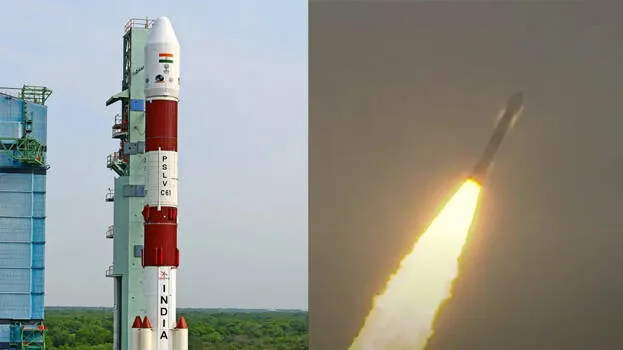
THIRUVANANTHAPURAM: India's PSLV rocket, which has been the most successful satellite launch in thirty years, repeated the same mistake it made last year yesterday, shocking the scientific world. PSLV is a rocket with a 94% accuracy and success rate among the world's launch missions.
The rocket lost control this time too during the third stage where the solid fuel burns. The same was the case in the 63rd launch on May 18 last year. If it was at the beginning of the third stage in 2025, control was lost just before entering the fourth stage burn yesterday. The initial assumption is that there was a pressure drop. The authorities are on a mission to clear the mystery. A detailed investigation has been ordered.
The PSLV-C62 rocket, which was supposed to launch DRDO's advanced surveillance satellite Anvesha-1 along with 15 commercial satellites, lost its course after its launch at 10.17 am yesterday from Sriharikota. The satellites could not be put into orbit.
The satellites were stored in the payload fairing (or heat shield), the fourth part of the four-stage PSLV rocket. Since the third stage did not separate, the fourth stage did not start working. Due to this, its trajectory and control systems did not work. The fourth stage of the rocket could not move forward and fell down. Its satellites were also lost.
Loss was Rs 600 crore, along with orders
The loss was around Rs 600 crore, including the cost of the rocket, which cost Rs 200 crore, and the cost of the 15 satellites, which cost around Rs 400 crore. Apart from this, NSIL, the commercial arm of ISRO, may face difficulties in securing future foreign satellite launch contracts as potential international clients might reconsider due to reliability concerns.
Apart from EOS-N1 (codename Anvesha), India's other satellites were Sanskar Sat, an artificial star in the sky developed by Ahmedabad's Laxman Jnanpith School; Ayul Sat, which is testing in-space refuelling, developed by Orbit Aerospace; MOI-1 Sat, an AI lab in space developed by an Indian startup, and four satellites by Dhruva Space.
Foreign satellites were:
Improbable.... But
The PSLV has made 64 launches, including yesterday's, and has failed only four times. PSLV is the rocket that launched Chandrayaan 1, Mangalyaan, Aditya L.1, and Astrosat missions, and set a world record by launching 104 satellites into space at once. Experts say that such a mistake is unlikely to happen to PSLV.
"A detailed investigation is underway into what happened"
Dr. N. Narayanan,
ISRO chief





 HOME
HOME LATEST
 NOTIFIED NEWS
 POLL
POLL KERALA
  EDITORIAL
  INDIA
INDIA  WORLD
WORLD  CINEMA
  SPORTS
  LIFESTYLE
  SPECIAL
  SCIENCE & TECHNOLOGY
 |
| 


