


THIRUVANANTHAPURAM: 'Iyam akashvaNi. Samprati vartah Shruyatam. Pravachaka Baladevananda Sagara'- Although many do not know the meaning, those who heard these lines on the radio have never forgotten them.
In the past, only one or two houses in a neighbourhood had a radio. The idea of radio kiosks was created by the panchayats so that everyone could enjoy radio programs. Radio kiosks were the only way to get news and information when newspapers were not very popular.
All India Radio's local news, Yuva Vani and Vayalum Veedum, etc., found a place in the minds of the people because of kiosks. Radio kiosks were information and communication centres that ignited the thoughts of a generation. This building is one of the nostalgic memories of the older generation.
Not only news, including the India-Pakistan war, the Emergency, and the assassination of Indira Gandhi, shocked the country, but people also heard the results of the general elections, film songs, and plays through such kiosks. In the evenings, everyone would gather in front of the kiosk to listen to the radio. The youth clubs formed by those who gathered here became a cultural movement.
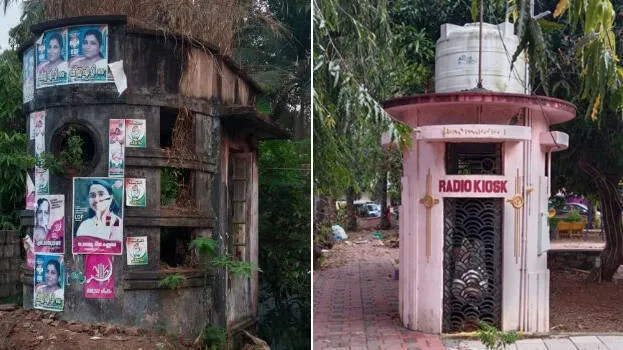
With the advent of the transistor radio, the crowd in front of the kiosks started to decrease. The start of Doordarshan in the 1980s and the arrival of private TV channels in the 90s made the kiosks a relic. Kiosks became walls for posters of politicians and film stars. History lovers say that such monuments need to be preserved.
Kiosks have the same shape
Radio kiosks were built in Kerala after 1965. They were operated by local bodies. A kiosk had a valve radio, a storage cell and a loudspeaker. The main radio brands were Murphy, Nelco, HMV and Philips.




 HOME
HOME LATEST
 NOTIFIED NEWS
 POLL
POLL KERALA
  EDITORIAL
  INDIA
INDIA  WORLD
WORLD  CINEMA
  SPORTS
  LIFESTYLE
  SPECIAL
  SCIENCE & TECHNOLOGY
 |
| 


