


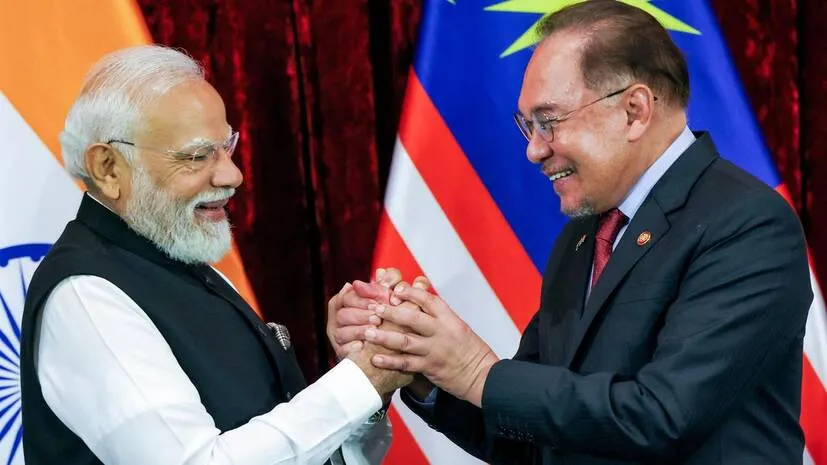
Prime Minister Narendra Modi’s visit to Malaysia is likely to be a major boost to bilateral ties between the two countries. India's Union Budget recently laid strong emphasis on making a breakthrough in the semiconductor industry. It is no coincidence that the Indian Prime Minister chose to visit Malaysia as the first country after the crucial budget presentation. Malaysia accounts for 13 per cent of global trade in the semiconductor industry. During Modi's visit, the two countries also signed an agreement for cooperation in this sector.
The meeting with Malaysian Prime Minister Anwar Ibrahim also agreed to form a Malaysia-India Digital Council for cooperation in the digital economy. India, especially Kerala, has decades-long ties with the Muslim nation of Malaysia. The two countries have signed deals to make the relationship stronger and warmer. In a joint statement, India and Malaysia stated that there will be no compromise or double standards in combating terrorism.
Although he didn’t mention Pakistan, PM Modi’s statement that India would never keep double standards in combating terrorism was an indirect warning to the neighbours. Malaysia, a nation that desires peaceful existence, coming in to support PM Modi’s statement is no surprise. The two nations also signed 11 agreements for cooperation in various fields. It is also worth mentioning that Modi and Anwar Ibrahim welcomed the use of the Indian rupee and the Malaysian ringgit for trade between the two countries. India's trade agreements with Asian countries are a concern for the United States because they eliminate the dollar.
The decision to open an Indian Consulate General in Malaysia was also announced. In gratitude for this, Malaysia also expressed its support for India's permanent membership in the UN Security Council. The contribution of Indian-origin industrialists and workers to Malaysia's development is no small feat. Highlighting this, Modi invited Malaysian companies to invest in India. During his visit to Malaysia, the Indian Prime Minister also met with Indian-origin ministers, members of parliament, and senators, and even praised them in a social media post for their role in strengthening cooperation between the two countries.










 HOME
HOME LATEST
 NOTIFIED NEWS
 POLL
POLL KERALA
  EDITORIAL
  INDIA
INDIA  WORLD
WORLD  CINEMA
  SPORTS
  LIFESTYLE
  SPECIAL
  SCIENCE & TECHNOLOGY
 |
|