


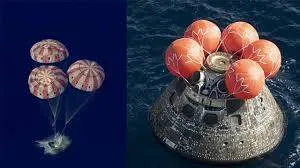
Achievements in science and technology always bring new hope and inspiration to humanity. The recent mission in which four astronauts travelled about 11 lakh kilometres, orbited the Moon, and returned to Earth in ten days has created excitement not just in the United States, but across the world. After 53 years, the Artemis II mission has marked a historic moment in lunar exploration. As part of preparations for the next mission to land humans on the Moon, NASA’s Artemis II successfully completed a record-breaking journey carrying four astronauts Victor Glover, Reid Wiseman, Jeremy Hansen, and Christina Koch. After the historic space mission, the spacecraft made a smooth landing in the Pacific Ocean. The success of this mission has also provided fresh momentum to India’s plans to send humans to the Moon within the next decade.
From ancient times, humans have explored unknown regions on Earth, discovering new continents and oceans. Today, in the modern era, the search for answers to the mysteries of the universe has taken humanity into space. These missions also aim to discover new sources of energy and knowledge that can help secure the future of humankind. In 1969, the Apollo 11 mission first took humans to the Moon. What was achieved at that time with limited knowledge and technology still amazes the scientific world today. It is a striking fact that the spacecraft was controlled by computers far less powerful than even a basic modern smartphone, something that scientists today find astonishing to even reflect upon.
Although the Artemis mission used advanced modern technology, there were tense moments during the journey. When the spacecraft moved behind the Moon, communication with Earth was temporarily lost for about 40 minutes. This happened when the Moon came between the spacecraft and Earth. During this time, the spacecraft came as close as about 6,550 kilometres to the Moon, allowing astronauts to capture clearer images and collect valuable data. Once communication was restored, the astronauts shared new information that had never been available before. NASA also released images of Earth taken from a great distance.
The Artemis II mission is the farthest humans have ever travelled into space. Three more missions are planned: Artemis III to test lunar lander systems, Artemis IV to send humans back to the Moon, and Artemis V to establish a permanent base on the Moon. Seen from a distance, Earth appears very small, like a tiny ball floating in space. It would have been truly meaningful if this scientific achievement had also inspired leaders in the United States to reflect on whether it is right for humans, who depend on each other and are meant to live with love, to continue fighting among themselves.














 HOME
HOME LATEST
 NOTIFIED NEWS
 POLL
POLL KERALA
  EDITORIAL
  INDIA
INDIA  WORLD
WORLD  CINEMA
  SPORTS
  LIFESTYLE
  SPECIAL
  SCIENCE & TECHNOLOGY
 |
|