


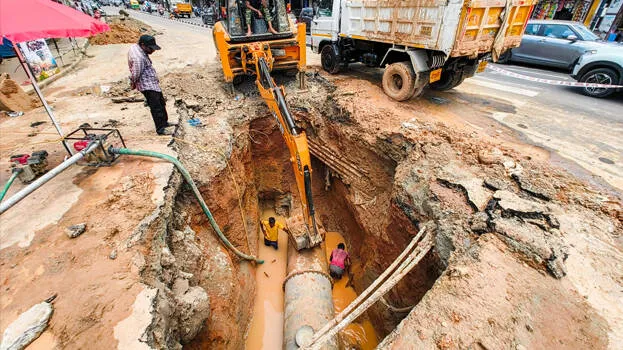
Frequent pipe bursts and leaks have severely disrupted the drinking water supply across Thiruvananthapuram. Due to persistent mismanagement by the water authority, these issues often remain unresolved for weeks—and in some cases, months—sparking widespread public frustration and conflict. Compounding the problem is a post-election lull, which has led to an apparent lack of urgency among top officials in the irrigation department.
The Thiruvananthapuram Taluk Office, which houses hundreds of revenue officials and sees a massive daily influx of citizens, has been without a reliable water supply for three months. Desperate for a resolution, employees were recently forced to strike just to get the water authority’s attention.
Despite their intervention, the problem persists; water is only trickling in. An initial attempt to provide a new connection from the main road failed, leading officials to renew the old connection. However, water still isn't reaching the storage tanks. Revenue officials now suspect that major blockages in the lines near the office are the culprit.
The situation at the Taluk Office is merely a microcosm of a city-wide crisis. In many densely populated wards, drinking water has been cut off for days during the peak of an intense summer heatwave. The scarcity has even led to physical violence.
In Andoorkonam Panchayat, a dispute over water supply escalated into a public scuffle between ruling and opposition party members. The Panchayat President and a ward member—both women—were injured during the altercation and are currently undergoing hospital treatment. The water authority attributes these shortages to pipes bursting under the roads due to extreme thermal expansion, leading to the loss of thousands of litres of water underground.
While a homeowner would fix a leak immediately to avoid a high bill, the water authority has failed to address leaks in public spaces with any sense of urgency. A prime example is the 900mm main pipeline at the base of the Thattinakam bridge in Sreekaryam, which recently ruptured again. This aging concrete pipeline, which transports water from Aruvikkara to reservoirs in Manvila and beyond, has now broken five times in the last six months. As a result, water supply will be suspended in approximately 25 wards for at least ten days.
While these frequent bursts cause fear and hardship for residents, they appear to benefit a select few. Because these ruptures are classified as emergencies, repair contracts can be awarded without a formal tender process, allowing for immediate payouts. Similarly, those tasked with temporary water distribution find the crisis to be a lucrative opportunity.
Before public frustration boils over into large-scale street protests, the government must implement a high-level action plan. A comprehensive assessment of the city's aging infrastructure is no longer optional; it is a necessity to ensure the fundamental right to clean drinking water.








 HOME
HOME LATEST
 NOTIFIED NEWS
 POLL
POLL KERALA
  EDITORIAL
  INDIA
INDIA  WORLD
WORLD  CINEMA
  SPORTS
  LIFESTYLE
  SPECIAL
  SCIENCE & TECHNOLOGY
 |
|