


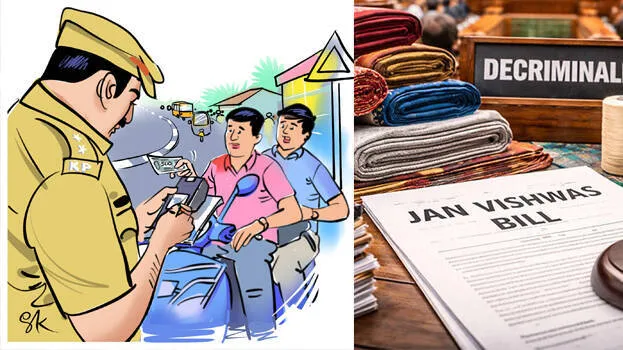
NEW DELHI: The Central Government has passed the Jan Vishwas (Amendment of Provisions) Bill in Parliament to decriminalise various minor offences, including several under the Motor Vehicles Act, by replacing imprisonment with more lenient penalties. Under this reform, 784 provisions across 79 central laws have been amended so that minor infractions can be resolved through warnings or fines rather than jail time. This initiative is a strategic move to remove outdated rules and streamline the legal system for both citizens and businesses.
This legislative shift aims to address the staggering backlog of over five crore pending court cases, which Union Minister Piyush Goyal noted will be disposed of expeditiously as prosecutors apply to the courts for formal closures. By shifting the resolution of these disputes to designated adjudicating officers, the government intends to drastically reduce the judicial burden and enhance the ease of living. To ensure the reform is effective nationwide, the Union Minister has also urged state governments to urgently implement similar updates to their own local laws.
While the new framework offers a reprieve for first-time offenders—such as those causing noise pollution, who may now receive only a warning—the legal landscape shifts significantly for repeat violators, who will face much stricter penalties and the imposition of more severe sections of the law. Furthermore, the reform introduces a major relief for road accident victims by extending the window for filing compensation petitions. The previous six-month deadline has been bolstered by an additional twelve-month allowance, ensuring that those seeking justice have a total of eighteen months to navigate the claims process.
The reform also introduces practical changes to daily commuting, most notably regarding driving licenses. Previously, a license was considered technically invalid the very day it expired; however, the law has been amended to include a 30-day grace period. This allows motorists to legally operate their vehicles and renew their documents within a month of expiry without being charged with an offence.
Public transportation rules have also been softened to favour fines over criminal prosecution. For instance, travelling without a ticket on a bus will no longer result in a court case, but will instead attract a fine of up to ₹500. Similarly, unauthorised occupancy of a reserved berth in a train will now be handled with a penalty of up to ₹1,000 rather than a criminal filing, and a similar ₹1,000 penalty has been established for the misuse of public drinking water.
Finally, the government has moved to eliminate outdated policing powers that often led to harassment. A notable change is the freezing of a specific section of the Delhi Police Act that allowed for the detention of individuals seen in "suspicious circumstances" at night. Under the new guidelines, simply being outdoors late at night is no longer grounds for a case, ensuring that personal movement is not criminalised under vague or colonial-era provisions.
Amendment is as follows:
This Bill strengthens a trust-based framework that empowers our citizens. It marks the end of rules and regulations that are outdated. - Prime Minister Narendra Modi





 HOME
HOME LATEST
 NOTIFIED NEWS
 POLL
POLL KERALA
  EDITORIAL
  INDIA
INDIA  WORLD
WORLD  CINEMA
  SPORTS
  LIFESTYLE
  SPECIAL
  SCIENCE & TECHNOLOGY
 |
|