


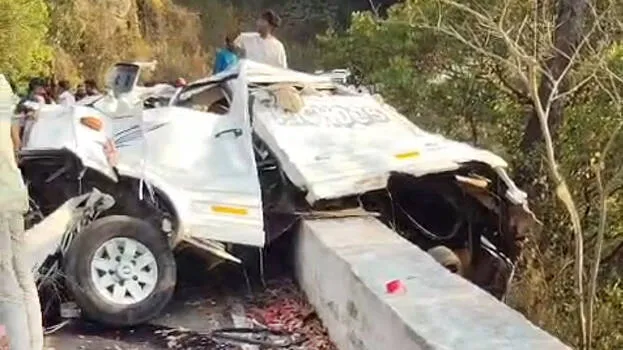
THRISSUR: Initial investigations suggest that a brake failure caused the tempo traveller to overturn at the Aliyar pass in Valparai. The Tamil Nadu police have concluded that the braking system likely overheated and ceased to function.
Reports indicate that after navigating 27 hairpin bends, the driver realised the brakes had failed. In a desperate attempt to stop the vehicle, he tried to downshift gears but was unsuccessful. The vehicle subsequently crashed through the iron pillars of the stone safety wall and plunged 800 feet down the gorge.
The vehicle overturned multiple times during the fall, scattering debris across the mountainside. Many passengers died instantly as the vehicle plummeted from the thirteenth bend, eventually landing in the area between the ninth and tenth bends. Notably, the protective wall at this location is only two feet high.
Inexperience and congestion: Hidden killers
Experts point out that driver inexperience and heavy traffic congestion are frequent "villains" on mountain passes. A primary issue is that drivers accustomed to flat, normal roads often maintain the same driving style on steep inclines and descents. As traffic increases, drivers are forced to brake continuously. If a vehicle is not kept in the correct gear while descending, this excessive braking can lead to catastrophic system failure.
Low gears for speed control
When descending in a low gear, the engine provides "engine braking," which naturally controls the vehicle's speed and requires only minimal use of the foot brake.
The general rule of thumb is to descend in the same gear used to climb the incline. Relying solely on continuous braking rather than gear management is extremely dangerous; it causes the brake drums to overheat, leading the brake liners to harden and lose all friction efficiency.
"Excessive braking without utilising the correct gear on downhills is a frequent cause of these fatal accidents." — P.N. Sivan, Retd. Joint RTO





 HOME
HOME LATEST
 NOTIFIED NEWS
 POLL
POLL KERALA
  EDITORIAL
  INDIA
INDIA  WORLD
WORLD  CINEMA
  SPORTS
  LIFESTYLE
  SPECIAL
  SCIENCE & TECHNOLOGY
 |
|