


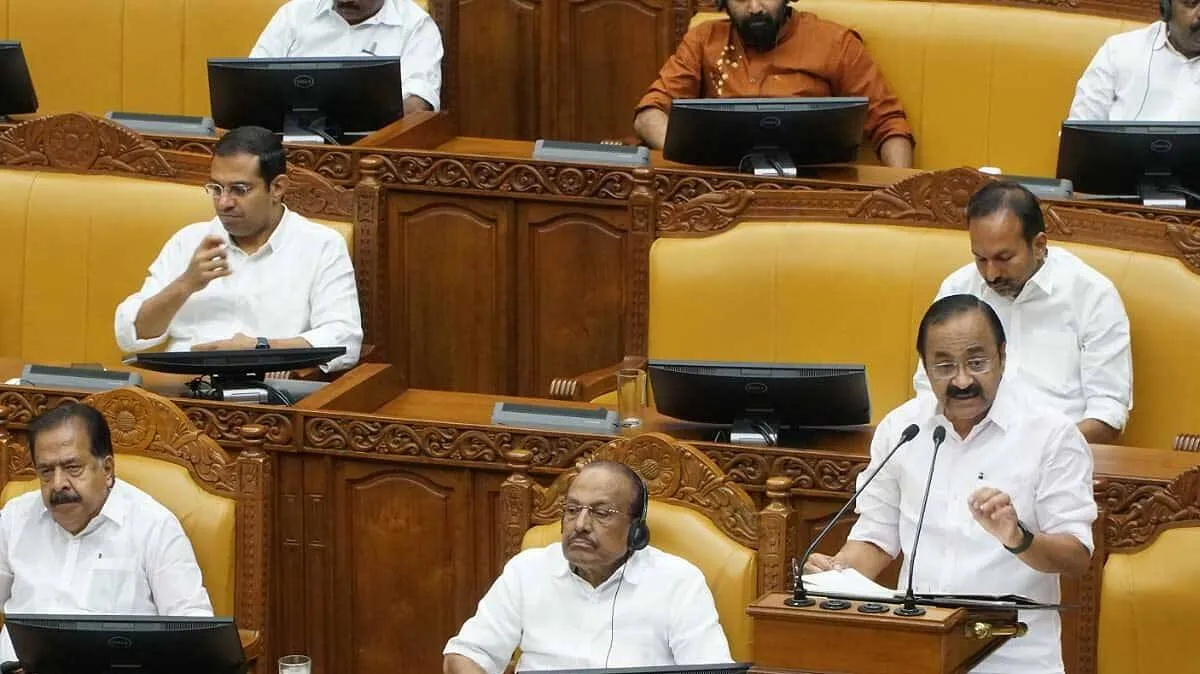
The revised budget 2026-27 presented by Chief Minister V D Satheesan was expected to signal a decisive departure from the fiscal drift of the past decade. Instead, it stands as a document that correctly diagnoses Keralam’s problems but offers almost no credible solutions. While the government deserves credit for tabling a candid White Paper, the budget itself remains disappointingly thin on substance, reform, and execution.
At its core, this budget suffers from a fundamental contradiction: it speaks the language of realism and course correction, yet continues with the same structural weaknesses that have plagued Keralam for years.
The persistent structural rot
The most glaring weakness is the government’s refusal to confront the elephant in the room - Keralam’s bloated committed expenditure.
Even in the revised estimates, committed expenditure (salaries, pensions, and interest payments) continues to consume 77.6% of revenue receipts. The Revenue Deficit remains stubbornly high at Rs 35,355 crore. Despite all the talk of realism, the budget offers no serious roadmap to reduce this structural burden. Instead, it has chosen the easier path of cutting the plan size, which essentially means reducing development spending rather than reforming unproductive expenditure.
This is not fiscal discipline. This is fiscal retreat.
The decision to present a highly conservative budget despite recording Rs 5,629 crore in additional revenue in just the first two months (April–May) further damages its credibility. If the government was truly being realistic, it should have at least acknowledged this early momentum and revised its projections accordingly. Instead, it chose to underplay positive signals, raising questions about whether the conservative stance was driven by fiscal caution or political messaging.
Big announcements, small allocations
Nowhere is the hollowness of this budget more visible than in its flagship announcement - Mission Samudra.
The government has declared its ambition to turn Keralam into a global maritime hub within five years. Yet, it has allocated only Rs 400 crore for this supposedly transformative project. There is no financing strategy, no implementation agency, and no clear set of milestones. This is not a project. This is an announcement waiting for a plan.
Similar hollowness runs through other major proposals:
• The aviation hub and economic corridors have been announced with modest allocations and no execution framework.
• The MSME Youth Scheme has been given Rs 100 crore - a token amount for a statewide intervention.
• The One Keralam Karuthal Mission, meant to support the most vulnerable, has been given a symbolic Rs 1 crore.
These are not signs of a government preparing for serious implementation. These are signs of a government making announcements to create political optics while avoiding hard fiscal and administrative decisions.
The missing reforms
What makes this budget particularly disappointing is what it does not contain.
There is no attempt at pension reform. There is no credible plan to rationalise subsidies. There is no serious push to improve tax compliance beyond general statements. The government has identified the problem of high committed expenditure but has chosen not to touch it. This is the same pattern that defined the budgets of the last decade -identifying problems while avoiding the difficult reforms needed to solve them.
The only genuine optimistic element
Amid this landscape of cautious projections and underfunded announcements, there is one area that offers some genuine hope - the potential alignment with central government schemes.
Projects like Mission Samudra, the proposed Economic Corridors, and the focus on Rare Earths can potentially draw support from central initiatives such as:
• Sagarmala (port-led development)
• PM Gati Shakti (integrated infrastructure planning)
• Bharatmala (highway and connectivity projects)
• National Critical Minerals Mission (rare earths and strategic minerals)
If the Keralam government moves quickly to prepare high-quality project proposals and engages proactively with the Centre, it can attract significant central funding and policy support. This alignment represents the only structural opportunity in an otherwise defensive budget.
However, even here, the optimism must be tempered. Other states like Gujarat, Maharashtra, and Tamil Nadu have been far more successful in leveraging these central schemes because of better project preparation, faster land acquisition, and more consistent engagement with the Centre. Keralam’s track record in these areas remains weak. Without urgent improvement in execution capacity, even this opportunity may remain underutilized.
The road ahead
The revised budget 2026-27 is not a disastrous budget. It is something more concerning - a hollow budget.
It has the tone of responsibility without the substance of reform. It has the language of growth without the resources or mechanisms to deliver it. It has correctly identified Keralam’s fiscal problems but has chosen to manage the symptoms rather than treat the disease.
If the government wants this budget to be remembered as a turning point rather than another missed opportunity, it must move quickly on three fronts:
1. Prepare detailed, bankable projects under Mission Samudra and other schemes to tap central funding.
2. Begin structural reforms on the expenditure side, particularly pensions and subsidies.
3. Build institutional capacity for faster project execution and land acquisition.
Without serious structural reforms and stronger execution mechanisms, this budget is in danger of becoming another addition to the long list of half-hearted documents that Keralam has produced in recent years - honest in its admission of the crisis, but hollow in its response to it.
The government appears to be placing its bet on the Centre stepping in to fund key projects under Sagarmala, Gati Shakti, and other national schemes. While central support can provide crucial momentum, Vikasit Keralam cannot be built on the hope that New Delhi will repeatedly bail out the state. Sustainable progress will require the state to demonstrate its own willingness to undertake difficult reforms, improve project execution, and create a credible investment climate. Without these, even generous central assistance may not translate into lasting development outcomes.












 HOME
HOME LATEST
 NOTIFIED NEWS
 POLL
POLL KERALA
  EDITORIAL
  INDIA
INDIA  WORLD
WORLD  BUSINESS
  CINEMA
  SPORTS
  LIFESTYLE
  SPECIAL
  SCIENCE & TECHNOLOGY
 |
|