


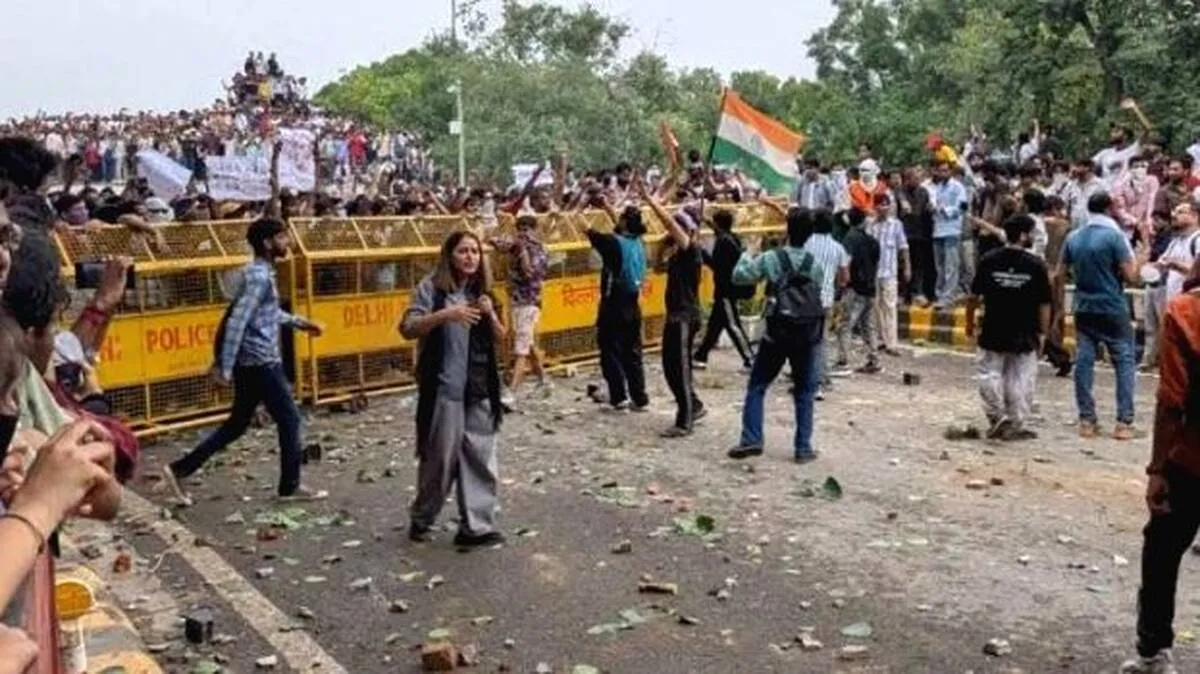
In a democracy, a citizen’s right to live is just as important as the right to protest. It is unjustifiable to infringe upon the ordinary citizen's right to life and freedom of movement in the name of staging a protest. Most protests in our country are predicated on the allegation that authorities are subverting the law; yet, ironically, it is often the protesters themselves who end up violating the law.
For years, protesters have destroyed public property like it is their inherent right. Such disruptive antics are fueled by the misguided belief that only violent protests garner attention. These forms of violent agitation are entirely unsuited to a civilised society. It is high time that political parties and other groups impose self-restraint and establish clear boundaries for their methods of protest.
Peaceful protest is one of the most potent weapons of democracy. The Constitution guarantees the right to protest and organise demonstrations—both as a means to oppose flawed policies of those in power and to safeguard one's rights—as a fundamental right. However, this right should not be exercised in a manner that completely disrupts the normal lives and livelihoods of others. In short, protesters are also obligated to abide by and uphold the laws of the land.
It is in this context that one must view the Supreme Court’s clarification—made in relation to protests at Jantar Mantar and Ramlila Maidan in Delhi—that such protest sites cannot be occupied indefinitely by a single group, and that a specific time limit must be set for their use. This observation, made by a bench presided over by Chief Justice Surya Kant, paves the way for serious discourse.
The court's intervention and significant observations come against the backdrop of widespread protests—led by opposition parties, independent organisations, and individuals—demanding the removal of Chief Election Commissioner Gyanesh Kumar. Addressing a traders' association in Delhi that complained about the disruption to business during the Diwali festive season, the court directed them to implead the protest organisers as parties to the petition. The court further questioned where farmers, labourers, and others would go to voice their grievances if a single organisation were to continue an indefinite protest. This remark was made after the Solicitor General, representing the Delhi Police, pointed out that a protest by the CJP—initially permitted for only one day in July—had actually persisted for 17 days.
The lawyer representing the traders submitted that the protests had resulted in a loss of business exceeding 10000 crore rupees. The court observed that the protesters alone cannot be held solely responsible for this; it acknowledged the reality that the excessive restrictions and barricades imposed by the police to manage these protests also adversely affect public life and commerce.
While protests may sometimes be necessary to rectify the errors of the authorities, occupying public space for an extended period on such grounds is not an appropriate practice.













 HOME
 LATEST
 NOTIFIED NEWS
 POLL
 KERALA
 EDITORIAL
 INDIA
 WORLD
 BUSINESS
 CINEMA
 SPORTS
 LIFESTYLE
 SPECIAL
 SCIENCE & TECHNOLOGY

 |