


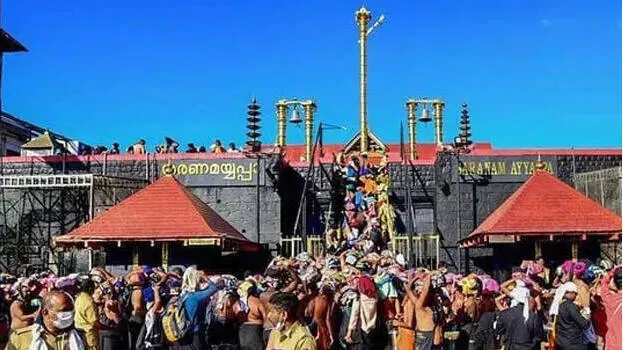
NEW DELHI: The Supreme Court on Wednesday made an important observation in the case related to women’s entry at Sabarimala. The Constitution Bench said it is difficult to declare a practice followed by lakhs of devotees as wrong. The observation was made by a bench led by Chief Justice Surya Kant. Justice M M Sundresh asked whether the ban could be lifted without hearing those who oppose the entry of women.
Justice B V Nagarathna said that the petition seeking entry of women at Sabarimala was not filed by believers and expressed the view that such a plea should not have been considered.
Senior advocate Abhishek Manu Singhvi appeared for the Travancore Devaswom Board, supporting the restriction on women’s entry. He questioned how long-standing traditions at Sabarimala (over 100 years) and Guruvayur (over 150 years) could be challenged through a public interest litigation.
He argued that there are more than a thousand Ayyappa temples in India, but only Sabarimala has restrictions on women’s entry. At Sabarimala, Lord Ayyappa is believed to be a “Naishtika Brahmachari” (eternal celibate). He also said that courts should not interfere in religious practices.
The Travancore Devaswom Board also opposed the argument of the NSS that decisions about temple entry should be left to the respective religious community. Abhishek Manu Singhvi argued that there should be no restrictions in public temples based on caste or class. At the same time, the board pointed out that devotees entering temples must follow the customs and traditions of those temples.





 HOME
HOME LATEST
 NOTIFIED NEWS
 POLL
POLL KERALA
  EDITORIAL
  INDIA
INDIA  WORLD
WORLD  CINEMA
  SPORTS
  LIFESTYLE
  SPECIAL
  SCIENCE & TECHNOLOGY
 |
|