


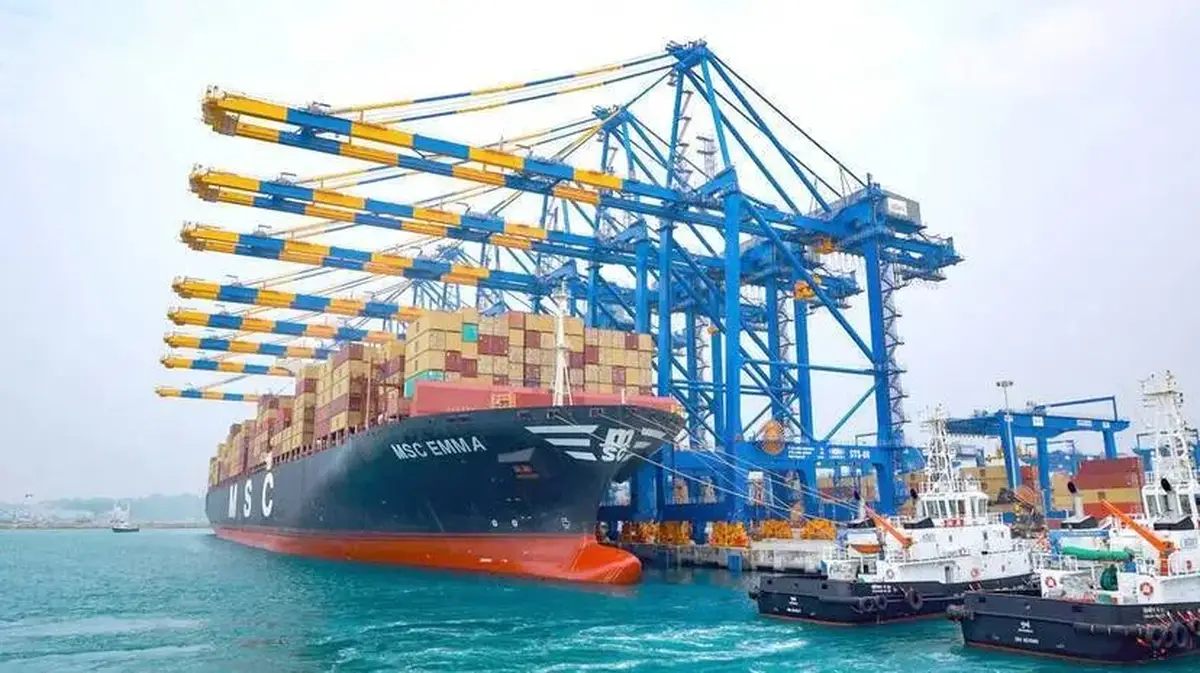
A clear, contract‑based argument that Clause 5.9 should safeguard competition and security at Vizhinjam without being overstretched to block strategic investment and port development.
Vizhinjam is not an ordinary port project. It is one of Kerala’s (if not India’s) most significant infrastructure assets, conceived as a deep-water international transshipment port capable of altering the maritime and logistics map of the region. It is also a public-private project structured through a Concession Agreement between the Government of Kerala and Adani Vizhinjam Port Pvt. Ltd.
That distinction is important. The port is not an unrestricted private asset. It is a public infrastructure project developed and operated within a contractual framework. The concessionaire has rights, but those rights are subject to conditions. The Government has oversight, but that oversight must also be exercised within the four corners of the agreement.
The present debate over the proposed investment by Terminal Investment Ltd. / TiL must therefore begin with the Concession Agreement itself.
On the question of prior approval, the agreement is clear. Clause 5.3.1 provides that the Concessionaire shall not undertake or permit any Change in Ownership except with the prior approval of the Authority. Clause 5.3.2 further provides that acquisition of 25% or more equity, directly or indirectly, or acquisition of control over the Board of Directors, requires prior approval of the Authority from the perspective of national security and public interest.
Therefore, there is no real controversy on the first point. A proposed 49% investment cannot be given effect without prior approval. The Government is fully within its rights to examine the transaction. It may call for the shareholding structure, beneficial ownership details, shareholders’ agreement, board rights, veto rights, reserved matters, operational rights, traffic arrangements and all documents necessary to satisfy itself on national security, public interest and competition concerns.
But prior approval is not the same as prohibition.
That distinction is now being blurred in the public debate, particularly with reference to Clause 5.9. Clause 5.9 is a competition-related clause. Its object is to prevent concentration of control or operational influence over competing ports within a 250-kilometre radius. It is not intended to become a mechanical weapon to block every investment by a global maritime player.
The clause must be read in its letter and spirit.
In its first limb, Clause 5.9 prevents the Concessionaire from acquiring, directly or through Associates or in any other manner, more than 25% control or interest in the operations or services of another port situated within 250 kilometres of Vizhinjam. In its second limb, it requires the Concessionaire to ensure that no person who controls or operates another port within 250 kilometres acquires more than 25% control or interest in the operations or services of Vizhinjam.
The spirit of this clause is clear. It is meant to prevent an anti-competitive situation where the same person controls or substantially influences competing ports in the same geographical zone, thereby affecting port neutrality, user choice, tariff discipline or cargo movement.
But the clause should not be stretched beyond that purpose.
A purposive interpretation does not mean an expansive interpretation at any cost. It means identifying the mischief the clause was intended to prevent, and then asking whether that mischief actually arises on the facts. If it does, Clause 5.9 must be applied firmly. If it does not, the clause should not be used to stifle a transaction that may bring capital, traffic, technology, global connectivity and commercial depth to Vizhinjam.
That is the balance the State must maintain.
The proposed acquirer is TiL. Therefore, the first legal question under Clause 5.9 is whether TiL itself controls or operates another port within 250 kilometres of Vizhinjam. The clause does not say “group”, “affiliate”, “parent company”, “ultimate beneficial owner” or “commercial associate”. It says “person”. That word cannot be ignored.
This is particularly important because the same clause uses wider language in its first limb: “directly or through Associates, or in any other manner.” But that expanded wording is absent in the second limb. In a carefully drafted commercial agreement, such a difference in language must be respected. Courts and authorities do not ordinarily add words to a contract merely because a broader reading may be convenient.
The separate legal personality of TiL is therefore relevant. It is not an absolute shield. It does not prevent scrutiny. It does not prevent the Government from examining whether TiL is acting as a mere conduit, alter ego or front for another entity. But separate legal personality does mean that TiL cannot automatically be treated as indistinguishable from the entire MSC Group unless the contract so provides or the facts legally justify such attribution.
That is the correct legal approach.
The second question is equally important: Clause 5.9 refers to control or operation of “any other port”. A port and a terminal inside a port may not always be the same legal thing. A statutory port may be owned and administered by a port authority, while a private operator may operate a terminal within that port. If the allegation is based on a terminal interest elsewhere, the Authority must examine whether such interest legally amounts to controlling or operating another port for the purpose of Clause 5.9.
Again, that is an evidence-based inquiry. It cannot be assumed.
Does TiL itself, in law and in fact, control or operate another competing port within 250 kilometres of Vizhinjam, and will its proposed investment give it more than 25% control or interest in the operations or services of Vizhinjam? If the answer is yes, Clause 5.9 must be applied firmly. If the answer is no, the clause should not be stretched to obstruct a strategic investment merely because TiL belongs to a wider global shipping group.
Kerala must protect Vizhinjam. But Kerala must also allow Vizhinjam to grow. A world-class transshipment port cannot be built through suspicion alone. It requires capital, shipping-line confidence, terminal expertise, cargo commitment, global network access and long-term commercial partnerships. If every strategic investment is viewed only through the lens of fear, development will suffer.
The purpose of the Concession Agreement is not merely to restrict. It is also to enable. The restrictions exist to ensure that development happens in a manner consistent with public interest, national security, competition and transparency. They should not be interpreted so narrowly or mechanically that the very development contemplated by the concession is defeated.
The proper approach is therefore neither blind approval nor reflexive rejection.
The Government must insist on prior approval. It must examine the transaction rigorously. It must satisfy itself that TiL’s entry does not compromise port neutrality, common-user access, competition, national security or public interest. But unless the factual ingredients of Clause 5.9 are clearly attracted, that clause should not be treated as an automatic bar.
Development should not be stifled by strained readings of protective clauses. Equally, public interest should not be diluted in the name of investment. The answer lies in a fair, purposive and commercially sensible interpretation of the agreement.
Vizhinjam deserves both protection and growth. The Concession Agreement must be read to achieve both.















 HOME
HOME LATEST
 NOTIFIED NEWS
 POLL
POLL KERALA
  EDITORIAL
  INDIA
INDIA  WORLD
WORLD  BUSINESS
  CINEMA
  SPORTS
  LIFESTYLE
  SPECIAL
  SCIENCE & TECHNOLOGY
 |
|