


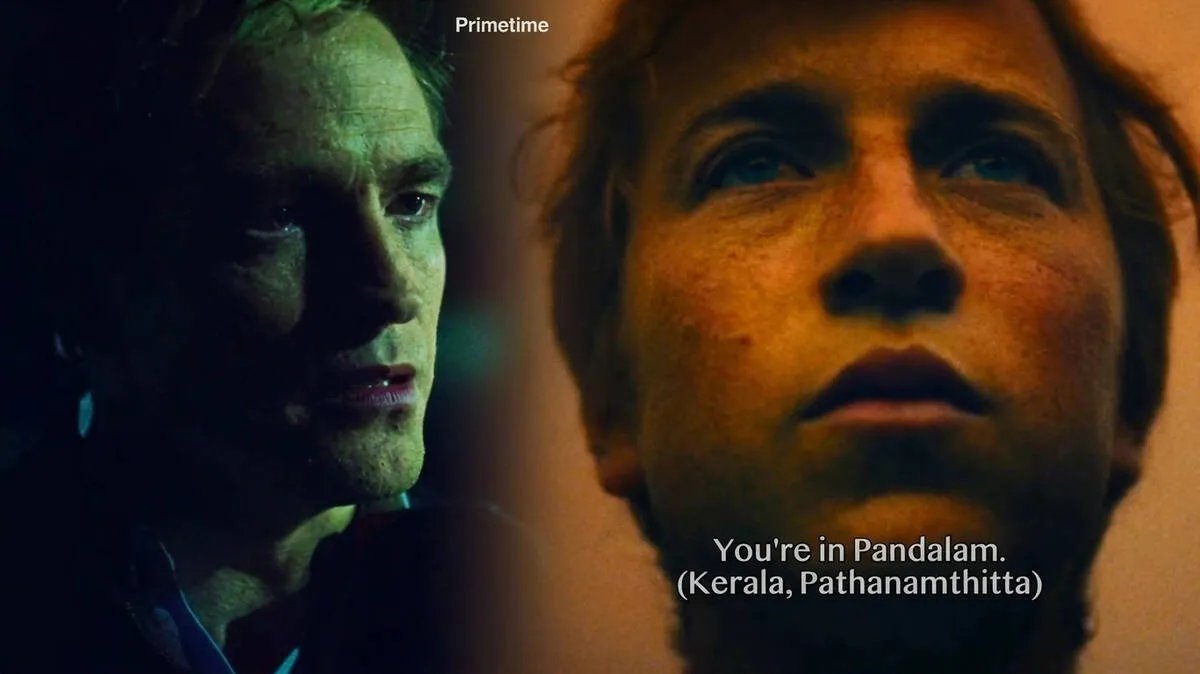
If you were watching Robert Pattinson’s latest A24 thriller Primetime and suddenly heard the word “Pandalam” drop during a scene, you weren't imagining things. Malayali viewers have been double-checking their audio ever since, scratching their heads over an unexpected shoutout to the quiet town in Kerala’s Pathanamthitta district.
There's just one problem: the Pandalam described in the film looks nothing like the real place.
In the film, directed by Lance Oppenheim, Pattinson plays a fictionalised version of To Catch a Predator host Chris Hansen. During a tense exchange with his colleague Dan Plum (Skyler Gisondo), Hansen recounts a disturbing story set during a fictional 1996 trip to India. He describes sitting at a cottage bar in Pandalam when a local approaches him and asks whether he is investigating a series of child disappearances.
What follows is an unsettling account of children going missing, villagers turning against one another and suspected perpetrators being lynched. The story eventually takes a supernatural turn, with a young girl describing a mysterious creature as an ancient evil.
While the shoutout immediately caught the attention of Kerala film buffs online, the visuals left them thoroughly confused. The sequence features sprawling tea estates and massive caves—landscapes that viewers familiar with Pandalam say they would struggle to associate with the town.
So why pick Pandalam for a werewolf-esque monster story?
The real-world inspiration, it turns out, came from much further north. In an interview with Novastream, screenwriter Ajon Singh revealed that the sequence drew inspiration from a 1990s New York Times report about wolf attacks on children in Uttar Pradesh.
The incidents occurred in eastern Uttar Pradesh, particularly in the districts of Pratapgarh, Sultanpur and Jaunpur. The attacks triggered fear and suspicion among villagers, with rumours of a supernatural creature, described as a wolf man, adding to the panic.
Singh said he was fascinated by the contrast between the real-world threat posed by wolves and the villagers' belief in a mythical creature. He took the idea to Pattinson and Oppenheim, who incorporated the supernatural element into the film's narrative.
There is, however, an important distinction between the account in the film and what later research established. While Singh recalled the attacks as the work of a pack of wolves, wildlife researchers YV Jhala and Dinesh Kumar Sharma subsequently concluded that a single wolf was responsible for the 1996 attacks.
The Pandalam reference, therefore, belongs to a fictionalised storyline inspired by incidents in another part of India. There is no indication that the events described in the film actually took place in Kerala or that the real Chris Hansen investigated such a case in Pandalam.
Hansen himself has criticised the film's portrayal of him, calling it “detached from reality” and saying it was a fictional depiction of him, his colleagues and the television series.
Ultimately, why was Pandalam chosen? The filmmakers have not publicly explained the decision. But for Malayali moviegoers, seeing tea plantations and massive caves associated with their familiar town remains a mystery of its own.















 HOME
 LATEST
 NOTIFIED NEWS
 POLL
 KERALA
 EDITORIAL
 INDIA
 WORLD
 BUSINESS
 CINEMA
 SPORTS
 LIFESTYLE
 SPECIAL
 SCIENCE & TECHNOLOGY

 |