


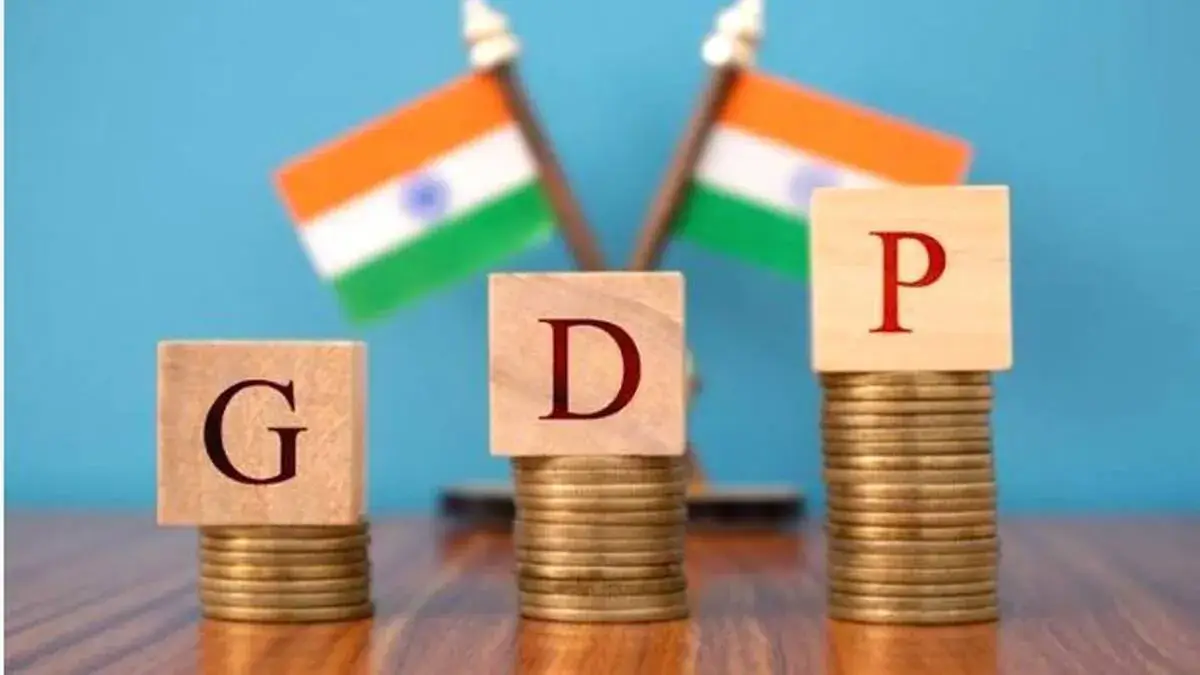
India’s latest growth number deserves some pride. Real GDP grew 7.8% in the April–June quarter, ahead of the Reserve Bank of India’s projection of 7%. It came at a difficult time: expensive energy, continuing turmoil in West Asia and weak growth across much of the developed world. The United States was growing at around 2% year-on-year, Europe at roughly 1%, China at 4.3%, while Japan was barely moving. Against that background, 7.8% is not an insignificant number. But pride should be exact, not loud.
It does not mean every Indian became 7.8% richer. It does not mean household budgets suddenly became easier, rents fell or vegetables became cheaper. GDP tells us something narrower and nevertheless important: India produced substantially more goods and services than it did a year earlier. More importantly, there was substance beneath the headline. Manufacturing grew 9.2%, services expanded at around 10%, and investment grew strongly. This was not merely consumption producing an attractive quarterly number. There was evidence of capacity being created.
Against this came an apparently contradictory message. Prime Minister Narendra Modi has been asking Indians to consider holidaying within India, holding weddings at home rather than in foreign destinations and avoiding unnecessary purchases of imported gold. The natural question is obvious: if India is growing at nearly 8%, why should Indians be told to conserve? The answer lies in a distinction that gets lost whenever GDP becomes the sole measure of economic strength. Growth and dollars are not the same thing.
GDP measures, broadly, what the economy produces. Foreign exchange is what India needs to pay the rest of the world. A rapidly expanding Indian economy requires enormous quantities of things that India still cannot produce sufficiently at home: crude oil, natural gas, electronic components, semiconductor equipment, industrial machinery, chemicals, fertiliser and advanced technologies. Many of these imports are not signs of economic weakness. Quite the opposite. They are among the inputs that make rapid growth possible. But they must still be paid for in foreign currency. Put simply, 7.8% growth does not automatically produce the dollars required to sustain 7.8% growth.
The trade numbers make the point better than rhetoric can. Between April and July, India exported roughly $174 billion of merchandise and imported about $292 billion, leaving a merchandise trade deficit approaching $119 billion. India’s formidable services sector repaired a large part of that gap, generating an estimated surplus of around $69 billion. India is certainly not running out of dollars; its foreign-exchange reserves remain substantial, and comparisons with the India of 1991 would be misplaced. The question today is subtler. It concerns the quality and economic purpose of foreign-exchange expenditure.
Every dollar spent importing machinery that expands productive capacity is economically different from a dollar spent purely on consumption. Crude oil keeps trucks moving, aircraft flying and factories operating. Semiconductor equipment may create tomorrow’s manufacturing capacity. Fertiliser supports agricultural production. These imports consume foreign exchange, but they also support current or future production. A discretionary purchase of imported gold that eventually rests in a household locker belongs to a different category.
Gold therefore deserves a more careful argument than simply calling it wasteful. India produces very little of what it consumes, and during April–July gold imports were about $15 billion, roughly a third higher than a year earlier. Yet India also has a substantial jewellery industry and jewellery exports, while gold remains deeply embedded in household savings and social custom. The distinction is not between “good imports” and “bad imports”. It is between foreign exchange that creates or supports productive capacity and foreign exchange spent on consumption that can reasonably be deferred. An additional necklace purchased because gold prices are rising does not have the same economic consequence as a machine imported to expand a factory.
The same principle applies, on a smaller scale, to overseas leisure and destination weddings. A wedding held in Kochi, Jaipur or Udaipur circulates expenditure through Indian hotels, caterers, florists, musicians, photographers, airlines, taxis and hundreds of workers. Move that celebration overseas and a significant portion of the expenditure becomes another country’s tourism receipt. The argument is not that Indians should stop travelling abroad, nor should economic policy become a sermon about how citizens may enjoy legitimately earned incomes. An increasingly prosperous society will naturally travel more. The relevant point is that domestic discretionary consumption generally carries lower foreign-exchange leakage and, particularly in tourism and hospitality, a considerable domestic employment multiplier.
Seen this way, the Prime Minister’s appeal is better understood as moral suasion rather than exchange control. There is some historical resonance here. Japan, South Korea, Taiwan and later China all passed through periods in which rapid domestic growth coexisted with intense concern over foreign exchange. Their economic ambitions initially exceeded their capacity to earn hard currency, and they responded by building manufacturing, exports and domestic technological capability. India today is in a very different and considerably stronger position: substantial reserves, a market-determined currency, globally competitive services exports and large remittance flows. We neither need nor should recreate the controls of an earlier age. But the underlying arithmetic has not disappeared.
That arithmetic also explains something that otherwise appears contradictory: a country can report excellent GDP growth while its currency remains under pressure. Domestic production determines one part of the economic story; the demand and supply of foreign currency determine another. Oil prices, merchandise deficits, portfolio movements, global interest rates and geopolitical risk can weigh on the rupee even while Indian factories, construction sites and offices are producing more. Strong GDP and a nervous rupee are not mutually exclusive.
There is, however, a limit to how far the argument about individual restraint should be carried. India cannot conserve its way to Viksit Bharat. Asking households to postpone a gold purchase or encouraging a family to hold its wedding in India may help at the margin, but these cannot substitute for economic policy. The durable solution is to reduce the foreign-exchange intensity of Indian growth while increasing the foreign-exchange earning capacity of the economy. That means producing more of the electronics, components and capital goods we currently import; improving energy security; developing semiconductor and advanced manufacturing capabilities; deepening domestic supply chains; and creating an Indian tourism product attractive enough that Indians choose it because it competes with the world, not merely because they have been exhorted to stay home.
Above all, it means exporting more. India’s services exports have become one of the great stabilisers of its external account. The next structural leap is to create a manufacturing sector capable of contributing to the external account on a comparable scale. A country aspiring to sustained growth of 7–8% cannot indefinitely depend upon imported energy, technology and capital equipment without simultaneously enlarging the pool of foreign exchange its own economy earns.
A growing company offers a useful analogy. A profitable business does not spend every rupee of cash merely because its income statement looks good. It preserves liquidity for the next machine, the next factory and the next opportunity. A growing country faces a vastly more complicated version of that discipline. So, there is nothing inconsistent about being proud of 7.8% growth while remaining careful about the external account. Indeed, the two thoughts belong together.
Be proud that India produced more when much of the world was struggling. Be particularly encouraged if manufacturing and investment are doing more of the lifting. But do not turn one strong quarterly GDP number into evidence that external constraints have disappeared. Equally, do not sneer at the growth number merely because the Prime Minister is simultaneously asking for restraint in discretionary foreign spending. Both propositions can be true. The scoreboard is strong. The purse still deserves attention.
Wed in India if you can. Holiday in India when India offers the experience you seek. Postpone the additional gold purchase if it is merely destined for another locker. But do not mistake these choices for the economic solution. The real test of India’s rise will not be whether it can produce another 7.8% quarter. It will be whether an economy growing at 8% can increasingly earn the dollars that an 8% economy needs. That is when a strong scoreboard and a strong purse finally become the same story.















 HOME
HOME LATEST
 NOTIFIED NEWS
 POLL
POLL KERALA
  EDITORIAL
  INDIA
INDIA  WORLD
WORLD  BUSINESS
  CINEMA
  SPORTS
  LIFESTYLE
  SPECIAL
  SCIENCE & TECHNOLOGY
 |
|