

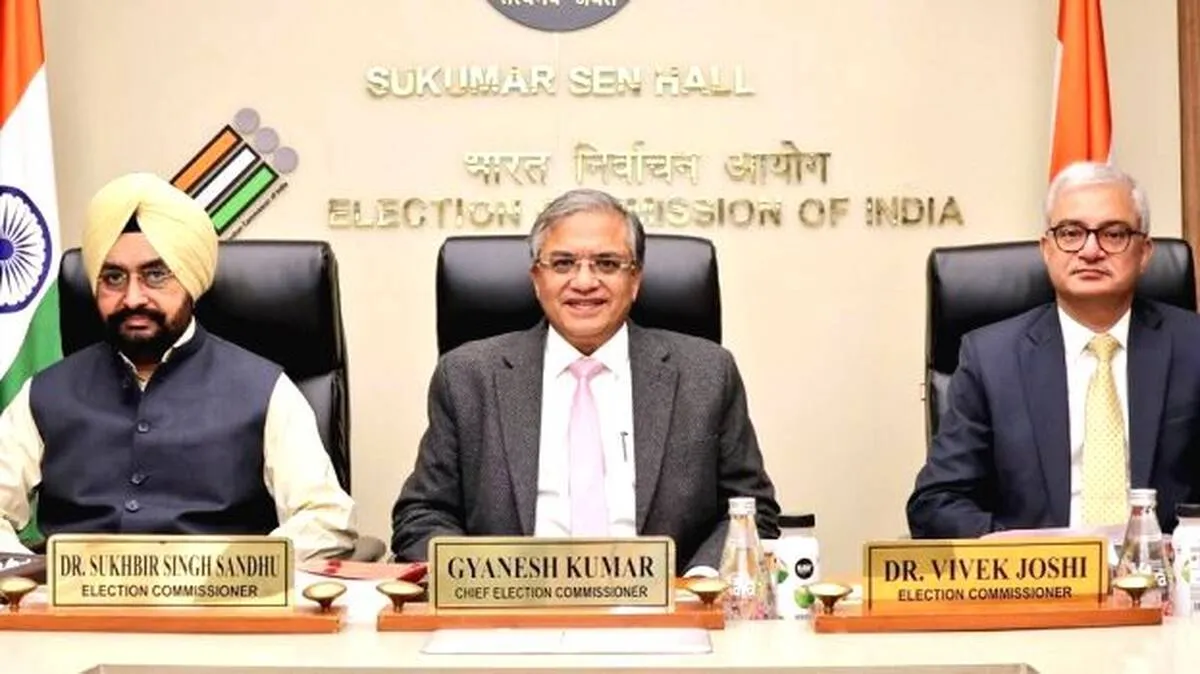
NEW DELHI: The Supreme Court’s observations on the independence of the process for appointing Election Commissioners came on a day when the Election Commission was also facing scrutiny over reported differences among its three members.
Opposition parties had alleged that Election Commissioners Sukhbir Singh Sandhu and Vivek Joshi were kept out of the loop on decisions concerning the Special Intensive Revision (SIR) process and accused Chief Election Commissioner Gyanesh Kumar of taking decisions without adequately consulting his colleagues. The allegations followed reports that the two commissioners had formally recorded objections to several decisions and orders over a 10-month period.
Justice Dipankar Datta observed that it was not enough for the Election Commission to be independent and that it must also appear to be independent. The observation came while the court was hearing public interest litigations challenging the Chief Election Commissioner and Other Election Commissioners (Appointment, Conditions of Service and Term of Office) Act, 2023.
The two judges hearing the matter differed on whether the challenge to the 2023 law should be referred to a five-judge Constitution Bench. Justice Datta held that the petitions did not warrant a reference to a larger bench, while Justice Satish Chandra Sharma held that they raised a substantial constitutional question requiring consideration by a Constitution Bench. Following the split, the matter was placed before the Chief Justice of India to consider whether a Constitution Bench of appropriate strength should be constituted.
Meanwhile, reports emerged that Sandhu and Joshi had written separately to Cabinet Secretary T.V. Somanathan over changes in work allocation concerning the Election Commission’s IT infrastructure. They said the changes had been made without their knowledge or approval. The two commissioners had formally recorded objections at least 14 times over 10 months to decisions and orders they said had been taken or issued without their knowledge.
The three-member Election Commission’s September 9 meeting was its first full meeting in four months. Under the 2023 law, the Commission’s business is to be transacted unanimously as far as possible. Where the members differ, the matter is decided according to the majority view.
Opposition parties subsequently demanded Gyanesh Kumar’s removal or resignation. The Election Commission, however, said differences of opinion and written observations were part of normal deliberations in a multi-member constitutional body and maintained that its decisions, including those relating to the SIR, had been unanimous.
1. Changes to Form 6
Form 6, the statutory form used by new voters to apply for inclusion in the electoral roll, was changed in July to include questions linking the applicant to the electoral roll of the last SIR held in the early 2000s. Applicants were asked whether their own name, or the name of a parent or grandparent, appeared in that roll. Although the section was not marked mandatory, applicants could not proceed with submission without answering it.
Election Commissioner Vivek Joshi had objected in May that Form 6, being a statutory form prescribed under the Registration of Electors Rules, 1960, could not be changed in this manner without an amendment to the rules. Election Commissioner Sukhbir Singh Sandhu subsequently agreed with him on file. The change was nevertheless implemented in July.
2. Appeals and voter verification in West Bengal
In West Bengal, around 60 lakh electors were placed under adjudication during the SIR process. After judicial officers appointed under Supreme Court directions adjudicated the cases, around 33 lakh electors were cleared for inclusion, while about 27 lakh were excluded.
The Election Commission subsequently faced questions over appeals filed against decisions clearing voters for inclusion in the rolls. Sandhu sought to know who had authorised such appeals, but, according to the report, did not receive a response.
3. Access to the electoral-roll database
The commissioners raised concerns over the functioning and control of the Election Commission’s electoral-roll IT systems, including ERONet and the newer ECINet platform into which electoral-roll functions have been integrated.
Electoral-roll preparation is carried out at the constituency level by statutory authorities including Electoral Registration Officers (EROs). Sandhu and Joshi raised concerns that the access of such officials to the electoral-roll database had been restricted and that control was becoming increasingly centralised at the Commission’s IT division in Delhi. Sandhu recorded that several officials had complained of not having proper and complete access to the system and said their ability to perform their statutory duties had been curtailed by centralised control.
The commissioners also sought an audit of the system and raised concerns over the integrity and control of access to the electoral-roll database. Joshi proposed that an outside IIT expert be involved in an audit to verify that only the concerned statutory authorities had credentials to alter the electoral-roll database.
4. Change in IT-related work allocation
Towards the end of July, an official was given charge of the Commission’s Administration Division and issued a work-allocation order affecting supervision of its IT infrastructure.
The two Election Commissioners separately wrote to Cabinet Secretary T.V. Somanathan, describing the move as a violation of the law governing the Commission and seeking appropriate action. The following day, they jointly set aside the order and directed that the previous work allocation continue until the Commission reached a consensus on any change.













 HOME
HOME LATEST
 NOTIFIED NEWS
 POLL
POLL KERALA
  EDITORIAL
  INDIA
INDIA  WORLD
WORLD  BUSINESS
  CINEMA
  SPORTS
  LIFESTYLE
  SPECIAL
  SCIENCE & TECHNOLOGY
 |
|