


Few things are more annoying than your internet slowing down at the worst possible moment. One minute you're in an important video call or watching your favourite series, and the next you're staring at the buffering icon.
If certain parts of your home seem to have weak Wi-Fi, your first instinct might be to buy a range extender or invest in a mesh system. But before spending money, there's a surprisingly simple experiment you can try using something most households already have: aluminium foil.
It sounds like one of those internet myths, but there's actually some science behind it.
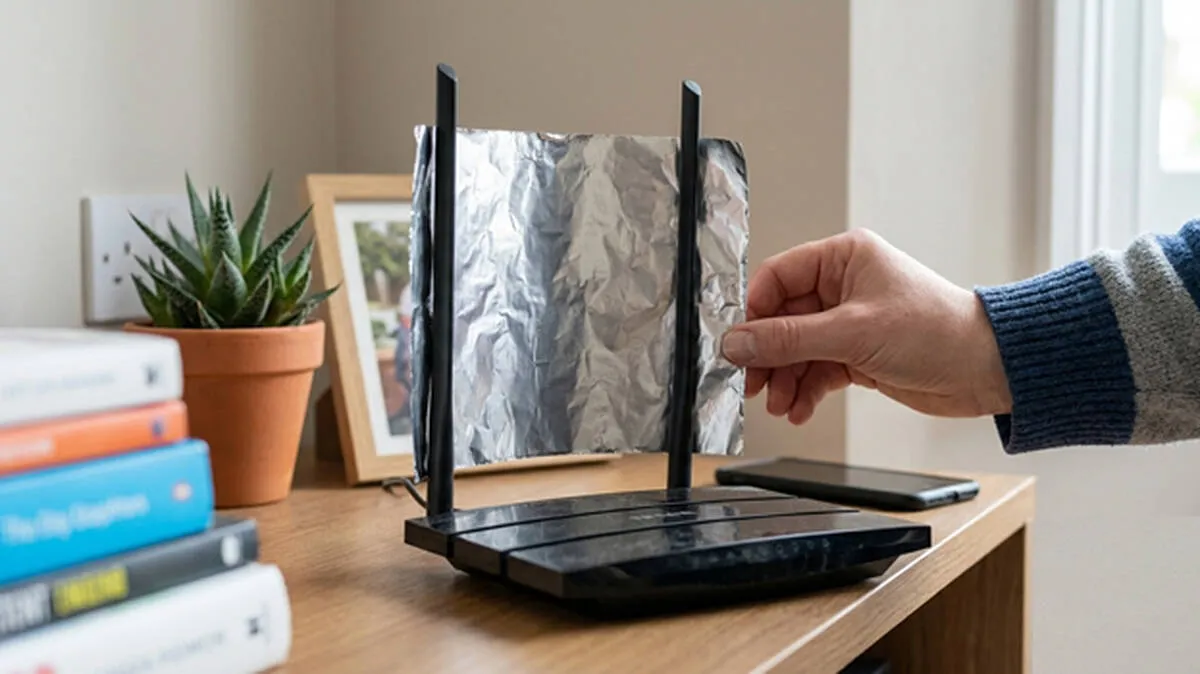
The idea is to place a curved sheet of aluminium foil behind your router's antenna—or behind the router itself if it has internal antennas—to redirect some of the wireless signal towards the rooms where you need better coverage.
Wi-Fi signals spread out in multiple directions. If your router sits against a wall, part of that signal is effectively wasted by travelling into the wall or empty space. A reflective surface can bounce some of those radio waves back towards the living areas of your home instead.
It's important to note that this doesn't make your router more powerful. It simply attempts to send more of the existing signal in a particular direction.
Making a reflector takes only a few minutes.
There's no guarantee of dramatic results, but if your router is positioned near a wall, it may be worth experimenting with different angles to see what works best.
The principle behind the hack has been studied by researchers.
Scientists at Dartmouth College developed a project called WiPrint, which used specially designed 3D-printed reflectors coated with a thin metallic layer to shape indoor Wi-Fi signals. Their research showed that carefully designed reflectors could improve signal strength and data throughput in selected areas while reducing unnecessary signal elsewhere.
That said, don't expect a homemade foil reflector to perform like the versions used in the research. The Dartmouth reflectors were precisely engineered using computer models, while a cardboard-and-foil version is a rough approximation. Whether it helps—and by how much—depends on factors such as your router, where it's placed, your home's layout and nearby sources of interference.
A sheet of aluminium foil won't eliminate every dead zone, double your internet speed or replace dedicated networking hardware.
If your broadband connection itself is slow, no reflector can fix that. Likewise, larger homes or buildings with thick walls may still need a mesh Wi-Fi system or a range extender for reliable coverage.
For the biggest improvement, networking experts continue to recommend placing your router in a central, elevated location, keeping it away from large metal objects and appliances, and ensuring its firmware is up to date.
Still, if you've got a spare piece of cardboard and some aluminium foil lying around, there's little harm in giving the experiment a go. It costs next to nothing, takes only a few minutes, and in the right setup, you might notice a small but worthwhile improvement in the rooms where you need a better Wi-Fi signal.















 HOME
HOME LATEST
 NOTIFIED NEWS
 POLL
POLL KERALA
  EDITORIAL
  INDIA
INDIA  WORLD
WORLD  CINEMA
  SPORTS
  LIFESTYLE
  SPECIAL
  SCIENCE & TECHNOLOGY
 |
|