


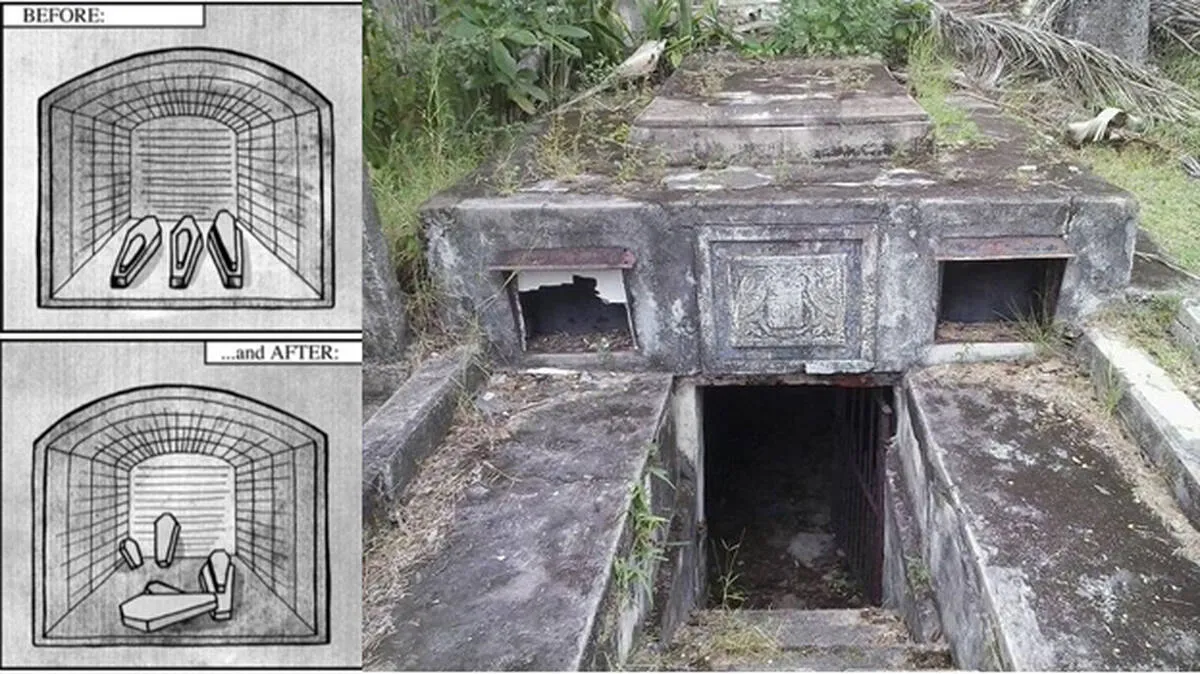
Barbados is world-famous for its sun-drenched beaches, turquoise waters, and vibrant Caribbean culture. But tucked away in the cemetery of Christ Church Parish Church in Oistins lies a macabre historical puzzle that has baffled investigators, historians, and ghost hunters for over two centuries: the Chase Vault.
This massive underground tomb, constructed of solid coral rock and marble, is the setting for one of the most enduring ghost stories in maritime history—a real-life locked-room mystery where the only suspects are the dead themselves.
Shocking discovery in 1812
The bizarre saga began on August 9, 1812. The vault was opened to receive the body of Colonel Thomas Chase, a wealthy and notoriously disliked British settler. Because the vault was partially subterranean and sealed with a massive, heavy marble slab that required several men to move, it was assumed to be entirely secure.
But when the workmen pushed back the stone door, they were met with a sight that chilled them to the bone.
The vault already housed three of Thomas’s family members: his infant daughter Mary Ann and his 12-year-old daughter Dorcas. Instead of lying side-by-side in peaceful repose, the heavy lead coffins had been violently tossed out of their positions. They lay scattered across the floor in complete disarray.
Crucially, while the coffins had been moved, none of them had been broken into, vandalized, or robbed. Mystified, the undertakers rearranged the coffins, placed the Colonel inside, and resealed the heavy stone entrance.
Pattern repeats
If the 1812 incident was a fluke, what happened over the next few years turned it into an outright panic.
Every few years, the vault was opened to inter another deceased relative, and every single time, the same chaotic scene played out. Even the Colonel’s massive, lead-lined coffin—which required several grown men just to lift—was found thrown across the chamber.
Investigating authorities quickly ruled out the obvious explanations:
Governor’s trap
By 1819, the rumors had reached the highest levels of colonial society. The Governor of Barbados, Lord Combermere, decided to intervene personally. He attended the burial of another family member that year and took extreme precautions to catch whoever—or whatever—was responsible.
After the coffins were neatly reset, the Governor ordered fine white sand to be scattered across the vault floor so that any future intruders would leave footprints. The heavy door was then cemented shut, and the Governor himself pressed his official seal into the wet mortar.
Nearly a year later, in 1820, fueled by intense public curiosity, Lord Combermere returned to open the vault.
The concrete seal was perfectly intact. The lock had not been touched. Yet, when they opened the door, the scene inside was pure chaos. The coffins were scattered once again, with one even leaning upright against the wall.
The twist? The sand on the floor was completely undisturbed. There were no footprints, no drag marks, and no signs of water damage.
Fact or 19th-century clickbait?
Terrified by the ongoing phenomena, the Chase family decided they had seen enough. They evacuated the vault, buried their relatives in separate, traditional graves elsewhere, and left the tomb wide open. It remains empty to this day.
Naturally, skeptics and scientists have tried to debunk the mystery. Some blame localized earthquakes, while others suggest that water leaked into the vault during heavy rains, causing the lead coffins to float and drift around. However, the lack of water damage or mud inside the vault makes the flooding theory highly unlikely.
Today, the tale of the moving coffins is largely treated as a classic urban legend. Skeptics point out a major red flag: there are no surviving contemporary newspaper articles or official parish burial records from that exact era that explicitly mention the moving coffins. Some historians believe the entire story might have been an elaborate piece of 19th-century fiction or a Masonic allegory that somehow transformed into local history.
Real or fabricated, the empty Chase Vault still stands in Barbados, an eerie monument to a mystery that refuses to stay buried.













 HOME
HOME LATEST
 NOTIFIED NEWS
 POLL
POLL KERALA
  EDITORIAL
  INDIA
INDIA  WORLD
WORLD  BUSINESS
  CINEMA
  SPORTS
  LIFESTYLE
  SPECIAL
  SCIENCE & TECHNOLOGY
 |
|