

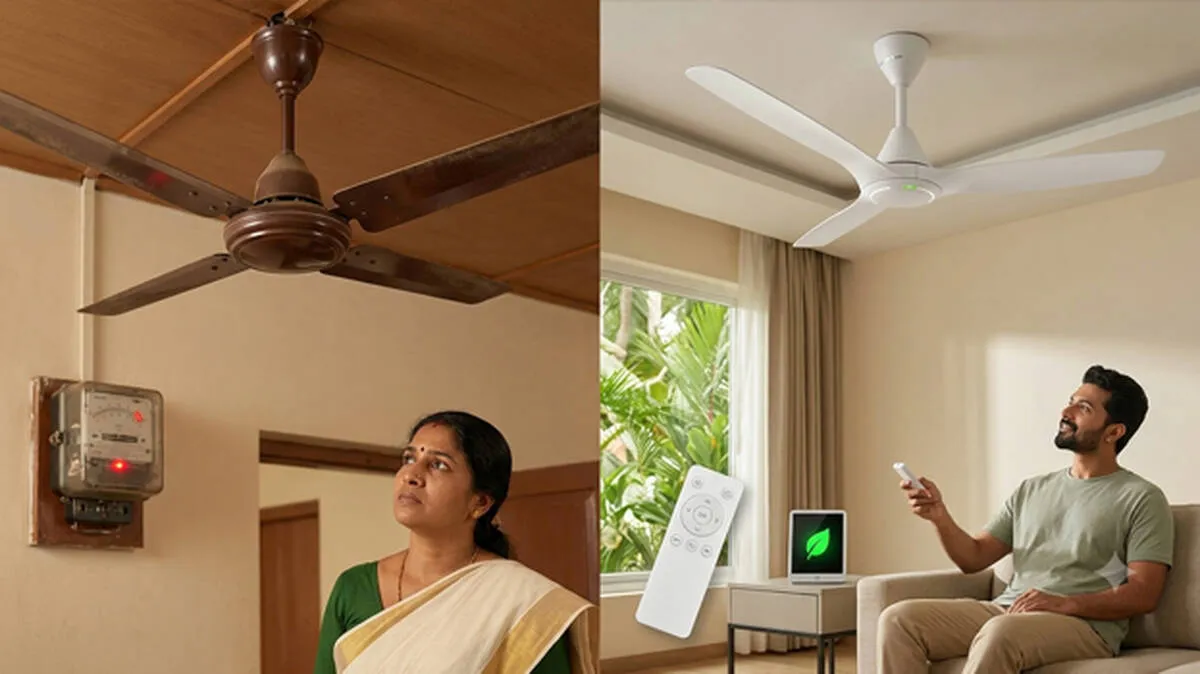
The Energy Management Centre in Thiruvananthapuram is championing a statewide push toward energy-efficient BLDC fans, giving households a practical way to shrink their monthly electricity bills while easing overall power consumption.
As households continuously look for ways to manage mounting utility costs, the answer might be hanging right above our heads. In an effort to curb escalating power consumption, the Energy Management Centre (EMC), operating under the Department of Power, has rolled out a targeted campaign encouraging residents to swap their traditional ceiling fans for advanced Brushless Direct Current (BLDC) models.
For the average household, which typically runs around three ceiling fans simultaneously, the shift promises a significant dent in power usage and noticeable relief on utility bills.
The primary driver behind this initiative is the stark contrast in energy efficiency between conventional fans and modern alternatives. A standard traditional fan requires roughly 74 watts of electricity to operate. In contrast, a BLDC fan demands a mere 28 to 35 watts, cutting energy consumption by more than half. When multiplied across multiple rooms and thousands of households in Thiruvananthapuram and beyond, this collective transition creates a massive drop in overall energy demand during peak usage cycles.
Making the switch has also become increasingly accessible for consumers. Quality BLDC fans are currently available in the market starting at around 2,500 rupees. To make adoption even smoother, authorities are implementing promotional schemes where consumers can trade in their old, power-hungry fans. Major manufacturers are participating by offering up to 50 percent discounts in exchange for older units.
The secret to this high-efficiency performance lies under the casing. While traditional ceiling fans rely on induction motors running directly on alternating current (AC)—which naturally generate higher friction and excess heat—BLDC fans utilise an advanced brush-free direct current motor paired with a smart controller.
The system takes incoming AC current, converts it into DC power, and then feeds it efficiently into the motor. Because the design eliminates the internal brush friction that wastes energy as heat, the appliance runs cooler and consumes far less power. Beyond energy savings, these modern units come with a suite of consumer-friendly perks: whisper-quiet operation, remote control functionality, and the distinct advantage of running for significantly longer periods on home inverters during power outages.
As energy demands fluctuate and environmental pressures grow, experts emphasise that individual choices matter just as much as grid-level adjustments.
"If we use electricity carefully, the energy crisis can be resolved to a large extent," notes Dr. R. Harikumar, Director of the EMC.
By encouraging consumers to modernise a household staple that runs for hours every single day, the EMC’s campaign offers a clear blueprint for sustainable living—proving that sometimes, the most effective path to energy conservation is simply a smarter spin on the everyday.














 HOME
HOME LATEST
 NOTIFIED NEWS
 POLL
POLL KERALA
  EDITORIAL
  INDIA
INDIA  WORLD
WORLD  BUSINESS
  CINEMA
  SPORTS
  LIFESTYLE
  SPECIAL
  SCIENCE & TECHNOLOGY
 |
|