

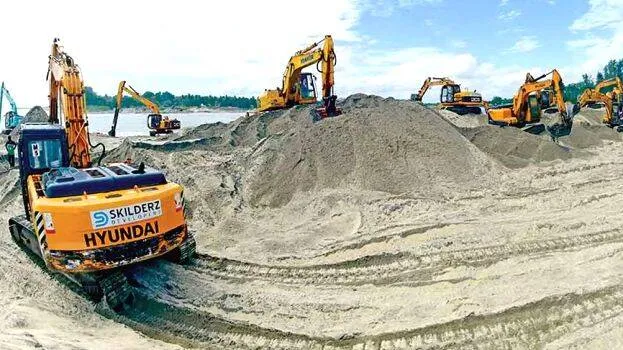
KOLLAM: As the 500 MW fast breeder reactor at the Kalpakkam nuclear power plant attained criticality, the Kollam coastal region is once again the centre of the country's attention. The coastal region from Neendakara to Kayamkulam is the centre of black sand deposits rich in rare minerals, including Thorium. As a result of the change in sea currents after the tsunami, the mineral deposits in the coastal region have spread to the Thottappally area of Alappuzha district.
State PSU Kerala Minerals and Metals Ltd (KMML) has invited global tenders for the technology to extract thorium. Central government agency Indian Rare Earth is extracting it on a limited scale.
Thorium is obtained when monazite is processed from black sand. KMML estimates that one tonne of black sand contains 0.6% thorium. Only the central public sector undertaking, Indian Rare Earths Limited, and the state public sector undertaking KMML are currently engaged in mineral mining.
KMML extracts minerals such as ilmenite, rutile, sillimanite and zircon from black sand. Ilmenite is mainly used to produce titanium dioxide pigment, a raw material for paint manufacturing. Rare earths are extracted from IRE monazite and supplied to various industrial enterprises.
The black sand, which is left after separating minerals such as ilmenite, rutile, sillimanite, and zircon, contains about 10% monazite. KMML has dug giant pits near the factory and stored about 1.5 lakh tons of this sand.
40 per cent thorium can be obtained from the processed monazite. KMML has stored sand to separate 6000 tonnes of raw thorium. From this, 3000 tonnes of pure thorium can be obtained.
KMML separates 5-10 tonnes of monazite sand per day. Apart from being used as fuel in nuclear reactors, the minerals separated from monazite are also used in the defence, space exploration and aviation sectors to make permanent magnets for motors of electric vehicles and wind turbines.









 HOME
HOME LATEST
 NOTIFIED NEWS
 POLL
POLL KERALA
  EDITORIAL
  INDIA
INDIA  WORLD
WORLD  CINEMA
  SPORTS
  LIFESTYLE
  SPECIAL
  SCIENCE & TECHNOLOGY
 |
|