

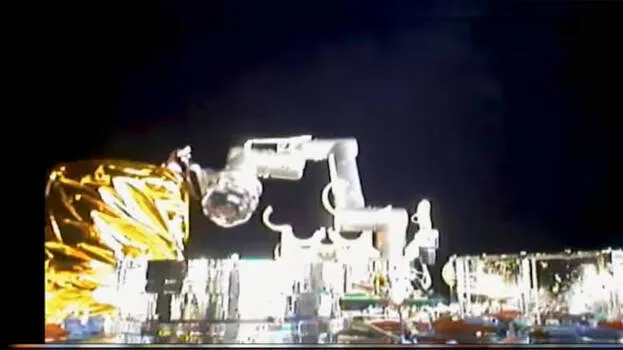
THIRUVANANTHAPURAM: ISRO has taken a significant step towards building its own space station with the successful testing of a robotic arm. The robotic arm called the Relocatable Robotic Manipulator was developed at the Inertial Systems Unit in Vattiyoorkavu, Thiruvananthapuram.
Meanwhile, the docking of twin satellites launched for assembly in space is scheduled for Tuesday, between 9:00 AM and 10:00 AM. This experiment is a precursor to the establishment of the space station. The twin satellites were launched using a PSLV rocket, and its defunct fourth stage was repurposed as a platform to test the robotic arm.
These robotic arms, known as Space Robotic Arms, are essential for performing various functions while the space station orbits Earth. They will be used to capture objects sent to the station and place them at designated locations, as well as to remove debris floating around the station. The technology is also crucial for repair and maintenance tasks. In the future, the system can even be used to refuel spacecraft.
The robotic arm is equipped with cameras, sensors, and specially designed software for monitoring and operations. It operates using a digital twin model, which enables precise simulation and control. This advanced technology is currently available to only a few countries in the world.
Robotic arm rotates up to 180 degrees
Cowpea seeds sprout in space
The PSLV Orbital Experimental Module (POEM-4) is conducting 24 experiments, including germinating cowpea seeds in space. The cowpea seeds sprouted in a small cabin that mimicked Earth's atmosphere. There are necessary levels of oxygen and carbon dioxide in this cabin. The cabin is equipped with cameras for monitoring. The seeds sprouted in four days, marking a historic achievement. However, the limited supply of carbon dioxide will be depleted in a few days, leading to the eventual death of the seedlings.
This experiment aims to study how plants regulate their growth in response to gravity, sunlight, and other environmental factors in space. The experiment was made possible using the Compact Research Module for Orbital Plant Studies, developed by VSSC (Vikram Sarabhai Space Centre) in Thumba.
Distance between satellites reduced to 5 km








 HOME
 LATEST
 NOTIFIED NEWS
 POLL
 KERALA
 EDITORIAL
 INDIA
 WORLD
 BUSINESS
 CINEMA
 SPORTS
 LIFESTYLE
 SPECIAL
 SCIENCE & TECHNOLOGY

 |