


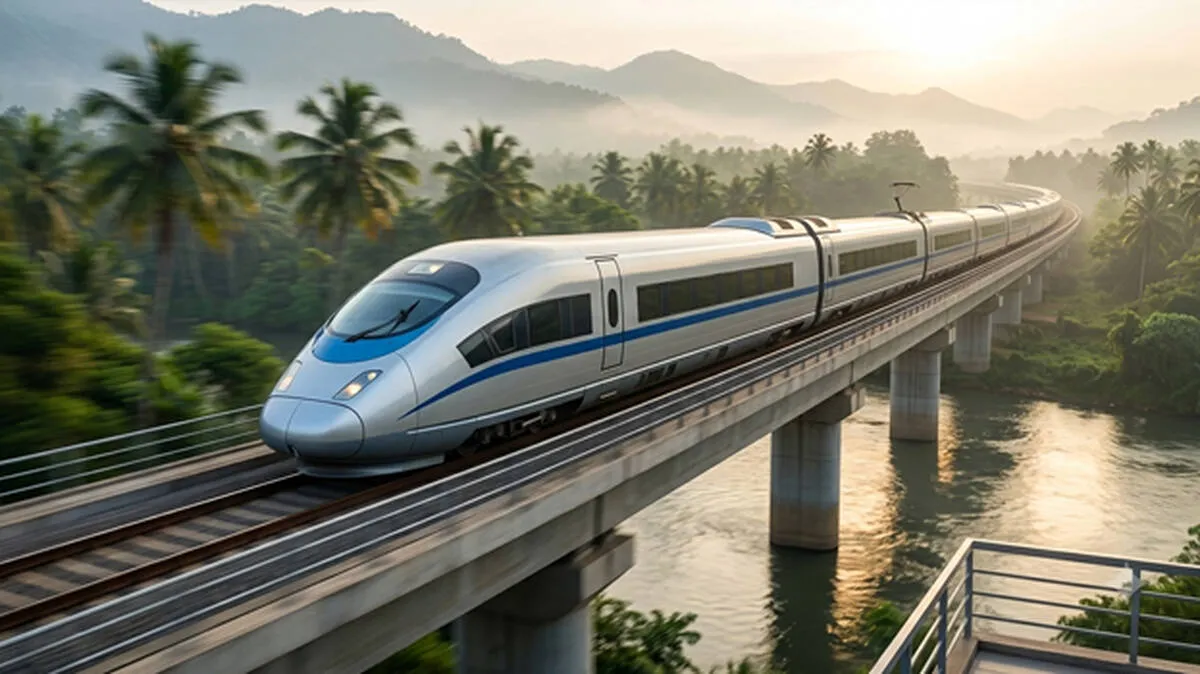
THIRUVANANTHAPURAM: The proposed high-speed rail corridor connecting Thiruvananthapuram and Kannur will raise 40 percent of its total estimated cost of ₹60,000 crore through public share participation. According to the project proposal submitted to the Kerala Chief Minister by E. Sreedharan, approximately ₹24,000 crore will be mobilised from the public, including non-resident Keralites (NRIs), utilising a crowdfunding model. The high-speed rail project is envisioned as an alternative to the SilverLine project, which was previously abandoned following public protests.
The remaining 60 percent of the project cost will be shared between the Central and State governments in a 51:49 ratio. Under this arrangement, the Central government will contribute ₹18,360 crore, while the Kerala state government will provide ₹17,640 crore over a five-year construction period. The state's annual commitment will amount to ₹3,528 crore, which will encompass land acquisition costs, royalty exemptions on construction materials, and tax concessions, thereby minimising the direct financial burden on the state exchequer.
The funding strategy is modeled after successful public-private partnership ventures in the state, such as Cochin International Airport Limited (CIAL) and Kannur International Airport. CIAL, which was established in 1994 and currently commands a market value exceeding ₹25,000 crore, features extensive retail investor participation across 30 countries. The new rail project expects a daily ridership of 2.28 lakh passengers and projects an initial annual return of 8.09 percent for investors. Sreedharan noted that the total economic growth rate of the project could reach 20.01 percent when accounting for new employment and business opportunities.
Covering a distance of 473.2 kilometers, the high-speed rail will reduce the travel time between Thiruvananthapuram and Kannur to three and a half hours, operating at speeds of 200 kilometers per hour. The estimated construction cost stands at ₹120.5 crore per kilometer, with the project expected to yield annual fuel savings worth ₹3,500 crore. Sreedharan described the efficiency of the high-speed rail network as equivalent to a nine-lane highway.
Future expansions are also under consideration to extend the corridor to Kasaragod and further to Mangaluru in collaboration with the Karnataka government. This expansion could integrate the route with the 'Mission Samudra' initiative, creating a dedicated rail link connecting the Vizhinjam and Mangaluru ports. The network is designed to link the major airports of Thiruvananthapuram, Nedumbassery, and Karipur, ensuring comprehensive multi-modal connectivity across the region.















 HOME
HOME LATEST
 NOTIFIED NEWS
 POLL
POLL KERALA
  EDITORIAL
  INDIA
INDIA  WORLD
WORLD  BUSINESS
  CINEMA
  SPORTS
  LIFESTYLE
  SPECIAL
  SCIENCE & TECHNOLOGY
 |
|