

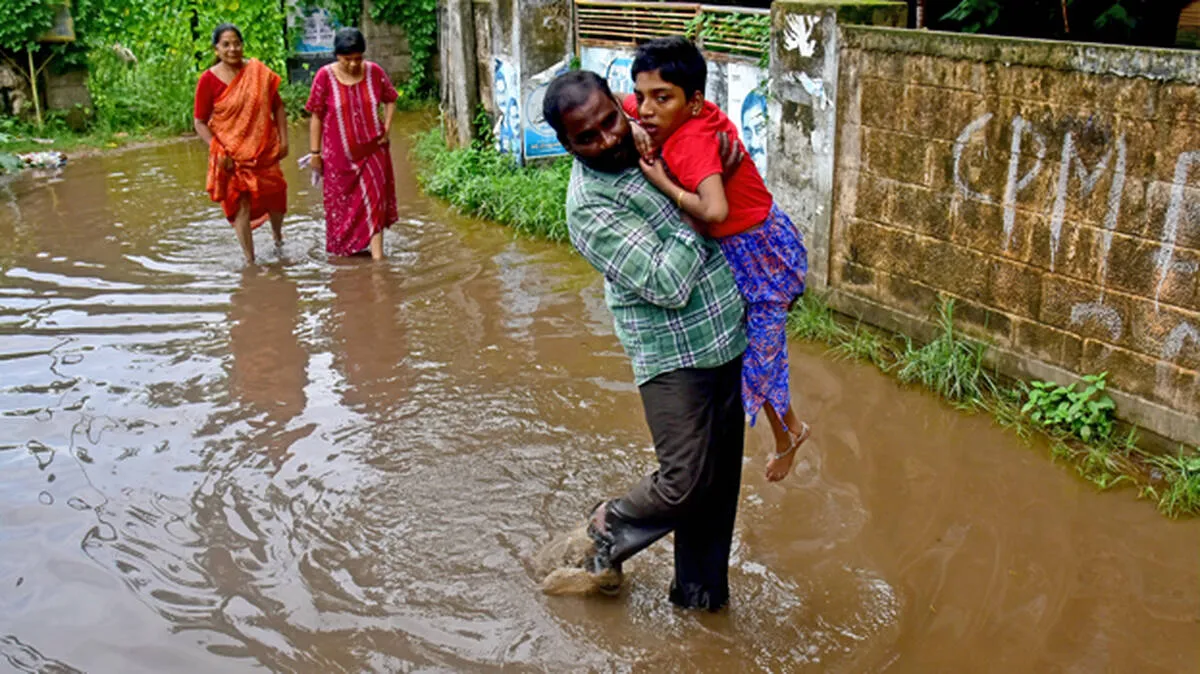
THIRUVANANTHAPURAM: The torrential rains currently lashing the capital city have produced many striking visuals, but none pierce the heart quite like the image captured here. At first glance, it is a picture of a father wading through muddy water with his child. Behind it, however, lies an unending downpour of human suffering, bureaucratic apathy, and a family’s desperate fight for survival.
The child in the photograph is 17-year-old Sneha. Born with 85% cerebral palsy, her life is a fragile tightrope of medical crises. Since she suffers from frequent, severe seizures, emergency trips to the hospital are a regular necessity for her family.
However, getting medical help for Sneha requires a harrowing trek. The road leading to their rented house floods at the slightest hint of rain. In the image, her father, Murugan, is seen wading through a slurry of mud and contaminated wastewater overflowing from the nearby Pettah railway tracks, carrying his completely dependent teenage daughter in his arms. Because the local infrastructure is so severely neglected, ambulances cannot reach their doorstep; the closest an emergency vehicle can get is 200 meters away.
The physical toll of this daily struggle is matched only by the crushing financial weight on the family. Murugan was a headload worker, but a recent major throat surgery left him physically incapable of lifting heavy loads. To keep the kitchen fire burning, he now takes up sporadic, low-paying day labour alongside local painters.
His wife, Divya, must remain at home around the clock to provide intensive care for Sneha, making it impossible for her to seek employment. Living with them in their cramped rented house near the Pettah Moonnam Manackal Bhagavathy Temple is Divya’s elderly mother, Seethalakshmiyamma, who witnesses the family's daily descent into poverty.
The mathematics of their survival simply do not add up. They are forced to find 7,000 rupees every single month just to cover the rent of their small home, alongside an additional 5,000 rupees strictly required for Sneha’s medical treatments. This base cost of 12,000 rupees completely dwarfs Murugan's irregular daily wages, a reality that became painfully clear when the Kerala State Electricity Board recently sent workers to cut off their power over unpaid bills.
Driven by desperation, Sneha’s elderly grandmother, Seethalakshmiyamma, took Sneha’s younger sister, Jyothi—a ninth-class student—and walked directly to the State Secretariat. Their goal was to personally meet the Chief Minister, hoping that a direct appeal might move officials to intervene.
They were turned away without an audience.
"We have gone everywhere," Seethalakshmiyamma said, her voice heavy with betrayal. "We directly met the local ward councillor, the City Mayor, and the District Collector. We pleaded our case. But not a single person has turned back to look at us or offer a shred of help."
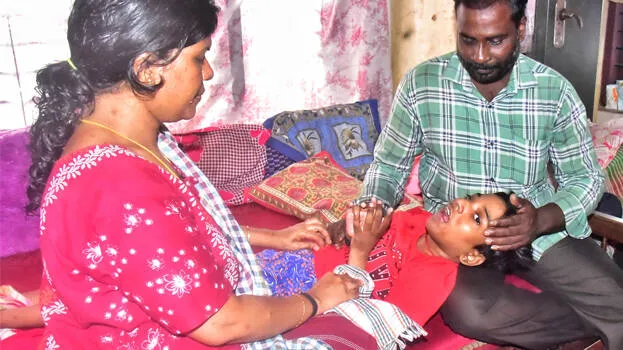
For Sneha, the world is becoming smaller, darker, and more terrifying by the day.
In addition to severe hearing loss, she recently lost all vision in her left eye due to ruptured nerves. Now, a rapidly progressing cataract is stealing the remaining vision from her right eye.
Living so close to the railway tracks adds a psychological element to her torture. Unable to process the world around her, Sneha wakes up in utter panic at the booming roar of passing trains, often screaming in terror. Her medical condition is highly unstable; her sodium levels frequently drop to critical depths, plunging her into unconsciousness, which invariably triggers a fresh wave of violent seizures.







 HOME
HOME LATEST
 NOTIFIED NEWS
 POLL
POLL KERALA
  EDITORIAL
  INDIA
INDIA  WORLD
WORLD  BUSINESS
  CINEMA
  SPORTS
  LIFESTYLE
  SPECIAL
  SCIENCE & TECHNOLOGY
 |
|