


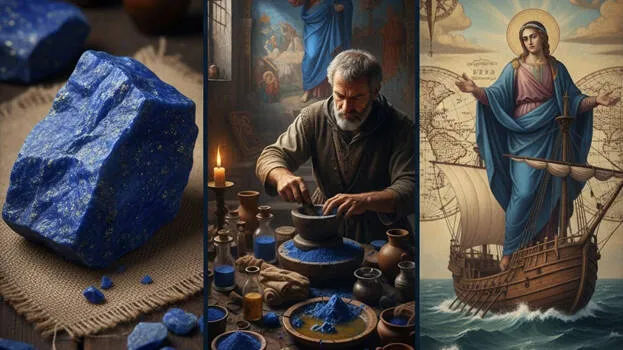
Have you ever wondered if a simple colour could be worth more than a fortune? We often measure luxury in gold and diamonds, but history hides a secret shade that once left kings and artists alike struggling to afford even a small dab of it. Meet Ultramarine Blue—the legendary "blue gold."
Centuries ago, if you wanted to paint with the most intense, vibrant blue, you couldn't just head to a store. You had to look toward the remote, rugged mountains of Afghanistan. Hidden deep within the Badakhshan province lies the world's oldest source of Lapis Lazuli—a mesmerising stone that looks like a midnight sky sprinkled with stardust.
But here is where the story gets truly fascinating. Turning this rock into a paint pigment wasn't just craftsmanship; it was an ordeal. The process was so agonisingly slow and complex—involving endless grinding, washing, and chemical purification—that artists often spent more on this single colour than they did on their homes. In fact, it was so precious that during the Middle Ages, the elite would reserve it only for the most sacred subjects, like the robes of religious figures, as a sign of ultimate devotion and status.
The name itself carries a sense of wonder. Called ultramarinus—meaning "beyond the sea"—this color traveled thousands of miles across oceans to reach Europe. Today, while we have synthetic alternatives, the story of the original natural pigment remains one of the art world’s greatest tales of obsession and luxury. It serves as a reminder that sometimes, the most priceless things on earth aren't just found in a vault; they are born from the earth and refined through pure human dedication.















 HOME
HOME LATEST
 NOTIFIED NEWS
 POLL
POLL KERALA
  EDITORIAL
  INDIA
INDIA  WORLD
WORLD  CINEMA
  SPORTS
  LIFESTYLE
  SPECIAL
  SCIENCE & TECHNOLOGY
 |
|