


Has India merely become a larger economy over the past decade, or has it become a stronger state?
That, in my view, is the more important question.
Public discourse often gets reduced to GDP growth, inflation, elections, welfare schemes or individual policy decisions. Important though they are, these are outcomes. They do not fully capture the underlying strength of a nation. As a practicing Chartered Accountant, I have always believed that numbers tell only part of the story. A company may report impressive profits on paper, yet remain fundamentally fragile. Its true strength lies in the quality of its governance, systems, people and resilience. Nations are no different. GDP is the profit and loss account; state capacity is the balance sheet.
This distinction becomes particularly significant when viewed against India’s recent history. In 2013, India was grouped among the world’s “Fragile Five” economies - countries considered vulnerable to external financial shocks due to high inflation, a widening Current Account Deficit, slowing investment, a weakening rupee and dependence on volatile capital flows. Twelve years later, India is widely regarded as one of the fastest-growing major economies and an increasingly influential geopolitical power. The real question, therefore, is not simply whether India has grown, but whether it has become structurally stronger.
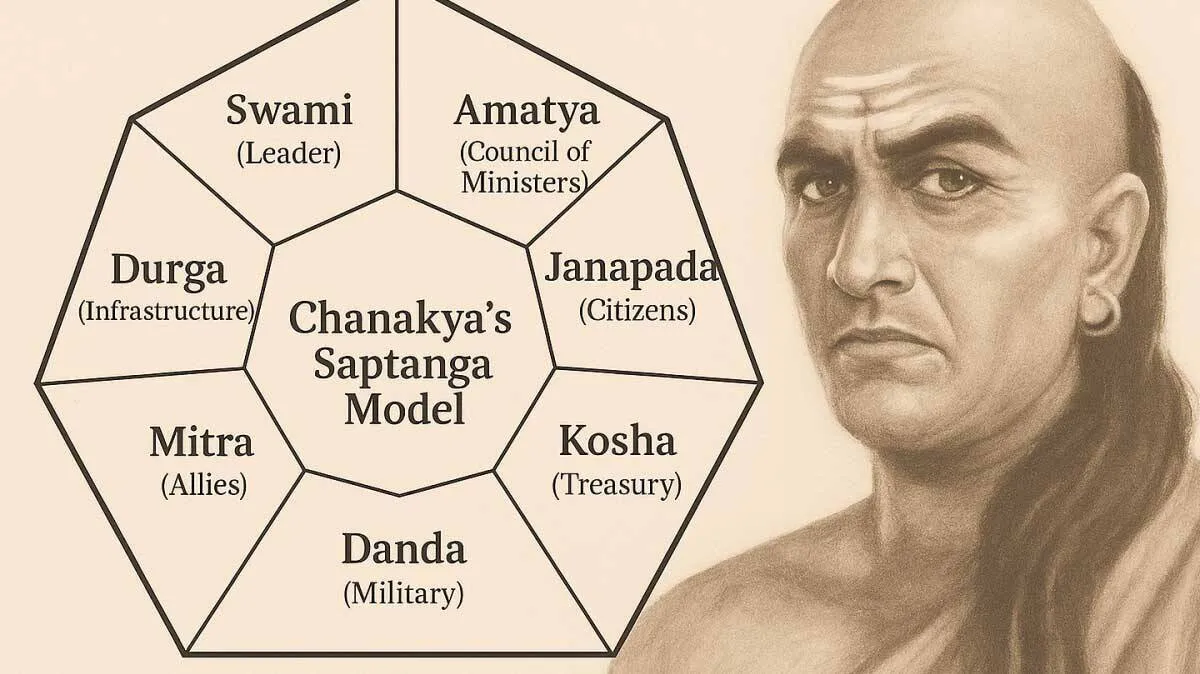
More than 2,300 years ago, Chanakya answered precisely this question in the Arthashastra. He argued that the strength of a state rests not upon wealth or military power alone, but upon the harmonious functioning of seven interdependent pillars - Swami (Leadership), Amatya (Institutions), Janapada (People), Durga (Infrastructure), Kosha (Treasury), Danda (Security) and Mitra (Alliances).
If Chanakya were to audit India today, how would the Republic fare?
Swami: Leadership with Direction
Chanakya expected the ruler to think beyond day-to-day administration and focus on strengthening the kingdom over generations. Leadership, in his conception, was measured not by popularity but by the willingness to take difficult decisions whose benefits would become evident only over time.
Judged by that standard, the past decade has witnessed several long-pending structural reforms. The Goods and Services Tax (GST), the Insolvency and Bankruptcy Code (IBC), corporate tax rationalization, direct benefit transfers, digital public infrastructure and sustained capital expenditure on infrastructure represent policy choices aimed at strengthening the economy’s long-term foundations.
Whether one agrees with every reform or not, there is little doubt that governance has increasingly adopted a longer planning horizon than was often evident in earlier decades.
Amatya: Institutions that deliver
Good policies are only as effective as the institutions that implement them.
Chanakya recognized that competent administrators and robust institutions transform vision into measurable outcomes. Perhaps the most underappreciated change over the past decade has been the improvement in execution.
Aadhaar-enabled governance, UPI, Digital Public Infrastructure and Direct Benefit Transfers exceeding Rs 34 lakh crore have significantly reduced leakages while improving transparency and delivery. The GST Council has emerged as a notable example of cooperative federalism where the Union and the States jointly shape tax policy.
Much remains to be done - particularly in judicial reforms, regulatory simplification and administrative efficiency - but the direction is encouraging. Increasingly, governance is becoming technology-driven, measurable and accountable.
Janapada: India’s greatest opportunity
If there is one pillar that will determine whether India truly becomes a developed nation by 2047, it is Janapada.
Chanakya’s conception extended far beyond population. He spoke of productive citizens, fertile land, thriving commerce and a society capable of creating enduring prosperity.
India’s demographic dividend is gradually being supported through expanded financial inclusion, improved healthcare, affordable housing, sanitation, digital connectivity and skill development. More than four crore houses under the Pradhan Mantri Awas Yojana, expanded health coverage through Ayushman Bharat, universal banking through Jan Dhan and large-scale skilling initiatives have widened access to opportunity.
There are also encouraging signs of expanding productive capacity. Female labour force participation has risen significantly, particularly in rural India. The QS World Future Skills Index 2027 ranked India first globally in Economic Capacity for an AI-driven future and thirteenth overall among 89 economies. At the same time, the Index identifies workforce readiness and human capital development as areas requiring substantial improvement - a finding broadly echoed by the World Bank’s Human Capital Index and the IMD World Talent Ranking.
This distinction is important. A young population is an opportunity - not an achievement.
Welfare creates access.
Education creates capability.
Employment creates dignity.
Productivity creates prosperity.
This is not merely a question of intent; it is the defining governance challenge of the next two decades. The National Education Policy (NEP) 2020, Production-Linked Incentive (PLI) schemes, apprenticeship programmes and the expanding digital skilling ecosystem recognize this reality. India’s demographic dividend will become meaningful only when it is translated into a productive dividend.
Durga: Infrastructure as National Capability
In Chanakya’s time, Durga referred to fortified cities that protected the kingdom. Today, infrastructure is the fortress of economic competitiveness.
Few areas demonstrate India’s transformation more visibly.
National highways have expanded from around 91,000 kilometres in 2014 to over 146,000 kilometres. Operational airports have more than doubled. Dedicated Freight Corridors, PM Gati Shakti, metro rail expansion, inland waterways, modernised ports and renewable energy have substantially improved India’s productive capacity. Digital infrastructure, particularly Aadhaar and UPI, has become a globally recognized model for inclusive innovation. Infrastructure should not be viewed merely as public expenditure. It is productive national capital that generates economic returns for decades.
Kosha: The Health of the Treasury
Chanakya regarded the treasury as the backbone of sovereignty. Without a sound treasury, no kingdom could defend itself, invest in development or withstand external shocks.
India’s macroeconomic position today is materially stronger than it was a decade ago. Foreign exchange reserves have more than doubled, the Current Account Deficit is far more manageable, inflation management has become more credible and tax collections have improved through formalization and digital compliance. Banking reforms, recapitalization and the Insolvency and Bankruptcy Code have strengthened financial discipline.
The difference between 2013 and today is not that the rupee never comes under pressure. The difference is that India’s capacity to absorb external shocks has become significantly stronger.
Much remains to be done. Private investment must deepen, manufacturing competitiveness must improve and productivity growth must accelerate. Yet the economic foundations today are undeniably stronger.
Danda: Security as an Enabler of Development
Chanakya viewed security not merely as military strength but as the state’s ability to preserve order, defend its borders and inspire confidence among its people.
India has significantly expanded indigenous defence manufacturing, modernised military capabilities and strengthened border infrastructure. Defence exports have grown from less than ₹700 crore in 2013-14 to over ₹38,000 crore in 2025-26.
In today’s world, security extends beyond conventional defence. Cyber resilience, maritime security, energy security, semiconductor capability and supply-chain resilience increasingly define national strength. India’s policy framework is gradually adapting to this broader understanding.
Mitra: Strategic Friendships in a Multipolar World
Chanakya advised that alliances should always serve national interest rather than sentiment.
India’s diplomacy increasingly reflects this realism.
Partnerships with the United States, Europe, Japan, Australia, ASEAN and the Gulf have expanded while India continues active engagement with BRICS, the Quad, the Shanghai Cooperation Organisation and the Global South. The successful G20 Presidency and initiatives such as the India-Middle East-Europe Economic Corridor (IMEC) reflect growing diplomatic confidence.
Strategic autonomy has evolved from a slogan into a practical instrument of foreign policy.
The Road Ahead
Those who dismiss the past decade as merely political optics overlook measurable improvements in infrastructure, institutional delivery, digital governance, macroeconomic resilience and India’s global standing.
Equally, those who believe the journey is complete underestimate the magnitude of the remaining task.
Serious public policy lies between these two extremes.
Employment quality, manufacturing competitiveness, learning outcomes, agricultural productivity, judicial reforms, innovation and human capital development will determine whether India successfully completes the transition from a middle-income economy to a developed nation.
These are not peripheral concerns; they are the central agenda of the next twenty years.
Conclusion
Chanakya believed that a kingdom became truly powerful not when one limb excelled, but when all seven reinforced one another. Leadership without institutions is fragile. Wealth without security is vulnerable. Infrastructure without productive citizens is incomplete. Diplomacy without economic strength is unsustainable.
Judged by that timeless standard, India today appears institutionally stronger, economically more resilient, technologically more capable and strategically more confident than it did a decade ago. That does not imply perfection, nor does it diminish the considerable work that remains. Rather, it suggests that the architecture of the Indian State has been strengthened in ways that extend beyond annual growth figures or electoral cycles.
In public discourse, we often ask whether India is becoming richer. Chanakya would probably have asked a different question:
Is the State becoming stronger?
On that test, there are solid reasons for quiet confidence.
The journey to Viksit Bharat will not be completed by slogans or by governments alone. It will be realized through the patient strengthening of every limb of the Republic - its leadership, institutions, people, infrastructure, economy, security and partnerships.
The road is undoubtedly long. But judged through Chanakya’s timeless framework, India appears to be walking in the right direction.











 HOME
HOME LATEST
 NOTIFIED NEWS
 POLL
POLL KERALA
  EDITORIAL
  INDIA
INDIA  WORLD
WORLD  BUSINESS
  CINEMA
  SPORTS
  LIFESTYLE
  SPECIAL
  SCIENCE & TECHNOLOGY
 |
|