

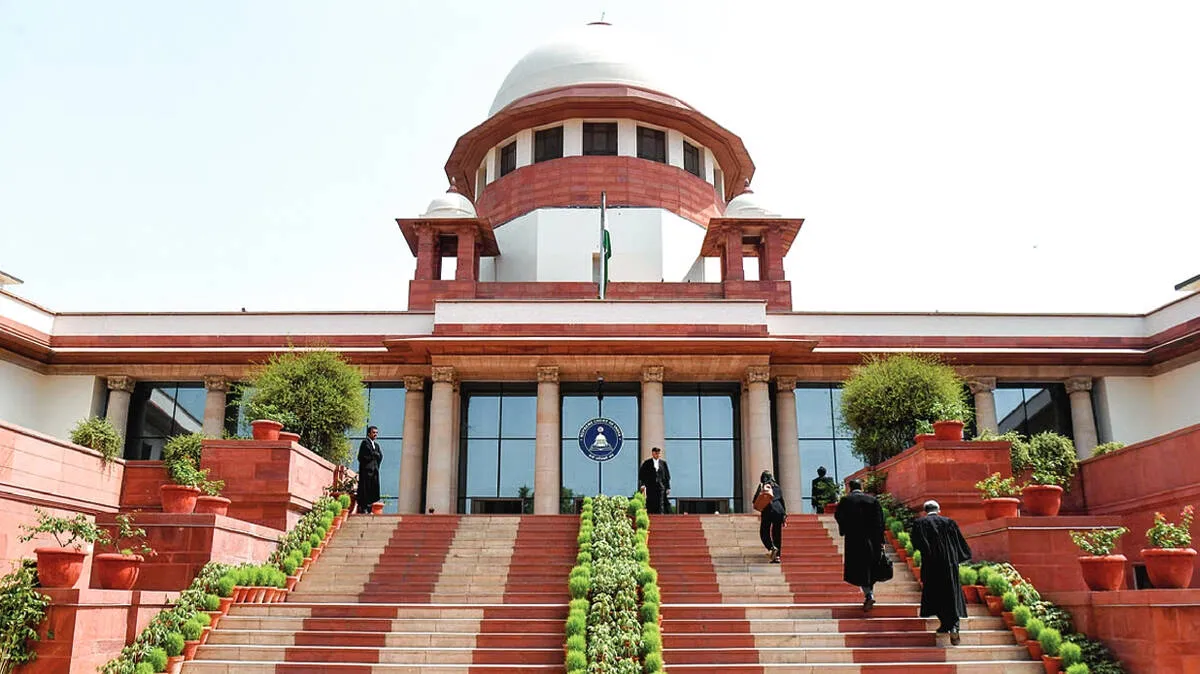
NEW DELHI: The Supreme Court on Tuesday said it expected that a person who does not sing one or all stanzas of Vande Mataram on grounds of religion or conscience would not face criminal consequences. The observation came as the court considered a petition filed by Carnatic vocalist T.M. Krishna challenging the constitutional validity of the 2026 amendment to the Prevention of Insults to National Honour Act, 1971, which extends penal protection to the National Song, Vande Mataram. Krishna has also challenged the Ministry of Home Affairs' directions requiring the complete six-stanza version of the song to be sung at specified government, ceremonial and cultural functions.
A bench comprising Chief Justice of India Surya Kant and Justices Joymalya Bagchi and V. Mohana said it would examine the question of penal consequences in the light of fundamental rights. The bench also referred to the Supreme Court's 1986 judgment in Bijoe Emmanuel vs State of Kerala, which protected three schoolchildren who respectfully stood during the national anthem but did not sing it because of their religious beliefs. The court indicated that it would not examine whether the official version of Vande Mataram should comprise two or all six stanzas, saying the choice of the National Song and its content was a matter for the democratically elected government. It said, however, that whether a conscientious objector could face penal consequences for refusing to sing one or all of its stanzas was open to examination. The court sought the Centre's response to Krishna's petition but did not issue a formal notice at this stage.
Krishna has primarily challenged the MHA directions requiring the complete six-stanza version of Vande Mataram to be sung at specified official functions. In his petition, he contends that the last four stanzas contain references to Hindu deities, including Durga, Lakshmi and Saraswati, and argues that making their rendition compulsory is contrary to the secular character of the Constitution. The amended Section 3 of the Prevention of Insults to National Honour Act provides for imprisonment of up to three years, a fine, or both, for intentionally preventing the singing of the National Anthem or National Song, or causing disturbance to an assembly engaged in such singing. The present challenge concerns whether such penal consequences can apply to a person who does not sing on grounds of conscience or religion.
Solicitor General Tushar Mehta, appearing for the Centre, opposed the petitioner's submissions and argued that secularism could not be interpreted so narrowly. During the hearing, Mehta also said that law-making could not be based on what he described as the ideology of Naxalites. Senior advocate S. Muralidhar, appearing for Krishna, subsequently objected to the remark.















 HOME
HOME LATEST
 NOTIFIED NEWS
 POLL
POLL KERALA
  EDITORIAL
  INDIA
INDIA  WORLD
WORLD  BUSINESS
  CINEMA
  SPORTS
  LIFESTYLE
  SPECIAL
  SCIENCE & TECHNOLOGY
 |
|