


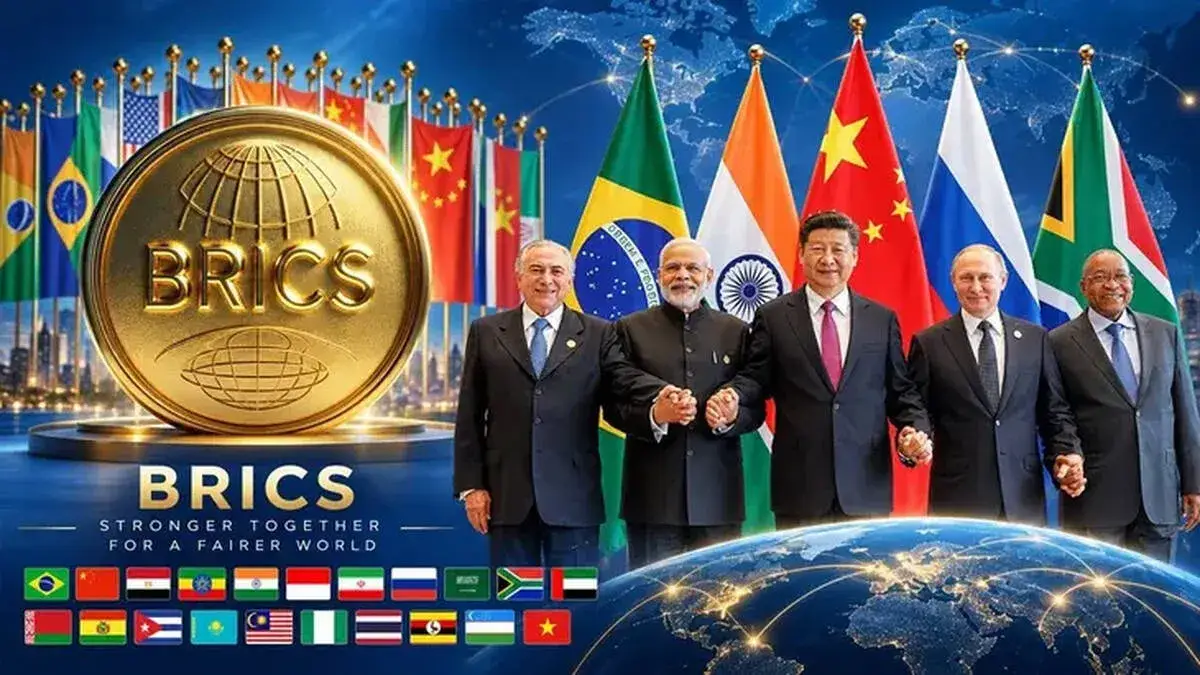
The real achievement of the BRICS New Delhi Declaration is not the handshake. It is the sentence that almost did not get written.
The West Asia paragraph expresses “deep concern,” recalls the members’ respective national positions and calls for “maximum restraint.” It identifies no aggressor and does not pretend that the members share one account of the war. Iran and the United Arab Emirates could sign it without accepting each other’s version of events. Russia, China and India could invoke the United Nations Charter without accepting language that might later be directed against them.
India did not settle the quarrel. It found wording under which the quarrel could remain inside the room. That is diplomacy. It is only the beginning.
Narendra Modi did not invent BRICS, its bank or multipolarity. India inherited an established five-member forum. The New Development Bank had been agreed in principle at Durban in 2013; its founding agreement was signed at Fortaleza in July 2014, seven weeks after Modi took office. The fairer claim is that India, particularly during its 2016 and 2026 presidencies, tried to steer an inherited institution in a more definite direction.
Goa placed terrorism nearer the centre of the BRICS security agenda, but India could not overcome Chinese resistance to naming Pakistan-based groups. Xiamen later named Jaish-e-Mohammed and Lashkar-e-Taiba. New Delhi condemned the Pahalgam attack and reaffirmed the need for action against terrorist safe havens. Pakistan was still not named, and no Indian military operation was endorsed. BRICS moved from a generic denunciation of terrorism towards recognition of the infrastructure that sustains it, but no further.
The second correction concerned purpose. Russia and China have often presented BRICS as a sharper counterweight to Western power. India has resisted its transformation into an anti-Western bloc. Modi’s declaration that BRICS is “not against anyone” was more than diplomatic reassurance. It was a claim about what the organisation is for: greater bargaining power for the Global South, not a common enemy.
The third correction was directed inward. The proposed Continuity and Implementation Mechanism, supported by the Troika and a digital repository, acknowledges the organisation’s least glamorous but most serious failure. BRICS does not lack declarations. It loses owners when one annual presidency hands unfinished files to the next.
NAM and the G77 could articulate grievances and mobilise votes. They were less successful at converting political solidarity into common economic capacity. BRICS risks the same fate. Four hundred meetings constitute activity, not necessarily achievement.
ASEAN provides the nearer lesson. Its value lies not in European-style integration but in its habit of sectoral bodies, technical protocols, ministerial review and continuous follow-up. BRICS should borrow that discipline. The year after New Delhi must become an implementation cycle.
First, publish a scorecard. Every commitment should have a responsible country or institution, a deadline, a financing source and a public status: completed, on schedule, delayed or closed. The exercise should begin with outstanding commitments from Kazan, Rio and New Delhi. If an initiative remains “under discussion” after two years, the members should renew it with a revised deadline or formally discontinue it.
A simple rule would impose discipline: no major new initiative until at least three delayed ones have been completed or dropped. Institutions seldom die solely because of their enemies. They more often suffocate beneath their unfinished paragraphs.
Second, fund five projects that touch ordinary life. Establish a food-and-fertiliser continuity mechanism so that a closed strait does not become a kitchen crisis. Operationalise the proposed Seafarers Emergency Support Network and measure the time between a distress call and confirmed assistance. Launch two or three lawful payment corridors for trade in energy, food, medicines and essential industrial inputs, using regulated banks rather than a fantasy currency. Require the New Development Bank to disclose how much it actually lends in rupees, reais, rand and other member currencies, and who bears the exchange risk. Finally, create a pre-agreed emergency reserve of vaccines, essential medicines and diagnostics.
Everything else can wait until these projects demonstrate results.
Third, put the trade imbalance on the table. Intra-BRICS trade accounts for about five per cent of world merchandise trade and remains heavily centred on China. India’s merchandise trade deficit with its BRICS partners reportedly reached about $226 billion in FY2026, with imports of approximately $322 billion against exports of about $96 billion.
Not every deficit is evidence of exploitation. Russian energy, Indonesian coal and Chinese capital goods may support Indian production and moderate domestic costs. But an economic coalition that will not identify the principal barriers facing each other’s goods, or acknowledge its dependence on a few members for critical inputs, is practising solidarity as camouflage.
Every member should publish its ten most significant tariff and non-tariff barriers affecting other BRICS countries. The register should disclose regulatory delays, rejected market-access applications and excessive concentration in critical minerals, pharmaceutical ingredients, telecommunications equipment and industrial machinery.
BRICS does not need compulsory purchasing quotas. It needs transparency about who is buying, who is selling, where access is blocked and whether membership is producing a more balanced economic relationship.
Fourth, forget the common currency. The members have no shared fiscal authority, inflation target, lender of last resort or integrated capital market. What they need is cheaper settlement and a lawful backup channel when conventional correspondent banking routes become unavailable.
The practical course is to begin with limited, properly invoiced trade corridors involving regulated institutions and clear rules on foreign exchange, sanctions screening, anti-money-laundering compliance and dispute resolution. Call it financial plumbing. Advertise it as dethroning the dollar, and the project dies.
Fifth, apply the civilian, humanitarian and nuclear principles inside the room. BRICS should develop a modest incident-reporting mechanism capable of recording independently verifiable facts, disputed allegations and the applicable rules of international law. It need not function as a court or pronounce guilt. Its evidentiary standard must, however, apply equally to members and non-members.
A principle that binds only adversaries is not a principle. It is an instrument.
Sixth, publish numbers citizens can verify: months of staple-food and fertiliser cover, cargo delays at major chokepoints, the proportion of small-business invoices settled within a week, the currency composition of NDB lending, the availability of emergency medical reserves and the time taken to assist a seafarer in distress.
The dashboard must distinguish targets, actual results and unavailable information. Missing data is not progress.
Seventh, remain a table rather than become a bloc. Members prepared to cooperate on payments, food security or maritime assistance should proceed and publish the results. Not every country must participate in every project. Each project must nevertheless disclose its participants, financing, legal basis, deadlines and performance.
Variable participation is more credible than fictitious unanimity. BRICS does not need every member to pretend agreement on everything. It needs a few members to deliver something that others later wish to join.
Eighth, write the UN reform proposal. The New Delhi Declaration’s support for the “aspirations” of India and Brazil is not sponsorship of permanent seats. BRICS should produce an actual negotiating text covering additional seats, regional representation, the treatment of the veto and a review clause. Members should then disclose whether they will co-sponsor it.
If China and Russia are unwilling to move beyond supporting the aspirations of India and Brazil, that limitation should become visible. An honest refusal is more useful than another recycled paragraph.
Over the next twelve months, BRICS should establish the scorecard, select the five operational projects, publish the trade-barrier register, launch the first payment pilots, agree on the citizen indicators and circulate a negotiating text on UN reform.
The failures that hurt people are not inadequate adjectives in declarations. They are closed sea lanes, expensive credit, missing medicines, inaccessible markets and payments that stop when geopolitics enters the bank.
The test is deliberately crude. Can a farmer, a seafarer, a small exporter or a patient identify one thing that worked because BRICS existed?
If the answer remains, “We adopted another declaration,” the organisation will already be standing on the stone over which its predecessors stumbled.














 HOME
HOME LATEST
 NOTIFIED NEWS
 POLL
POLL KERALA
  EDITORIAL
  INDIA
INDIA  WORLD
WORLD  BUSINESS
  CINEMA
  SPORTS
  LIFESTYLE
  SPECIAL
  SCIENCE & TECHNOLOGY
 |
|