


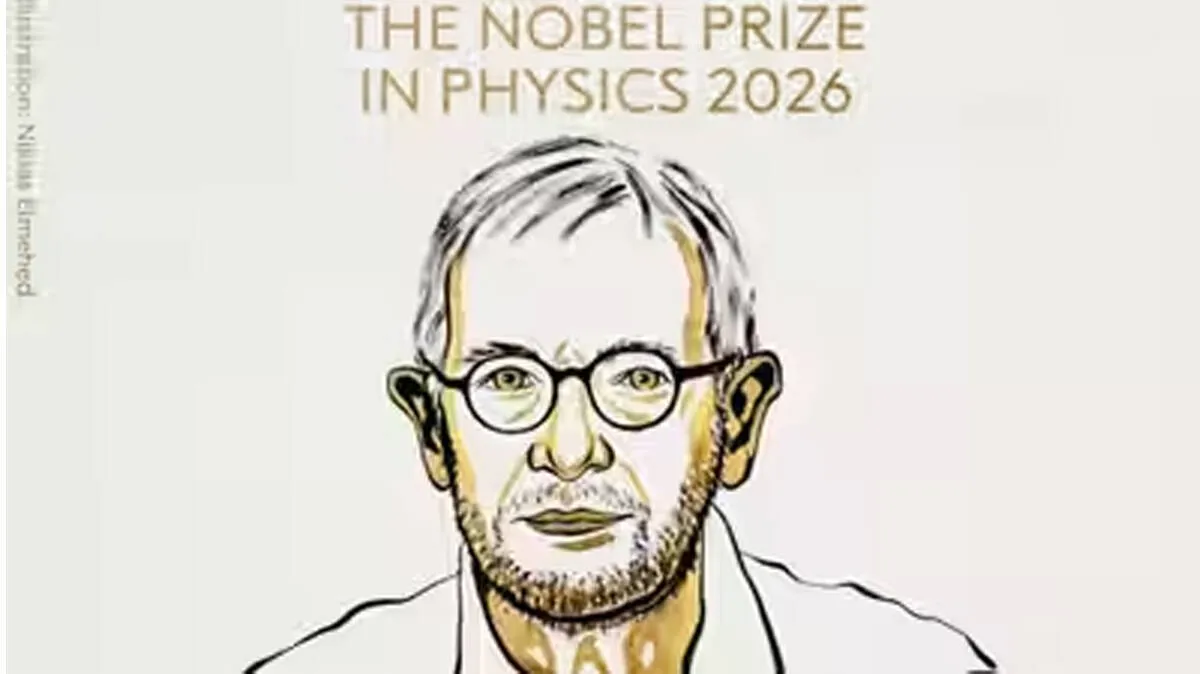
STOCKHOLM: Belgian-born physicist Francis Halzen has won the 2026 Nobel Prize in Physics for his decisive contributions to the IceCube Neutrino Observatory and the discovery of high-energy neutrinos of astrophysical origin.
Halzen, a professor at the University of Wisconsin–Madison, is the principal investigator of the IceCube Neutrino Observatory and has played a central role in its development. Born in Tienen, Belgium, in 1944, he has been a leading figure in neutrino physics and has worked on the IceCube project since the late 1980s.
Halzen proposed using the clear Antarctic ice at the South Pole to detect neutrinos. When a neutrino rarely interacts with an atomic nucleus, the collision produces a flash of light that can be detected by sensors embedded deep in the ice. This idea led to the development of IceCube, a cubic-kilometre neutrino detector equipped with thousands of light sensors beneath the Antarctic surface.
IceCube was designed to detect high-energy neutrinos from some of the most energetic processes in the universe. Because neutrinos can travel vast distances without being deflected by magnetic fields, detecting them provides scientists with a new way to study violent cosmic environments and trace the origins of these elusive particles.















 HOME
HOME LATEST
 NOTIFIED NEWS
 POLL
POLL KERALA
  EDITORIAL
  INDIA
INDIA  WORLD
WORLD  BUSINESS
  CINEMA
  SPORTS
  LIFESTYLE
  SPECIAL
  SCIENCE & TECHNOLOGY
 |
|