

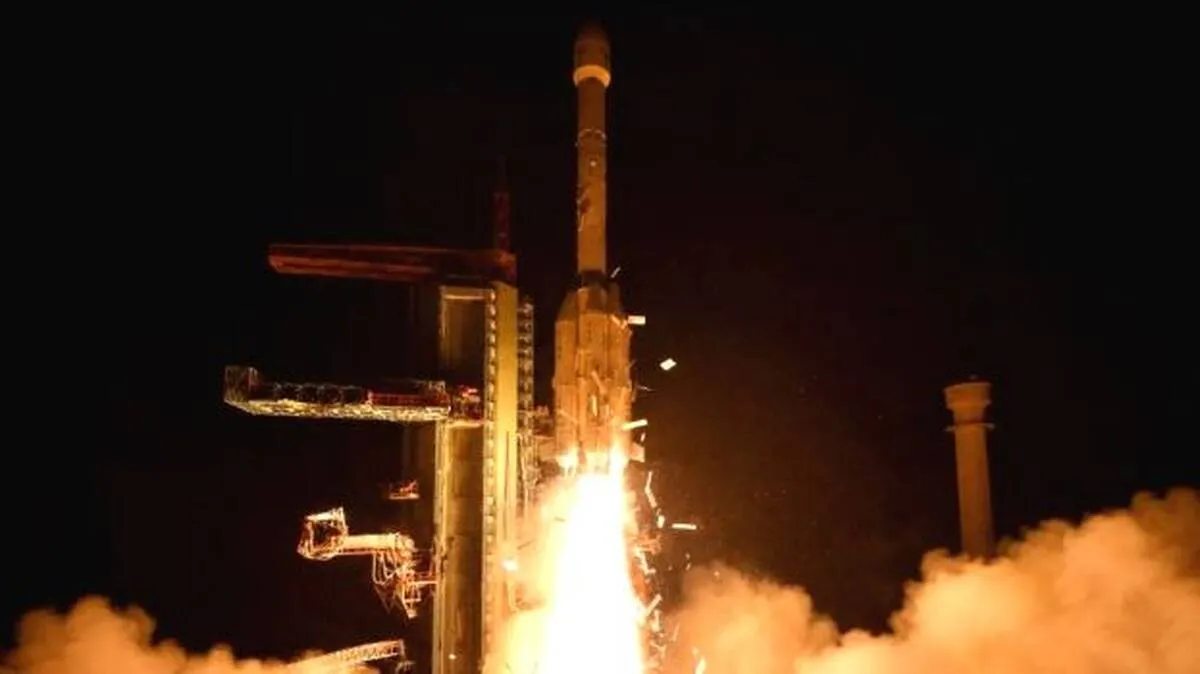
THIRUVANANTHAPURAM: After a series of recent setbacks, ISRO has returned to the path of success with the successful launch of the EOS-05 Earth observation satellite.
The 2,400-kg satellite was launched aboard the GSLV Mark-II rocket. The successful mission has also paved the way for six more launches in the next six months, including the uncrewed Gaganyaan mission and a NavIC navigation satellite. The central government is expected to give the required approval for the missions.
The launch was also hailed as a major achievement for the country’s space programme and a testament to the dedication and commitment of ISRO scientists. Prime Minister Narendra Modi congratulated the team on the successful mission.
The GSLV Mark-II F17 rocket lifted off from the second launch pad at the Satish Dhawan Space Centre in Sriharikota at around 2.55 am on Friday. Around 18 minutes after liftoff, the rocket placed EOS-05 into a temporary orbit at an altitude of more than 171 km. In the coming days, the satellite will gradually change its orbit before reaching its final geosynchronous orbit at an altitude of around 36,000 km. EOS-05 is the first Indian imaging satellite to be placed at such an altitude. It has a planned operational life of 10 years.
As the satellite moves along with the Earth, it will enable round-the-clock observation of India and neighbouring countries. Weighing more than 2,360 kg, EOS-05 is the heaviest satellite ever carried by a GSLV Mark-II rocket. The ignition of the rocket’s third stage, powered by a cryogenic engine, was carried out with high precision. Of the six missions undertaken by ISRO in 2025 and 2026, three had ended unsuccessfully.
“This is a major achievement for the space programme. This success is the result of collective efforts,” said ISRO Chairman Dr V. Narayanan.
“Every Indian can be proud of this achievement. It will give greater strength and reach to the country’s space programme,” Prime Minister Narendra Modi said.






 HOME
HOME LATEST
 NOTIFIED NEWS
 POLL
POLL KERALA
  EDITORIAL
  INDIA
INDIA  WORLD
WORLD  BUSINESS
  CINEMA
  SPORTS
  LIFESTYLE
  SPECIAL
  SCIENCE & TECHNOLOGY
 |
|