

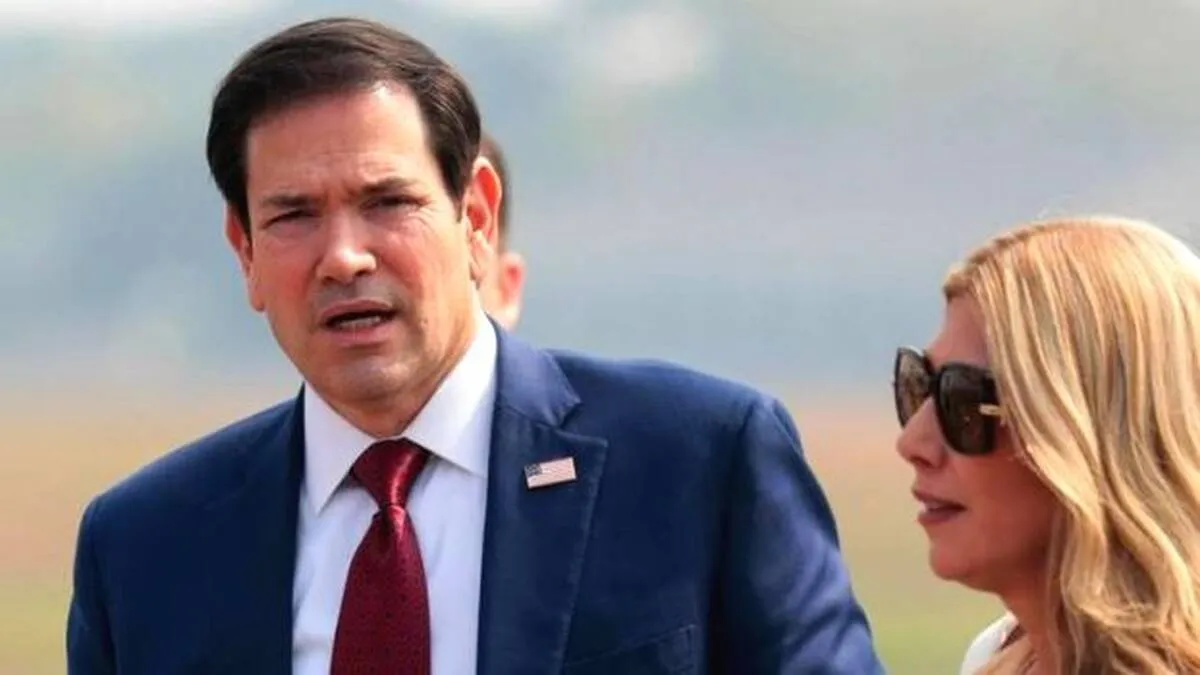
When Secretary of State Marco Rubio called India a "refining superpower" at his Mumbai press conference on 20 October and then toured Reliance's Jamnagar complex the next day, commentators reached for the usual vocabulary: a reset, a reward, a romance. The record supports something more sober. This is not pampering, and it is not trade in the ordinary sense. It is sustenance, and the party being sustained is Washington.
Consider the timing. US retail diesel topped $6 a gallon in mid-September, a record. American distillate stocks in late August were among the lowest on record for that time of year. The midterm elections fall on 3 November, and a fuel price is the one policy failure no voter needs explained. In that market, a refinery of Jamnagar's scale, rated by Reliance at 1.4 million barrels a day and able to run well over two hundred crude grades, is not a courtesy to be flattered. It is a utility to be kept running. India supplies roughly a tenth of global diesel shipments. Very little of that goes to America directly; Kpler's September data put it near 40,000 barrels a day, against some 620,000 in total. America's dependence on India is therefore indirect: Indian barrels sent to Europe and elsewhere ease the global price that American motorists pay.
The sequence is revealing. On 16 October the President waived the tariffs and sanctions that the Lindsey O. Graham Sanctioning Russia and Iran Act had made available only a month earlier. Three days later, Mr Rubio said the India trade deal was among the things taken into consideration in such waivers. Two days later, he was at Jamnagar. Former Foreign Secretary Kanwal Sibal reads the waiver as not India-specific, with India benefiting only "collaterally". Whether one accepts that or not, no official has said the quiet part aloud, so this is an inference from converging facts rather than an admission. But it is the inference that best fits the dates.
WHAT THE LAW ACTUALLY GIVES INDIA
Here the lawyer's eye is useful, because the public discussion has been loose. The 25 per cent penalty on India for buying Russian oil was imposed by Executive Order 14329, signed on 6 August 2025 and effective from 27 August, under the International Emergency Economic Powers Act, taking many Indian goods to 50 per cent. A further order withdrew it on 7 February 2026, on the stated premise that India had committed to stop importing Russian oil. India has never publicly confirmed any such commitment. That silence is the fault line beneath everything since.
On 20 February the US Supreme Court held, six to three, in Learning Resources v. Trump, that IEEPA does not authorise tariffs at all. The coercive instrument was therefore struck from the President's hands, only to be replaced by statute. The Graham Act, signed on 18 September, authorises duties of up to 100 per cent on the goods of the largest buyers of Russian energy. Note the drafting: the duty falls on a country's goods, not on the buyer, and 100 per cent is a ceiling, not a rate.
What was waived on 16 October was not repealed. It was a presidential waiver under the Act's national-interest provision, certified to Congress, with no end date, to last until the administration decides further action is appropriate. India holds no enforceable right under it. A unilateral certification can be withdrawn by the same pen that signed it. The Global Trade Research Initiative put it well: the waiver "buys time but offers no lasting certainty." The WTO route exists on paper, but with the Appellate Body non-functional and Article XXI contested, it is a signal, not a remedy.
THE NUMBERS THAT DEFLATE THE HEADLINE
Three figures in circulation need correcting. The first is the claim that US liquefied petroleum gas now supplies about two-thirds of India's imports. The Petroleum Minister did say something like 67 per cent in August. But Kpler's data show the US share at 6.7 per cent in 2025, peaking at 73 per cent in July during the Hormuz disruption, and falling to 23 per cent in September as Gulf supplies returned. The 2026 term contract covers only 2.2 million tonnes. A crisis spike is not a structural shift, and Indian households paid for it: CREA estimates a 29 per cent premium on cooking gas.
The second is the idea that India has abandoned Russian crude. It has not. Russian volumes fell to about 1.1 million barrels a day in February, surged to between 2.7 and 2.8 million in July under waivers and the Gulf shock, and settled at about 1.74 million, roughly a third of imports, in September. That decline looks more like substitution by economics than compliance by conviction.
The third is American crude, which is about 3 per cent of India's September imports. Venezuela, reportedly licensed to Reliance in February on terms undisclosed, is about 4 per cent. The US-India energy story is one of products and gas, not of barrels.
WHAT INDIA SHOULD DO
A counterparty with leverage and a counterparty with urgency are not the same, and India is currently the latter's customer. Mr Rubio himself said the two sides were "about as close as you can be without having executed the agreement." India's own price, a tariff edge over competitors before signing, is rational, and the Finance Minister's reported remark that talks had plateaued suggests New Delhi knows it. India has also used these months to widen its crude basket, and it can keep doing so without conceding that diversification amounts to compliance.
Three things follow. First, convert the waiver into text. A trade agreement is the only instrument that can give India an enforceable treatment clause, and it should say expressly how Russian-energy purchases are to be treated and what notice precedes any reimposition. Second, write in a dispute-resolution mechanism with real teeth, whether consultation, expert determination or arbitration. A framework without a forum is a promise, and the 2018 Iran waivers, granted to eight buyers and not renewed, are the cautionary precedent. Third, treat every 2026 supply arrangement as revocable: US cargoes take weeks against days from the Gulf, and Venezuelan barrels rest on a licence another government can cancel.
Meanwhile, the macro cushion is thin. The RBI raised the repo rate on 7 October, and the rupee is trading near record lows, with Brent above $100. Frozen retail fuel prices shield consumers while oil marketing companies and the exchequer absorb the shock.
The test of this courtship is whether it survives the midterms, a Gulf recovery and a fall in Brent. Flattery is cheap, and the 2018 Iran-waiver precedent is clear: when the political need passes, so does the generosity. India should treat the current window as a negotiating chip, lock any Russian-energy treatment and notice provisions into an enforceable trade text with real dispute settlement, and sign nothing whose durability depends on the midterms or a fall in Brent.









 HOME
 LATEST
 NOTIFIED NEWS
 POLL
 KERALA
 EDITORIAL
 INDIA
 WORLD
 BUSINESS
 CINEMA
 SPORTS
 LIFESTYLE
 SPECIAL
 SCIENCE & TECHNOLOGY

 |