


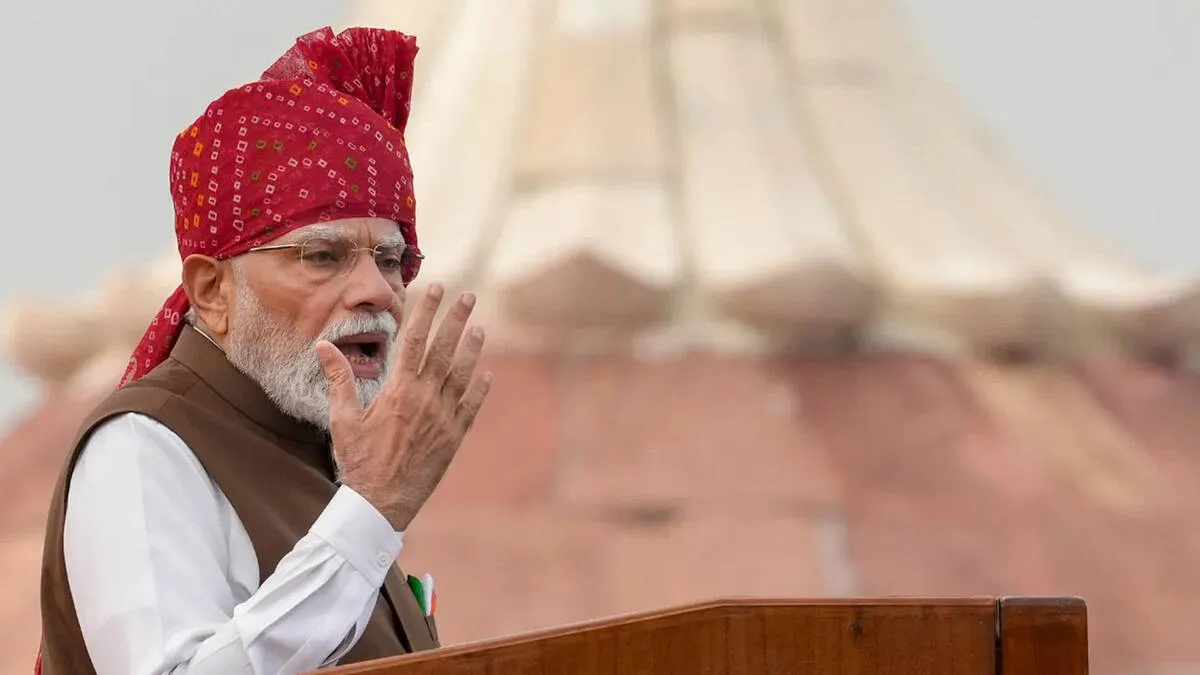
On India’s 80th Independence Day, Prime Minister Narendra Modi set out seven streams of national strength for the next phase of the country’s development: manufacturing, agriculture and food processing, technology and innovation, Gati Shakti, defence, the green and blue economy, and soft power.
It is an attractive formulation. It gives shape to an economic agenda that would otherwise run across several ministries and dozens of programmes. It should not, however, be mistaken for a conventional economic taxonomy. Defence is also manufacturing; green industry is partly manufacturing and energy policy; Gati Shakti is an enabler rather than a sector; technology runs through almost everything else.
That does not diminish the formulation. Independence Day speeches are meant to establish national direction, not construct input-output tables. The more useful question is whether these seven streams can together generate the productivity India requires to become a developed economy by 2047.
That question begins with a number we have perhaps become too accustomed to quoting.
The World Bank estimated in 2025 that India would have to grow by an average of about 7.8 per cent a year for 22 years to reach high-income status by 2047. More important than the headline number were the conditions attached to it: investment would need to rise from about 33.5 per cent of GDP to 40 per cent by 2035; overall labour-force participation would need to exceed 65 per cent; female participation would have to rise from 35.6 per cent towards 50 per cent; and productivity growth would have to accelerate.
These are the numbers I would watch.
India's new national-accounts series, with 2022-23 as its base, now estimates real GDP growth at 7.7 per cent in FY2025-26. But the World Bank's 7.8 per cent pathway was calculated before that rebasing. The two numbers are therefore not strictly like-for-like. The revised series incorporates new data sources and methodological changes intended to capture the economy better. That is precisely why it would be unwise to build too much of the 2047 argument around whether the current growth rate is one or two decimal points short of 7.8.
The more revealing gap lies underneath GDP.
Moving investment towards 40 per cent of GDP is not something the Union government can achieve simply by continuing to build highways, railways and ports. Public capital expenditure has already done much of the heavy lifting in the present investment cycle. Fiscal arithmetic limits how long the State can keep increasing that burden at the same pace.
Private capital must increasingly take over.
That makes one question particularly important. Corporate taxes were reduced in 2019. Banks have been recapitalised and their balance sheets substantially repaired. Corporate leverage has moderated. Infrastructure has improved. Yet private investment has not consistently accelerated to the level that the 2047 arithmetic ultimately requires.
Why?
Regulatory certainty, demand expectations, land, logistics, contract enforcement, the cost of capital and the time taken to resolve commercial disputes probably matter more here than another investment slogan. If India wants substantially more private capital, it has to make the expected return on productive investment more attractive than the alternatives.
This is where the Prime Minister's manufacturing stream becomes interesting.
The Production Linked Incentive programme has produced substantial numbers. By December 2025, approved projects across 14 sectors had attracted cumulative investment exceeding ₹2.16 lakh crore, generated sales above ₹20.41 lakh crore and exports exceeding ₹8.3 lakh crore.
There is another number in the same statement that interests me more.
Against a total PLI outlay of ₹1.91 lakh crore, ₹28,748 crore had actually been disbursed by December 2025. That is about 15 per cent.
That ratio is not evidence that PLI has failed. These are performance-linked schemes, several run over multiple years, and disbursement is deliberately conditional upon firms achieving specified outcomes. But it is exactly the sort of number that deserves examination rather than celebration or condemnation.
Are firms meeting the thresholds? Are some schemes better calibrated than others? Is the relatively modest disbursement simply a consequence of programme timing? Which sectors are producing genuine additional investment that would not otherwise have occurred?
Those answers matter because manufacturing depth cannot be measured merely by the gross value of what leaves a factory.
Electronics demonstrates the distinction. India has unquestionably built scale in mobile-phone manufacturing and exports. But the next stage is about how much of the value chain India actually owns.
Assembly creates economic activity. Components create industrial depth. Design creates intellectual property. Brands capture a larger share of the final value.
The ambition must therefore move gradually from making more in India to owning more of what is made in India.
Agriculture presents the same problem in another form. We often tell farmers that the future lies in value addition, processing and branding. That is true but incomplete. An individual smallholder does not fail to build a cold chain because he lacks ambition. At his scale, the investment may simply make no economic sense.
Aggregation, farmer-producer organisations, reliable contracts, storage, affordable working capital, predictable market access and processing infrastructure alter that calculation. When the economics changes, behaviour changes.
This distinction matters because development discourse has a recurring temptation to transfer the burden of reform to the citizen. We tell workers to acquire skills, farmers to become entrepreneurs, businesses to innovate and citizens to become more disciplined.
Economics is rarely so convenient.
People respond to incentives. A worker invests in skills when there is a credible return. A business improves quality when competition rewards it. A farmer adopts technology when the expected gain justifies the risk. Women enter and remain in the workforce when suitable jobs, transport, safety, childcare and household circumstances make employment worthwhile.
Citizen capability is itself partly an institutional outcome.
The State therefore cannot declare that it has built the infrastructure and that society must now do the rest. Its responsibility extends to enforceable contracts, efficient courts, competitive markets, good schools, safe cities, regulatory predictability and institutions that make productive behaviour rational.
But that argument does not absolve the citizen either.
Once opportunity becomes credible, enterprise has to respond. Capital has to be risked. Professionals have to maintain standards. Students have to acquire difficult capabilities. Businesses must eventually compete without permanent protection. Tax compliance must become ordinary civic conduct rather than a negotiation with the State.
That is why I would describe Viksit Bharat neither as a government programme nor as a citizens' movement.
It is an institutional bargain.
Government must create credible opportunity. Citizens and enterprises must convert it into productive activity.
This is also how I would read the other streams of the Saptadhara. Gati Shakti succeeds not when another kilometre of highway is inaugurated, but when logistics costs fall and businesses reorganise around better connectivity. Defence succeeds not merely when exports rise, but when aerospace, electronics, materials, drones and precision engineering create technological spillovers into the wider economy. The green transition matters not only for carbon targets, but because domestic energy can reduce strategic dependence. India's coastline becomes an economic asset only when ports, shipping, fisheries, shipbuilding and maritime services create value around it.
Even soft power deserves to be understood economically.
India has enormous cultural capital, but cultural capital does not automatically become cultural industry. South Korea's experience with music, cinema and television is instructive precisely because Hallyu was not simply spontaneous artistic success. Public institutions helped create an ecosystem around training, finance, intellectual property, international distribution and export promotion. Creativity remained private; the architecture that allowed it to scale was partly public.
India can do the same with cinema, gaming, music, cuisine, yoga, Ayurveda, crafts, heritage and tourism without reducing culture to a government programme.
There is, however, another reason I find the inclusion of soft power significant.
It takes the argument beyond Viksit Bharat.
India speaks increasingly of becoming a Vishwaguru. The expression can easily become rhetorical, particularly if it is understood to mean that India has somehow acquired the right to instruct the world.
There is a more demanding interpretation.
A Vishwaguru should be a country whose success becomes useful to others.
India occupies an unusual position. It remains a developing economy with formidable internal challenges, yet it has built capabilities in digital
public infrastructure, pharmaceuticals, space technology, renewable energy and low-cost innovation that are relevant far beyond its borders.
That matters particularly to the Global South.
A digital architecture designed to provide identity, banking and payments at Indian scale may offer lessons to countries confronting financial exclusion. Affordable Indian medicines already matter to global public health. Agricultural technologies developed around smallholder conditions may be more relevant to parts of Africa and Asia than solutions designed for industrial farms in wealthy economies. India's experience with renewable energy, digital governance and low-cost space applications can similarly travel.
This, to me, is the more interesting meaning of Vishwaguru.
Not a country that tells the world what to do, but one that becomes useful because it has solved difficult problems under constraints familiar to much of humanity.
There is an important distinction here.
Viksit Bharat is about solving India's problems. Vishwaguru begins when some of those solutions become useful beyond India.
The Prime Minister's seven streams offer one way of organising the first ambition. Their success should therefore be judged rigorously: by private investment, domestic value addition, productivity, labour participation, intellectual property, exports and ultimately household prosperity.
And citizens should respond to that ambition positively, but not passively. Supporting a national vision does not require suspending scrutiny. In fact, serious scrutiny is a form of participation. Programmes that work should be scaled; those that do not should be redesigned. Protection should eventually produce competitiveness. Public infrastructure should crowd in private capital. Education should produce capability. Technology policy should produce ownership, not merely adoption.
India has set itself an unusually ambitious destination for 2047. The important question is no longer whether the aspiration is sufficiently grand. It is whether our institutions, enterprises and citizens can become sufficiently productive to reach it.
If they can, India will become richer and stronger.
Whether it becomes Vishwaguru will depend on what it does with that strength.
Power can be accumulated. Respect has to be earned.
CA. M R Ranjit Karthikeyan BCom., LLM., DISA (ICAI), FCA
Managing Partner, Ranjit Karthikeyan Associates LLP
Thiruvananthapuram | Kochi | Kozhikode | Bengaluru
www.rkaglobal.com | +91 989 599 7000 | 949 727 0000














 HOME
HOME LATEST
 NOTIFIED NEWS
 POLL
POLL KERALA
  EDITORIAL
  INDIA
INDIA  WORLD
WORLD  BUSINESS
  CINEMA
  SPORTS
  LIFESTYLE
  SPECIAL
  SCIENCE & TECHNOLOGY
 |
|