

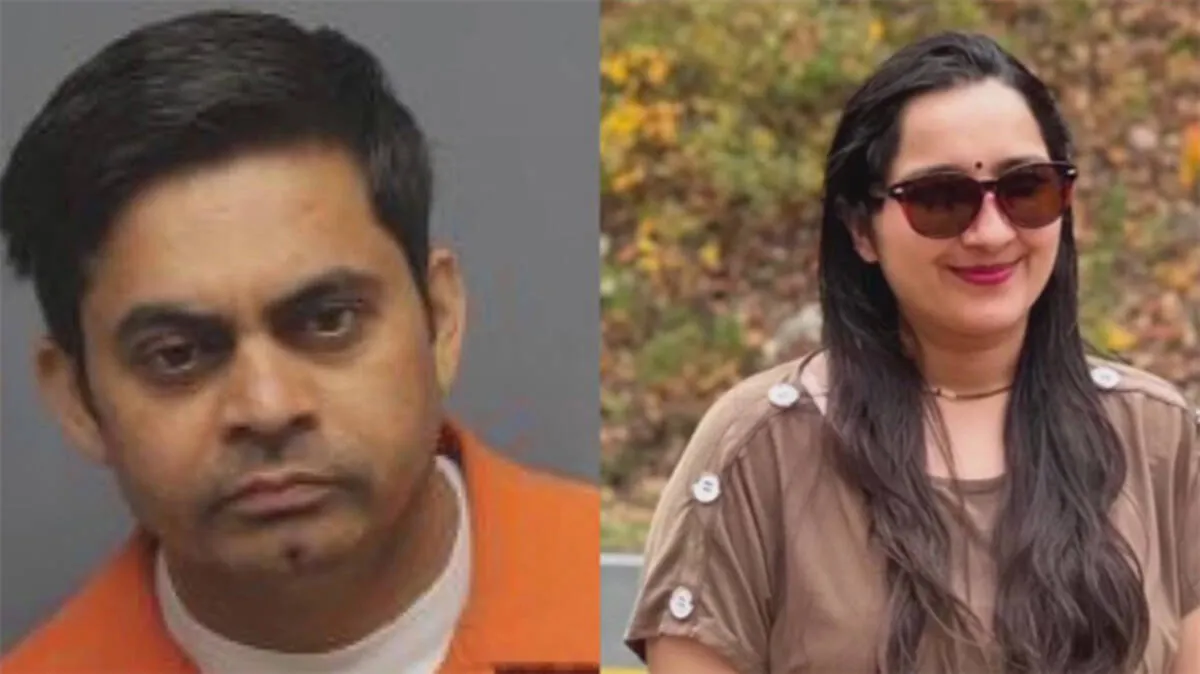
WASHINGTON: An Indian-origin man accused of murdering his Nepali wife, whose body has been missing for more than two years, has admitted in a US court that he dismembered her body and disposed of the remains. However, Naresh Bhatt denied killing Mamta Kafle, claiming that he found her dead at their home and panicked.
Bhatt made the admission while testifying in his trial at Prince William County Circuit Court in Virginia. He said he found his wife dead on the bedroom floor on the morning of July 30, 2024. According to Bhatt, he had slept in a separate room with their infant daughter the previous night. He said he found Mamta lying on her back, with vomit on her face and on the floor. He claimed the vomit contained blood, food particles and pill capsules, while open packets of Celphos, an agricultural fumigant, were also present in the room.
Bhatt testified that he attempted to revive his wife for 45 minutes to an hour, including performing CPR, before moving her to the bathroom and trying to give her water. He maintained that she showed no signs of life. Asked by his defence lawyer why he had not called the police, Bhatt said he was terrified and overwhelmed by panic. He claimed he had tried to make the call but felt unable to do so. Bhatt acknowledged that he feared being held responsible for his wife's death. He subsequently left their daughter with the babysitter and went to Home Depot to purchase supplies to conceal the body. He also testified that he had considered disposing of the body in the Potomac River and later contemplated suicide.
Bhatt said he initially attempted to dismember Mamta's body on July 30 but stopped because he lacked the physical strength to continue. He resumed the process the following day, using a saw and knives. He admitted placing the remains in plastic bags and disposing of them in rubbish bins. The prosecution presented CCTV footage showing Bhatt carrying several bags to different rubbish disposal locations. However, he denied that the bags contained his wife's remains, claiming they held her personal belongings instead.
His testimony contradicted his earlier statements to police, in which he claimed Mamta had left home and might be in New York or Texas. During cross-examination, Bhatt also admitted that he had lied to his wife's relatives, friends, neighbours and police about her disappearance. He acknowledged that their marriage had experienced problems but denied physically abusing Mamta. Prosecutors, however, presented photographs and messages that they said indicated a history of domestic abuse.
Mamta's brother, Mahesh Kafle, testified that he had advised his sister against marrying Bhatt. He said that in February 2024, several months before her disappearance, Mamta had secretly sent him a photograph that appeared to show an injury around her eye. She had also expressed concerns about her safety, he told the court. The judge had restricted the use of certain statements attributed to Mamta following objections from the defence.
Forensic evidence has also emerged during the trial. A forensic scientist testified that DNA profiles obtained from samples recovered from an electric saw, including swabs taken from inside it, were consistent with a reference profile developed from a hairbrush recovered from the couple's home. Another expert testified that the DNA on the hairbrush was overwhelmingly likely to belong to the mother of the couple's daughter. The defence questioned whether the hairbrush had been conclusively established as Mamta's. The prosecution said Bhatt purchased the saw on June 2, 2024, nearly two months before Mamta's disappearance, and later gave it to a landscaper. Police subsequently seized it from the worker.
Bhatt faces charges of first-degree murder, defiling a dead body and concealing a dead body. He has pleaded not guilty to all three charges. The prosecution has rested its case after presenting more than 80 witnesses, and the defence began presenting its case with Bhatt's testimony. The trial is expected to resume on November 9, with closing arguments anticipated the following day. Although Bhatt has admitted dismembering and disposing of his wife's body, he maintains that he did not kill her. Prosecutors must establish that she was murdered and that Bhatt was responsible, despite the absence of her remains.














 HOME
 LATEST
 NOTIFIED NEWS
 POLL
 KERALA
 EDITORIAL
 INDIA
 WORLD
 BUSINESS
 CINEMA
 SPORTS
 LIFESTYLE
 SPECIAL
 SCIENCE & TECHNOLOGY

 |